
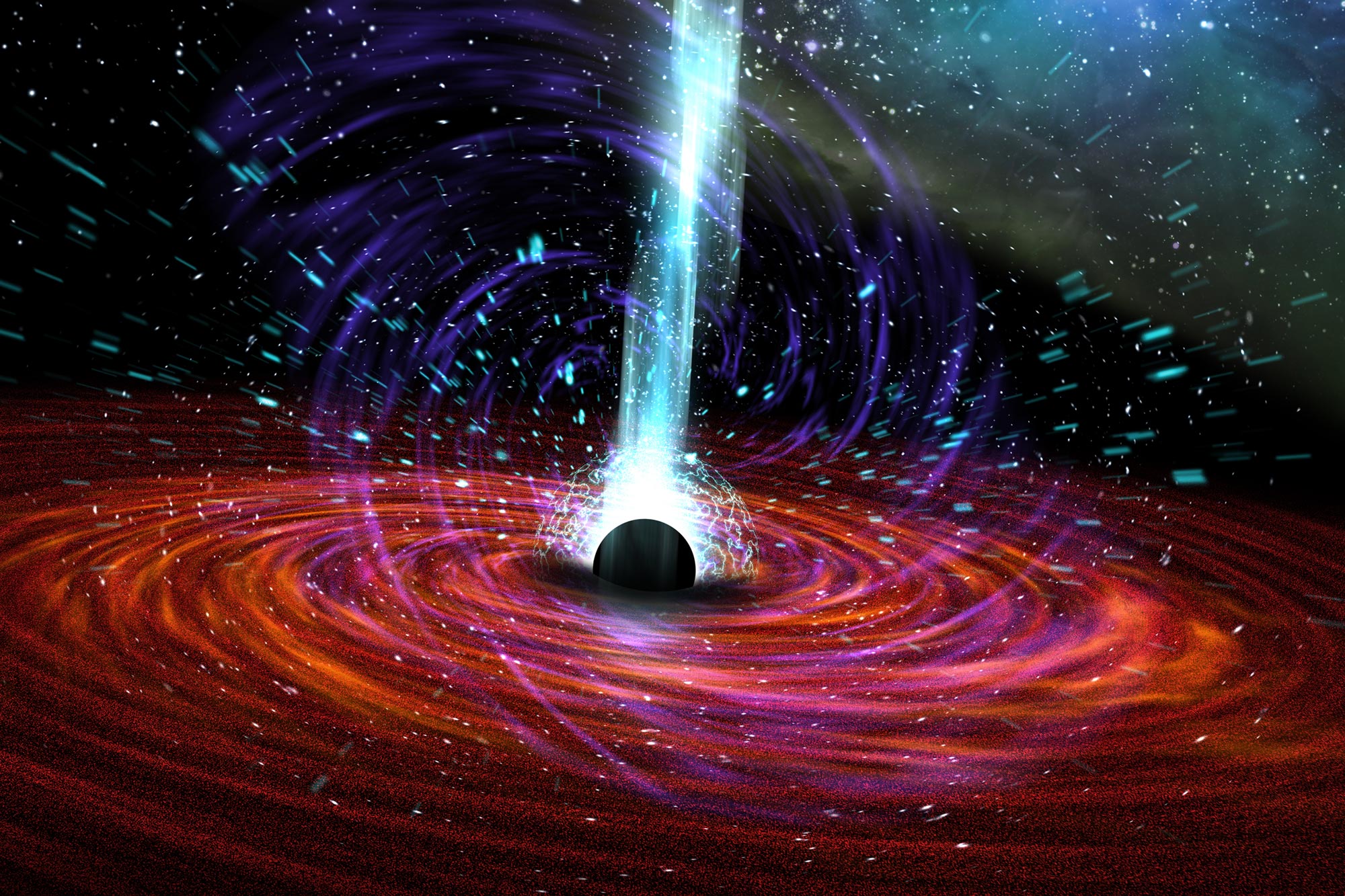
By combining advanced X-ray and radio observations, scientists have uncovered new clues about how magnetic fields and superheated plasma enable supermassive black holes to generate powerful jets.
Some supermassive black holes consume enormous amounts of gas while blasting powerful jets of plasma into space at nearly the speed of light. According to conventional models, these two behaviors should be difficult to sustain together. Rapidly feeding black holes are expected to develop cold, flat disks of swirling matter that make it harder for powerful jets to form.
Scientists studying a supermassive black hole in the galaxy 3C 120 have now identified a possible solution to this longstanding puzzle. Their observations suggest that a region of extremely hot plasma near the black hole creates conditions in which magnetic fields can help launch a relativistic jet, even as large amounts of matter continue falling inward.
A Superheated Region Near the Black Hole
The research, led by Associate Professor Hirofumi Noda of Tohoku University and Associate Professor Kazuhiro Hada of Nagoya City University, combined X-ray measurements with detailed radio observations to investigate both the material surrounding the black hole and the jet emerging from its vicinity.
“By looking at the same black hole with state-of-the-art X-ray and radio telescopes, we were able to see both the hot plasma surrounding the black hole and the jet emerging from it,” says Noda. “This allows us to directly connect the extreme environment near the black hole with the formation of the jet.”
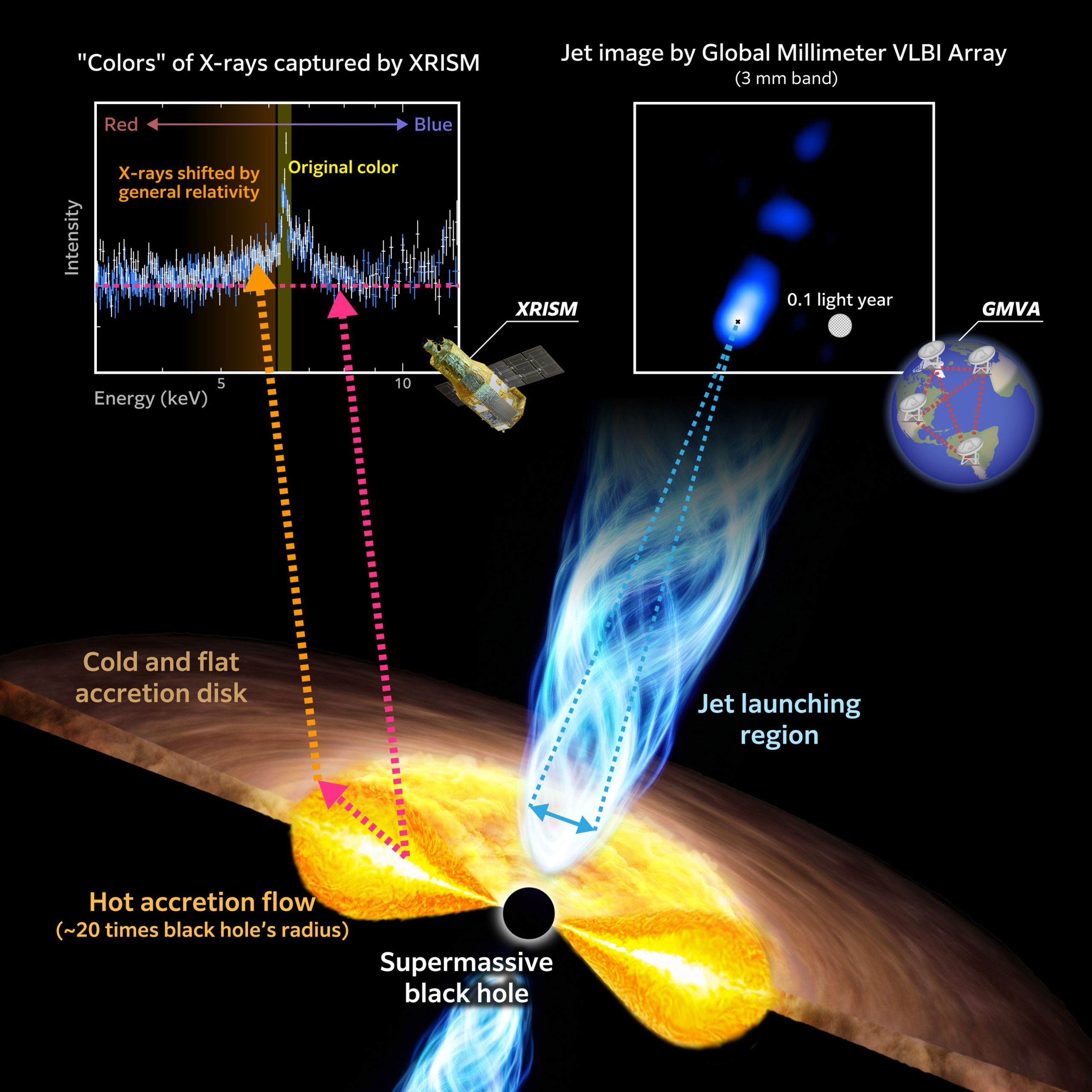
Located in the constellation Taurus, 3C 120 is an active galaxy whose central supermassive black hole is rapidly accumulating matter while producing a powerful jet. Observations from the X-Ray Imaging and Spectroscopy Mission (XRISM) indicate that the black hole’s cold accretion disk does not extend all the way inward. Instead, its inner edge lies at a distance of approximately 20 times the black hole’s radius. Closer to the black hole, the disk gives way to a flow of plasma heated to hundreds of millions of degrees.
How X-Rays and Radio Telescopes Exposed the Jet’s Origins
To investigate the structure of the accretion disk, the researchers examined an iron emission line detected by XRISM. The intense gravity near a black hole changes the energies of X-rays emitted by orbiting material, producing a characteristic distortion in the line’s shape. By analyzing this distortion using Einstein’s theory of general relativity, the team estimated how far inward the cold disk extends.
The researchers then used observations from the Global Millimeter VLBI Array, Very Long Baseline Array, and East Asian VLBI Network to examine the jet. These networks combine signals from widely separated radio telescopes, allowing astronomers to resolve structures too small for individual telescopes to distinguish. The measurements traced the jet’s narrowing structure back toward a launching region within the hot plasma flow close to the black hole.
Together, the X-ray and radio observations provide evidence that the black hole’s inner environment differs substantially from the cold, flat disk expected under rapid accretion. Rather than extending uninterrupted toward the black hole, the cooler material transitions into an extremely hot plasma flow in the region associated with the jet’s origin.
Magnetic Fields May Power the Powerful Jet
The hot plasma could help explain how a rapidly feeding black hole generates such an energetic outflow. Unlike a cold, thin accretion disk, this type of flow may allow strong magnetic fields to build up near the black hole. Those fields can potentially extract energy from the black hole’s rotation and direct it into a concentrated jet of plasma traveling at relativistic speeds.
This mechanism offers a possible explanation for the simultaneous rapid accretion and powerful jet observed in 3C 120. The measurements establish that the system has physical conditions consistent with the proposed process, although they do not directly demonstrate that rotational energy is being extracted to power the jet.
The findings also provide a way to examine how the structure of material surrounding a black hole relates to jet formation. By studying X-ray emissions from the accretion flow alongside high-resolution radio measurements of the jet, researchers can test whether similar conditions occur in other active galaxies.
Testing the Theory Around Other Supermassive Black Holes
The team is now extending its investigation to a more massive black hole using coordinated observations from XRISM and radio observatories around the world. They are also comparing the measurements with theoretical models and computer simulations to better understand how matter behaves under extreme gravity.
“Our next goal is to build a more complete picture of how matter, magnetic fields and black hole rotation interact in these extreme environments,” adds Noda. “Understanding this process may also help us better understand how supermassive black holes influence the evolution of galaxies and the larger structures of the Universe.”
Reference: “Disk Truncation Triggers Relativistic Jet Launching of a Highly Accreting Supermassive Black Hole” by Hirofumi Noda, Kazuhiro Hada, Hiroto Maruyama, Taishu Kayanoki, Kenji Toma, Taiki Kawamuro, Yoshiyuki Inoue, Tomohisa Kawashima, Soyeon Yeo, Ilje Cho, Keiichi Asada, Yasushi Fukazawa and Yoshihiro Ueda, 19 October 2026, The Astrophysical Journal Letters.
DOI: 10.3847/2041-8213/aeaa2c
Never miss a breakthrough: Join the SciTechDaily newsletter.
Follow us on Google and Google News.