
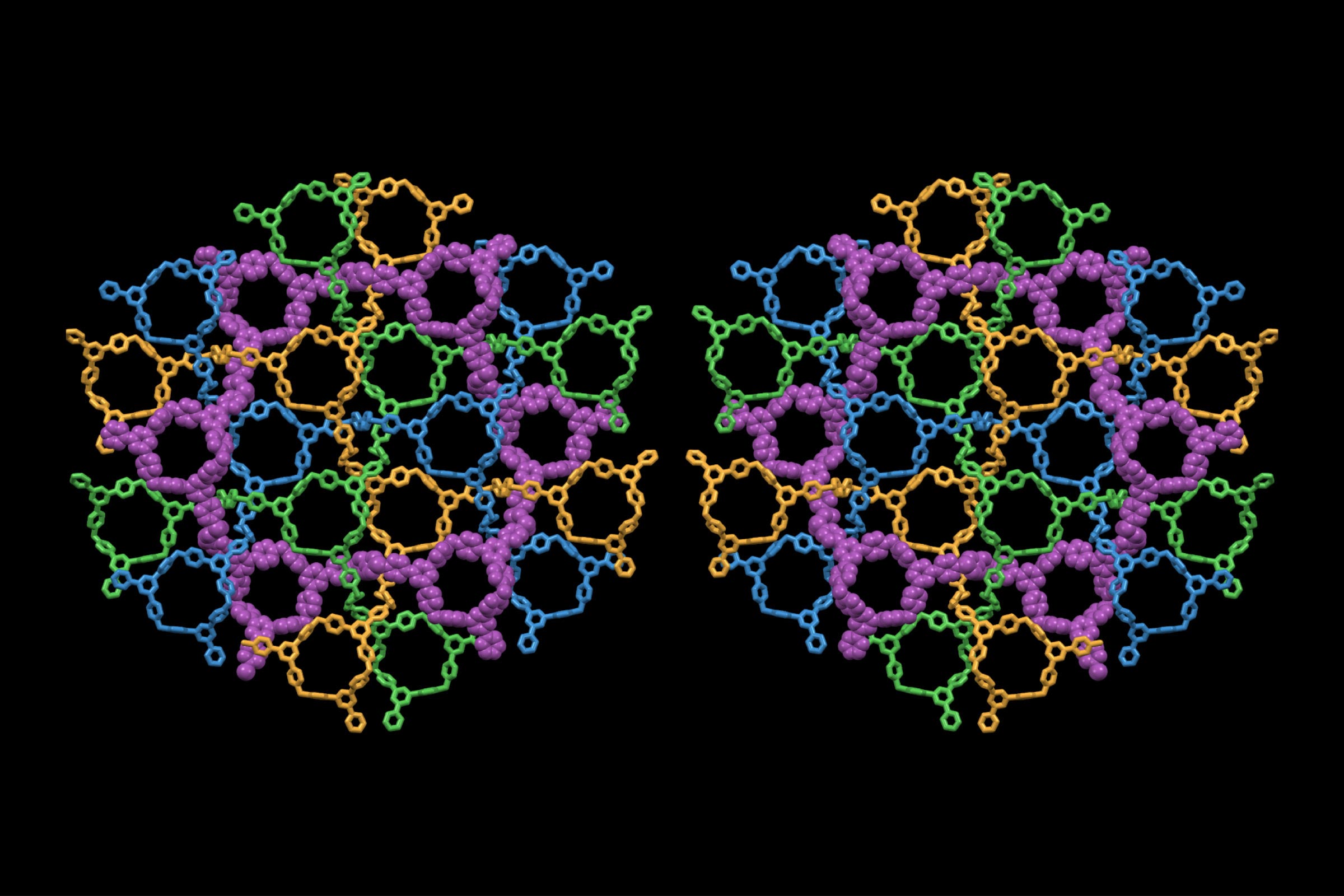
A fabric woven at the molecular level could help factories separate chemicals with less energy, opening a new path toward more sustainable manufacturing.
Reducing the environmental impact of manufacturing requires more than finding cleaner materials. It also means finding ways to make industrial processes use less energy and produce fewer hazardous byproducts. One promising approach comes from an unexpected place: the ancient craft of weaving.
Researchers from the University of Texas at Austin and Zhejiang University have developed a molecularly woven fabric that can separate benzene from cyclohexane, two chemicals that are notoriously difficult to separate using conventional methods. The material could offer a more energy-efficient way to handle chemical separation, potentially reducing the energy demands of industries that manufacture nylon, paint, polyurethane, furniture foams, and detergents. The research was published in Nature.
Cyclohexane is an important industrial chemical used to manufacture a range of everyday products. It is commonly produced from benzene, a known carcinogen, which can also remain as an unwanted byproduct. Removing the benzene is essential, yet the two chemicals have nearly identical boiling points, making conventional separation difficult.
Chemical plants typically rely on distillation, a process that heats mixtures to separate substances according to their boiling points. Chemicals with sufficiently different boiling points can vaporize at different temperatures, allowing one to be collected separately. Benzene and cyclohexane, however, vaporize at nearly the same temperature and tend to separate poorly. The process often requires additional additives and considerable energy.
“Unbelievable amounts of energy go into chemical separation. It’s one of the top energy sinks in the modern world,” said UT chemist Jonathan Sessler, one of the corresponding authors of the study. “In a sense, we are addressing the challenge of improving efficiency using one of humanity’s oldest technologies: weaving. It’s remarkable that the same principle of interlacing works at the molecular level.”
A fabric woven from molecular networks
The researchers developed a material made from four molecular networks that weave over and under one another, forming an interconnected structure. Each layer can take one of two mirror-image arrangements. In one, the networks cross in a clockwise spiral, while the other follows a counterclockwise spiral. This property, known as chirality or handedness, allows the researchers to alternate between the two arrangements as they stack the layers.
The resulting material forms a springy, thick fabric that can capture benzene from a mixture. Its interlocking, multi-thread structure also makes it stronger than conventional fabrics made by weaving individual threads in a single layer.
Watch a video showing how these layers self-assemble and stack. Credit: University of Texas at Austin
Unlike materials that require complicated manufacturing processes, this molecular fabric is self-assembling. Its chemical structure naturally guides the networks into their woven arrangement.
“The whole thing converges by itself based on the underlying chemistry, which is especially cool because it allows the creation of these new materials in a facile way,” Sessler said.
Reusable filtering could reduce industrial energy demands
The fabric can also be reused. After absorbing benzene from a chemical mixture, researchers heat the material to vaporize the captured benzene, preparing it for another round of separation.
Sessler and the Zhejiang University team, led by professors Feihe Huang and Guangfeng Li, tested the material using a mixture containing equal amounts of benzene and cyclohexane. A single application absorbed 97.9% of the benzene. Multiple passes could provide additional separation for processes requiring greater purity.
The researchers also demonstrated that the material could separate several other compounds of commercial interest, suggesting that its potential applications extend beyond benzene and cyclohexane.
At Zhejiang University, the team has demonstrated how the fabric could be used on a larger, industrial scale. However, an economic analysis has not yet been completed, so its eventual cost and commercial practicality remain uncertain.
If the technology proves viable, it could offer manufacturers a way to reduce the energy required for separating industrial chemicals. Improving these processes could help limit the environmental footprint of manufacturing, particularly across industries that depend on cyclohexane and other commercially important compounds.
Reference: “A two-dimensional reticular triaxial molecularly woven fabric” by Mengbin Wang, Shuai Fang, Xuedong Xiao, Zhewen Guo, Tianyu Shan, Han Han, Chun Tang, Ding Xiao, Guangguo Wang, Zhongwen Liu, Bohan Zhao, Shang Li, Ming Liu, Yan-Fang Wang, Jinbo Li, Ming Li, Liya Chen, Zhenglin Du, Chong Yao, Yizhao Du, Jiyong Liu, J. Fraser Stoddart, Jonathan L. Sessler, Guangfeng Li and Feihe Huang, 4 November 2026, Nature.
DOI: 10.1038/s41586-026-11218-8
The work at UT was supported by the Robert A. Welch Foundation and the work abroad was supported by the National Natural Science Foundation of China, the Zhejiang Provincial Natural Science Foundation of China, the ‘Pioneer’ and ‘Leading Goose’ R&D Program of Zhejiang, the Ministry of Education of China and the China Postdoctoral Science Foundation.
Never miss a breakthrough: Join the SciTechDaily newsletter.
Follow us on Google and Google News.