
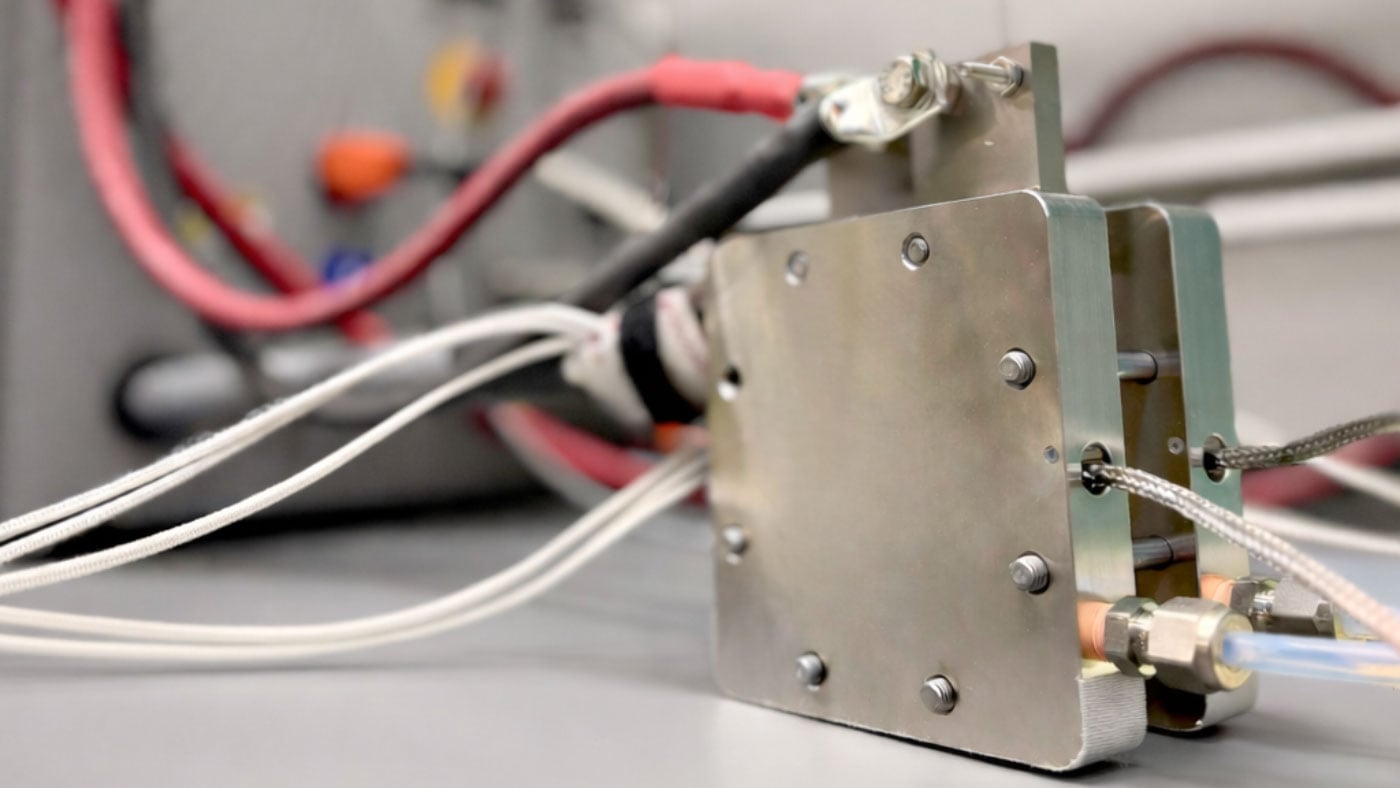
A new electrolyzer turns waste-derived syngas into ethylene with significantly lower energy input.
Ethylene sits at the center of modern manufacturing. It is used to make plastics and many other everyday materials, but producing it often comes with a major climate penalty. For every ton of ethylene created, one ton of carbon dioxide is produced. With more than 300 million tons of ethylene produced each year, that adds up to an enormous source of emissions that researchers want to shrink and ultimately remove.
In a new study from Northwestern University, Ted Sargent’s team reports an electrolyzer designed to push ethylene production toward a cleaner model by linking waste and renewable electricity.
The device uses electricity to turn syngas into ethylene. Syngas is a mixture of carbon monoxide and hydrogen that can be made by gasifying plastic waste. That starting point matters because it can be easier to upgrade syngas into valuable chemicals than it is to build the same products directly from carbon dioxide. The researchers also introduced a new material that helps the reaction run effectively, and they built the system to cut the overall energy required.
The results, published in Nature Energy, point to a potential route for making ethylene with renewable power, reducing the need for fossil-based inputs along the supply chain.
“Our goal is to decarbonize chemicals,” Sargent said. “And this work is a big step in that direction.”
Sargent is the Lynn Hopton Davis and Greg Davis Professor of Chemistry at Northwestern’s Weinberg College of Arts and Sciences and a professor of electrical and computer engineering at Northwestern’s McCormick School of Engineering.
“We want to create a circular system that creates chemical building blocks from waste without using fossil fuels,” said Ke Xie, a research faculty member in chemistry at Weinberg. “And this system is part of that new atom-efficient and energy-efficient supply chain.”
Creating energy from waste
Today, most ethylene is made through steam cracking, a process that uses high-temperature steam to break down crude oil into smaller chemical components. While effective, this method relies heavily on fossil fuels and consumes large amounts of energy.
Scientists have been investigating ways to replace it with electricity-driven processes powered by renewable sources. One possibility is to convert carbon dioxide directly into ethylene. However, that reaction requires significant energy input, making it difficult to compete with existing industrial methods.
Instead, Sargent’s team focused on syngas, which is produced by heating plastic waste in a low-oxygen environment. Syngas contains carbon monoxide and hydrogen. Because it is chemically closer to ethylene than carbon dioxide is, transforming it into ethylene requires less electricity.
“A lot of syngas is made into chemicals, so finding a route to take the syngas to ethylene that’s both very selective and very energy efficient is of industrial interest,” Sargent said.
To make this conversion practical, the researchers needed to design a different kind of electrolyzer, a cell that uses electrical energy to drive chemical reactions. Most electrolyzers rely on liquid water mixed with dissolved salts that supply both positive and negative ions.
The team explored whether they could build a system that operates with gases on both sides of the reaction. In their design, carbon monoxide from syngas would enter on one side (the cathode), while hydrogen would be supplied on the other (the anode).
“In initial attempts, we tried to make a gas-gas electrolyzer, but it just didn’t work,” he said. “And what we realized was that we didn’t just need the water — we needed the salt.”
A novel device that works with renewable energy
Salt provides the positive ions (cations) that the device’s copper catalyst needs to stabilize key intermediates in the reaction. Bosi Peng, a postdoctoral researcher in the lab and first author on the paper, searched for the right material that could trap those ions while also keeping them loose enough to react within the system.
“We needed to find a material in this Goldilocks zone to make a successful electrolyzer,” Sargent said. “And Bosi found a new way to solve this hard problem, which was really exciting.”
The material, sodium polyacrylate (PANa), creates a micro-environment within the system that mimics a liquid salt bath, while keeping the system dry of liquid water. The result is a process that is more than 60% more efficient than the most energy-efficient prior electrified processes that turn carbon dioxide into ethylene.
“Bosi significantly reduced the electricity needed by lowering the voltage we have to apply across the device,” Sargent said. Even further, the device works well with the intermittent nature of renewable energy sources.
“Solar and wind are very cheap sources of energy, but they come and go,” he said. “We needed to create a device that could deal with intermittent energy, and we found this system could do that. A key ingredient in doing so was to take out the liquid water with the high concentration salt in the electrolyte.”
Next, the team plans to try to reduce the energy consumption of the device even further, so it’s on par with energy used in steam cracking. They are also using artificial intelligence and machine learning tools to find catalysts that would make the device even more efficient.
Ultimately, the goal is to create a device that can scale up to be used in industry to continue to reduce ethylene’s carbon footprint.
Reference: “A cation-functionalized layer for ethylene electrosynthesis via CO reduction paired with H2 oxidation in a pure-water-fed solid-state electrolyser” by Bosi Peng, Zeyan Liu, Xiangyu Ma, Weiyan Ni, Aamir Hassan Shah, Charles B. Musgrave III, Hyundo Park, Jin Huang, Aditya Menon, Mercouri G. Kanatzidis, Ke Xie and Edward H. Sargent, 17 February 2026, Nature Energy.
DOI: 10.1038/s41560-026-01990-2
Never miss a breakthrough: Join the SciTechDaily newsletter.
Follow us on Google and Google News.