
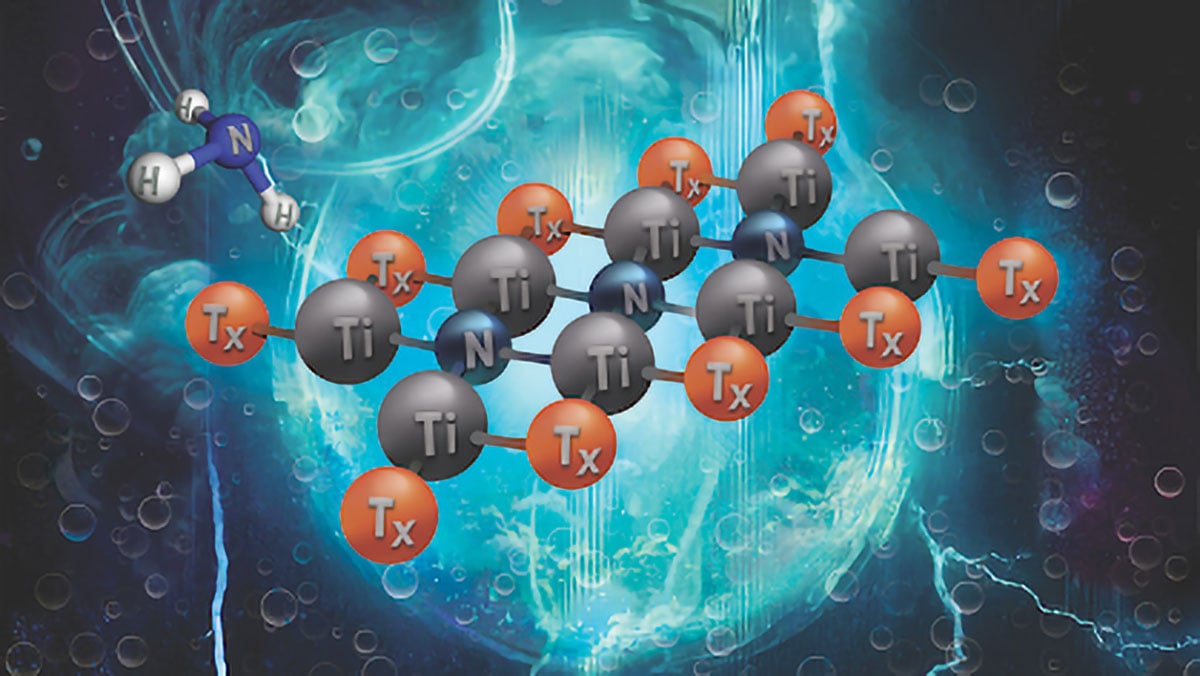
A team of researchers has explored how two-dimensional materials known as MXenes could revolutionize renewable energy and sustainable chemical production.
Scientists searching for cleaner and more sustainable technologies are turning their attention to two-dimensional materials that could transform renewable energy systems. Their work may make it possible to create essential compounds like ammonia, a key ingredient in fertilizers, through cleaner and more efficient methods.
Among the most promising of these materials are MXenes, an emerging class of low-dimensional compounds. MXenes can act as catalysts that convert elements from the air into ammonia, a process that could improve energy efficiency in both agricultural and transportation applications.
One of the remarkable features of MXenes is their highly adaptable chemical makeup. Their compositions can be finely adjusted, allowing scientists to precisely control their structural and functional properties for different uses.
This research, featured in the Journal of the American Chemical Society, was conducted by chemical engineering professors Drs. Abdoulaye Djire and Perla Balbuena, along with Ph.D. candidate Ray Yoo.
Djire’s team is questioning a long-held belief in materials science: that the performance of transition metal-based materials depends only on the specific metal used. Instead, they aim to uncover a deeper understanding of how various structural factors influence catalytic performance.
Understanding Catalytic Functionality
“We aim to expand our understanding of how materials function as catalysts under electrocatalytic conditions,” Djire said. “Ultimately, this knowledge may help us identify the key components needed to produce chemicals and fuels from earth-abundant resources.”
The structure of MXenes plays a key role in how they behave. By adjusting the lattice nitrogen reactivity, specifically by replacing a carbon atom with a nitrogen atom, researchers can modify the material’s vibrational properties. These properties describe how molecules move and vibrate based on the energy within them.
According to Yoo, this ability to fine-tune MXenes makes them highly adaptable for targeted uses in renewable energy. Their customizable nature positions them as strong contenders to replace current electrocatalyst materials that are often expensive and less efficient.
“MXenes are the ideal candidates as transition metal-based alternative materials. They have promising potential due to their many desirable qualities,” Yoo said. “Nitride MXenes play an important role in electrocatalysis, as shown through their improvement in performance compared to the widely studied carbide counterparts.”
Computational and Experimental Insights
The work was complemented by first-principles computational analyses performed by Ph.D. student Hao-En Lai in Dr. Balbuena’s group. The group evaluated changes in the surface vibrational modes caused by energy-relevant solvents in contact with MXenes. With these additional findings, the authors quantified the interactions of molecules, especially in the context of ammonia synthesis.
Throughout this research, Djire, Yoo, and the team have investigated the vibrational properties of titanium nitride using Raman spectroscopy, a non-destructive chemical analysis technique that provides detailed information about chemical structure.
“I feel that one of the most important parts of this research is the ability of Raman spectroscopy to reveal the lattice nitrogen reactivity,” Yoo said. “This reshapes the understanding of the electrocatalytic system involving MXenes.
Studies involving Raman spectroscopical characterization with nitride MXenes and polar solvents could lead to major breakthroughs, Yoo said.
“We demonstrate that electrochemical ammonia synthesis can be achieved through the protonation and replenishment of lattice nitrogen,” Djire said. “The ultimate goal of this project is to gain an atomistic-level understanding of the role played by the atoms that constitute a material’s structure.”
Reference: “Vibrational Property Tuning of MXenes Revealed by Sublattice N Reactivity in Polar and Nonpolar Solvents” by Ray M. S. Yoo, Bright Ngozichukwu, David Kumar Yesudoss, Hao-En Lai, Kailash Arole, Micah J. Green, Perla B. Balbuena and Abdoulaye Djire, 4 February 2025, Journal of the American Chemical Society.
DOI: 10.1021/jacs.4c13878
This work was supported by the U.S. Army DEVCOM ARL Army Research Office Energy Sciences Competency, Electrochemistry Program award # W911NF-24-1-0208. The views and conclusions contained in this document are those of the authors and should not be interpreted as representing the official policies, either expressed or implied, of the U.S. Army or the U.S. Government.
Never miss a breakthrough: Join the SciTechDaily newsletter.
Follow us on Google and Google News.
2 Comments
This sounds like a sales pitch for a ‘perpetual motion machine.’ I suspect that a rigorous analysis would discover that it would take more energy to create the catalysts than the catalysts will save in making the end products. Catalysts have their place and can be quite useful. However, I don’t think they allow us to violate the laws of thermodynamics on a large scale.
I dont know how much energy it takes to create the MXene materials but I believe that alternative approaches to creating ammonia fertilizers are achievable without breaking too many laws of thermo.
MXenes can act as electrocatalysts or photocatalysts, helping to convert N₂ → NH₃ under mild conditions, using electricity (electrocatalysis) or light (photocatalysis).
Why MXenes help:
1. Active surface sites:
The metal atoms (like Ti, Mo, or Nb) can adsorb N₂ molecules and weaken the N≡N bond.