
Industrial separations sit quietly at the heart of modern manufacturing, yet they consume enormous amounts of energy and generate significant environmental costs. A new membrane technology developed by an international research team promises a more precise and sustainable alternative.
Scientists from the CSIR-Central Salt and Marine Chemicals Research Institute (CSMCRI), the Indian Institute of Technology Gandhinagar, Nanyang Technological University in Singapore, and the S N Bose National Centre for Basic Sciences have teamed up to build a new kind of filtration membrane designed for unusually sharp molecular sorting.
Reported in the Journal of the American Chemical Society, the approach could cut the energy cost of industrial purification and make large-scale water reuse more achievable.
A huge share of manufacturing depends on “separations.” That single word covers everything from removing unwanted byproducts during drug making to stripping color from textile wastewater to refining ingredients in food processing. Today, many of these steps still lean on distillation and evaporation, which work well but burn vast amounts of energy and add significantly to industrial carbon emissions.
Membrane systems are often viewed as a cleaner alternative because they can separate chemicals without repeatedly heating and cooling large volumes, but common polymer membranes have a persistent weakness: their pores vary in size and can change as the material ages. When the pore landscape shifts, selectivity drops, and that is a deal breaker for precision work.
A New Class of Crystalline Membranes
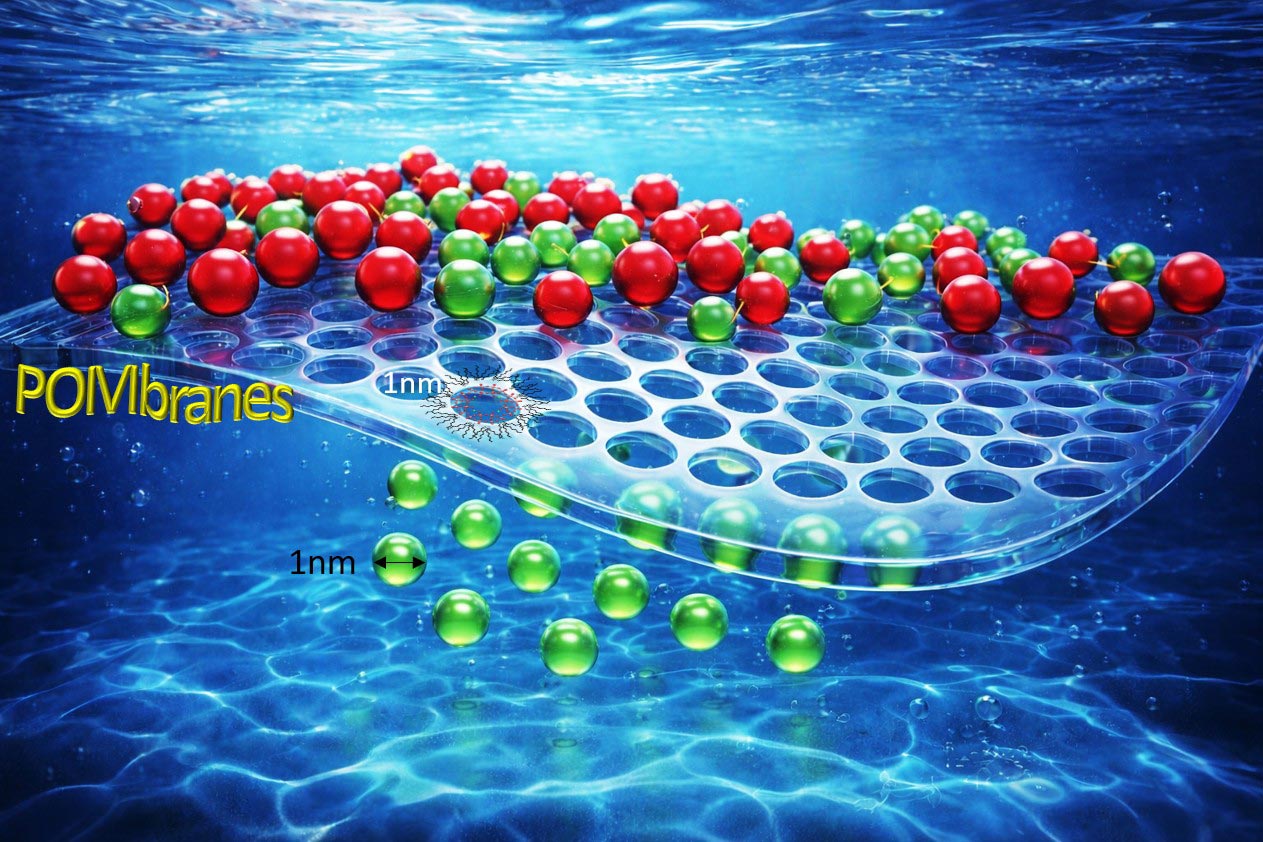
“To address these limitations, we engineered a new class of ultra-selective, crystalline membranes called “POMbranes”, which contain pores that are about one nanometer wide, thousands of times thinner than a human hair,” said Dr. Shilpi Kushwaha, Senior Scientist at CSMCRI.
That one-nanometer target is not just a small number. At this scale, tiny differences in molecular size and shape start to matter, which is why biology uses channels with near-perfect dimensions to control what passes through. The team drew inspiration from aquaporins, natural protein channels that let water through while blocking many other molecules, and aimed for the same kind of size-based decision-making in a synthetic material.
To do it, they turned to polyoxometalate (POM) clusters. These clusters already include a built in opening with a fixed diameter of exactly 1 nanometer, which means the filtering pathway is defined by the molecule itself rather than by a soft polymer that can slowly deform. According to Ms Priyanka Dobariya, a CSMCRI research scholar and co-first author of the article, “These POMs are tiny, crown-shaped metal clusters that have a permanent, perfect hole in their center that does not change or lose shape, which is the biggest hurdle with traditional plastic filters.”
Self-Assembly and Molecular Control
A membrane is only useful if it forms a continuous sheet without gaps, so the researchers focused on how to arrange enormous numbers of these ring-like clusters into a uniform layer. They attached flexible chemical chains to the clusters, then let the material assemble on the surface of water. Under those conditions, the clusters spread and align into an ultrathin film across large areas, a behavior that makes it easier to imagine scalable manufacturing rather than one-off laboratory samples.
By changing the chain length, the team could tune how tightly the clusters packed together. Tighter packing limits alternative routes around the pores, pushing molecules toward the designed pathway.
“This forced molecules to cross the membrane through the only open path, the one-nanometer holes built into each cluster, allowing the membrane to act like a high-tech sieve,” added Dr. Raghavan Ranganathan, Associate Professor at IITGN’s Department of Materials Engineering.
He and Mr Vinay Thakur, a PhD scholar at IITGN and the co-first author of the article, used molecular-level simulations to show how the structure guides transport and why the pores dominate what gets through.
Exceptional Selectivity and Industrial Performance
In tests, the membrane could tell apart molecules that differ in mass by only about 100 to 200 Daltons, a level of separation that conventional polymer membranes struggle to reach. For context, a Dalton is a unit used to describe molecular mass, so this result points to sorting that can discriminate between closely related compounds rather than just separating large from small.
According to Dr. Ketan Patel, Principal Scientist at CSMCRI, this level of control opens new possibilities for sustainable manufacturing. “Our membranes show almost ten times better separation performance compared to existing technologies, while remaining flexible, stable, and scalable,” he said. “Additionally, these membranes are flexible, stable across different acidity levels (pH ranges), and can be manufactured in large sheets. This combination is essential if the membranes are to be adopted widely in industry.”
That combination matters because real industrial streams are messy. Wastewater and process solvents can swing in acidity, include complex mixtures, and run continuously for long periods. A membrane that keeps its pore structure under those conditions becomes more than a laboratory curiosity.
The work is also closely tied to India’s textile and pharmaceutical industries. Textiles and apparel contribute over 2.3% of GDP and about 13% of industrial production, with a domestic market valued at USD 160 to 225 billion and projected to reach USD 250 to 350 billion by 2030.
Yet dyeing and finishing produce large volumes of polluted wastewater, so better dye removal and water recycling remain urgent. The new membranes could selectively remove dye molecules while allowing water to be reused, lowering freshwater demand and reducing chemical discharge. That is especially relevant as India’s wastewater treatment market is expected to expand rapidly in the coming years.
The new membranes could selectively remove dye molecules while allowing water to be reused, reducing freshwater consumption and chemical discharge. This is particularly significant as India’s wastewater treatment market is expected to grow rapidly in the coming years.
Toward Scalable, Nature-Inspired Manufacturing
For the pharmaceutical sector, where precise separations are essential for drug purity and cost-effective manufacturing, the technology could offer significant benefits. “Processes like drug purification and solvent recovery are both energy-intensive and quality-sensitive,” noted Mr Vinay Thakur. “Highly selective membranes such as these can lower energy use while maintaining the stringent standards required in pharmaceutical production.”
The versatility of the engineered POMbranes makes them an efficient platform technology. Their tunable structure, high selectivity, and stability under harsh chemical conditions ensure their suitability for a wide range of separation challenges, from wastewater treatment to advanced chemical processing.
As industries seek solutions that balance efficiency, durability, and sustainability, molecularly engineered membranes could form the backbone of next-generation manufacturing technologies. By drawing on a core principle from biology—precise control at the molecular scale—and translating it into a scalable materials system, the research shows how nature-inspired design can address real industrial needs.
Reference: “Large-Area Supramolecular Crystalline Thin Films of Polyoxometalates with Controlled 1-nm Pores Enabling Ultra-Selective Molecular Transport” by Priyanka Dobariya, Vinay Thakur, Amrutha A, Karan Marvaniya, Ashish Maurya, Pradip Pachfule, Prashant Kumar, Raghavan Ranganathan, Shilpi Kushwaha and Ketan Patel, 13 January 2026, Journal of the American Chemical Society.
DOI: 10.1021/jacs.5c17644
Never miss a breakthrough: Join the SciTechDaily newsletter.
Follow us on Google and Google News.
2 Comments
Since drugs are manufactured and entered into all water tables and have been detected in fish in high mountain creeks an streams, it is imperative that water be cleaned in all cities. This should be a an important product for water filtering schemes.
thanks for the last information