
Close Menu
    Facebook X (Twitter) Instagram
    SciTechDaily
    • Biology
    • Chemistry
    • Earth
    • Health
    • Physics
    • Science
    • Space
    • Technology
    Facebook X (Twitter) Pinterest YouTube RSS
    SciTechDaily
    Home»Chemistry»This Ultra-Hard Material Is Resistant to Radioactivity – Now It’s Cheap to Make
    Chemistry

    This Ultra-Hard Material Is Resistant to Radioactivity – Now It’s Cheap to Make

    By University of SevilleDecember 12, 20191 Comment3 Mins Read
    Facebook Twitter Pinterest Telegram LinkedIn WhatsApp Email Reddit
    Share
    Facebook Twitter LinkedIn Pinterest Telegram Email Reddit
    B6C Boron Carbide
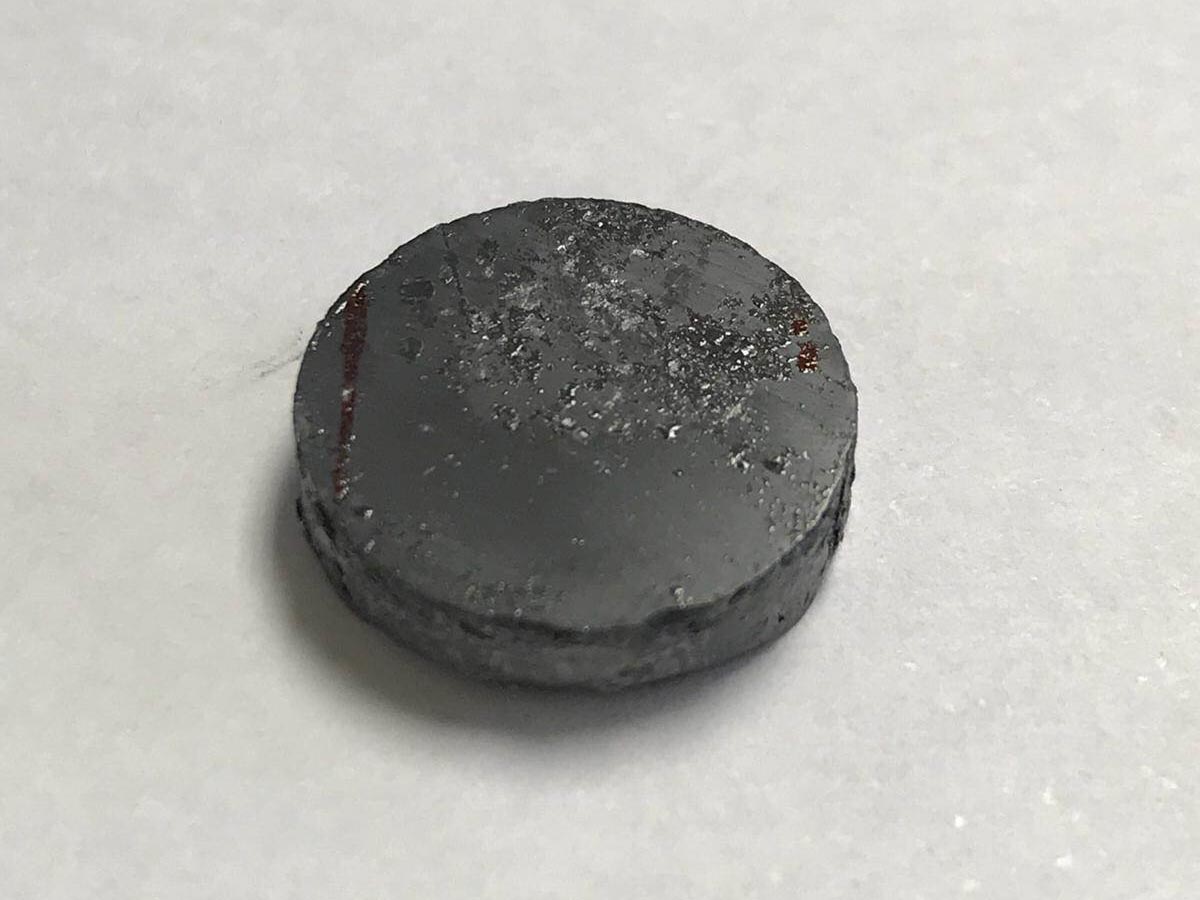
    Sample of the new material. Credit: Universidad de Sevilla

    Boron carbide is used in the design of planes, trains, and cars.

    University of Seville researchers, led by professor Francisco Luis Cumbrera, together with colleagues from the University of Zaragoza and CSIC, have found a procedure for producing the phase B6C of boron carbide. This phase had been described from a theoretical point of view, but obtaining it and describing its character were a task that remained unfulfilled. This scientific-technological advance will make it possible to provide a cheap, ultra-resistant material for the design of planes, cars, and other means of transport. In addition, B6C is also ultra-resistant to radioactivity.

    BxC is a family of ceramic materials known as “boron carbide.” The “official” or canonical member (in scientific language, stoichiometric) is B4C. This is a very hard black solid, which remains stable at very high temperatures. The family is big: from B4C to B14C. Depending on the proportion of B (boron) and C (carbon), its physical properties change. B6C is a member of the family (phase B6C) with 6 boron atoms to each one of carbon and theoretically it had been deemed that it would be ultra-resistant. Until now, a way to produce it systematically had not been found, nor how to distribute the boron and carbon atoms internally.

    The material has been made using the technique of laser zone floating, which consists of fusion by means of the application of intense laser radiation and then rapid solidification. Such an idea was proposed by Bibi Malmal Moshtaghion, a researcher trained in Iran and in Seville with a Juan de la Cierva contract to work at the University of Zaragoza. Professor Cumbrera’s team has used X-ray diffraction techniques to characterize the crystallography of the samples obtained and the defects present in them, as well as the possible preferential ordering of the polycrystal grains. Later, its mechanical properties were determined by both teams. The phase B6C obtained in this way possesses a hardness of 52 GPa and a Young modulus of 600 GPa. In comparison, the hardness of diamond is around 45 GPa, although it has a Young modulus of 1050 GPa. “This makes phase B6C the hardest material in nature after diamond and the cubic phase of boron nitride,” the researchers state.

    Reference: “Elusive super-hard B6C accessible through the laser-floating zone method” by Bibi Malmal Moshtaghioun, Francisco L. Cumbrera, Diego Gómez-García and Jose I. Peña, 16 September 2019, Scientific Reports.
    DOI: 10.1038/s41598-019-49985-2

    Never miss a breakthrough: Join the SciTechDaily newsletter.
    Follow us on Google and Google News.

    Chemical Engineering Materials Science University of Seville
    Share. Facebook Twitter Pinterest LinkedIn Email Reddit

    Related Articles

    Polymer-Eating Enzymes Make “Biodegradable” Plastics Truly Compostable

    Green Chemistry Creates Coatings From Nature: Turning Biomass Into High-Quality Coatings

    Engineers Build Chemically Driven Wheels That “Morph” Into Gears to Perform Mechanical Work

    A New Way to Synthesize Hydrocarbons Could Reduce CO2 Emissions and Slash Costs of Chemical Manufacturing

    A New Way to Synthesize Hydrocarbons Could Reduce Dioxide Emissions and Slash Costs of Chemical Manufacturing

    Solar Flow Battery: Single Device Generates, Stores and Redelivers Renewable Electricity From the Sun

    Atomic Layer Deposition Scaled Up to Large Surfaces With Lower Costs

    Converting Sunlight into Ionic Electricity for Direct Solar Desalination

    MIT Researchers Develop New Strategy for Stronger Polymers

    1 Comment

    1. Michael Lorrey on December 13, 2019 11:41 pm

      whats its thermal tolerance?

      Reply
    Leave A Reply Cancel Reply

    • Facebook
    • Twitter
    • Pinterest
    • YouTube

    Don't Miss a Discovery

    Subscribe for the Latest in Science & Tech!

    Trending News

    The Universe Is Expanding Too Fast and Scientists Can’t Explain Why

    “Like Liquid Metal”: Scientists Create Strange Shape-Shifting Material

    Early Warning Signals of Esophageal Cancer May Be Hiding in Plain Sight

    Common Blood Pressure Drug Shows Surprising Power Against Deadly Antibiotic-Resistant Superbug

    Scientists Uncover Dangerous Connection Between Serotonin and Heart Valve Disease

    Scientists Discover a “Protector” Protein That Could Help Reverse Hair Loss

    Bone-Strengthening Discovery Could Reverse Osteoporosis

    Scientists Uncover Hidden Trigger Behind Stem Cell Aging

    Follow SciTechDaily
    • Facebook
    • Twitter
    • YouTube
    • Pinterest
    • Newsletter
    • RSS
    SciTech News
    • Biology News
    • Chemistry News
    • Earth News
    • Health News
    • Physics News
    • Science News
    • Space News
    • Technology News
    Recent Posts
    • Scientists Overcome Major Quantum Bottleneck, Potentially Transforming Teleportation and Computing
    • Quantum Physics’ Strangest Problem May Hold the Key to Time Itself
    • Scientists Create “Liquid Gears” That Spin Without Touching
    • The Simple Habit That Could Help Prevent Cancer
    • Forgotten Medicinal Plant Shows Promise in Fighting Dangerous Superbugs
    Copyright © 1998 - 2026 SciTechDaily. All Rights Reserved.
    • Science News
    • About
    • Contact
    • Editorial Board
    • Privacy Policy
    • Terms of Use

    Type above and press Enter to search. Press Esc to cancel.