
Close Menu
    Facebook X (Twitter) Instagram
    SciTechDaily
    • Biology
    • Chemistry
    • Earth
    • Health
    • Physics
    • Science
    • Space
    • Technology
    Facebook X (Twitter) Pinterest YouTube RSS
    SciTechDaily
    Home»Science»Metal Substrates Shape Two-Dimensional Boron Monolayers
    Science

    Metal Substrates Shape Two-Dimensional Boron Monolayers

    By Mike Williams, Rice UniversitySeptember 2, 2015No Comments4 Mins Read
    Facebook Twitter Pinterest Telegram LinkedIn WhatsApp Email Reddit
    Share
    Facebook Twitter LinkedIn Pinterest Telegram Email Reddit
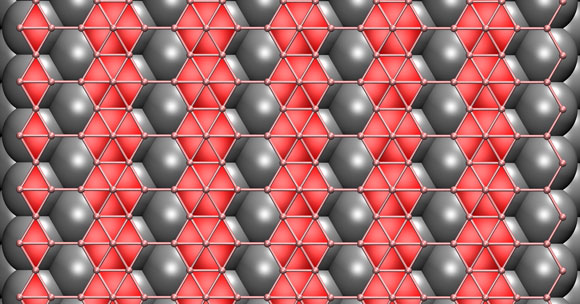
    Two-Dimensional Boron Monolayers Mediated by Metal Substrates
    Rice University scientists have determined that still-theoretical two-dimensional boron would adjust its form depending on the substrate used in the growth process. They found that a copper substrate would be best for growing flat boron in a chemical vapor deposition furnace. Credit: Zhuzha Zhang/Rice University

    New calculations from theoretical physicists at Rice University show it may be possible to guide the formation of 2D boron by tailoring boron-metal interactions.

    Rice University scientists have theoretically determined that the properties of atom-thick sheets of boron depend on where those atoms land.

    Calculation of the atom-by-atom energies involved in creating a sheet of boron revealed that the metal substrate – the surface upon which two-dimensional materials are grown in a chemical vapor deposition (CVD) furnace – would make all the difference.

    Theoretical physicist Boris Yakobson and his Rice colleagues found in previous work that CVD is probably the best way to make highly conductive 2D boron and that gold or silver might be the best substrates.

    But their new calculations show it may be possible to guide the formation of 2D boron by tailoring boron-metal interactions. They discovered that copper, a common substrate in graphene growth, might be best to obtain flat boron, while other metals would guide the resulting material in their unique ways.

    The Rice team’s results appear today in the journal Angewandte Chemie.

    “If you make 2D boron on copper, you get something different than if you made it on gold or silver or nickel,” said Zhuhua Zhang, a Rice postdoctoral researcher and lead author of the paper. “In fact, you’d get a different material with each of those substrates.”

    In chemical vapor deposition, heated gases deposit atoms on the substrate, where they ideally form a desired lattice. In graphene and boron nitride, atoms settle into flat hexagonal arrays regardless of the substrate. But boron, the researchers found, is the first known 2D material that would vary its structure based on interactions with the substrate.

    Perfectly flat boron would be a grid of triangles with occasional hexagons where atoms are missing. The researchers ran calculations on more than 300 boron-metal combinations. They found the pattern of atoms in a copper surface match up nicely with 2D boron and the strength of their interactions would help keep the boron flat. A nickel substrate would work nearly as well, they found.
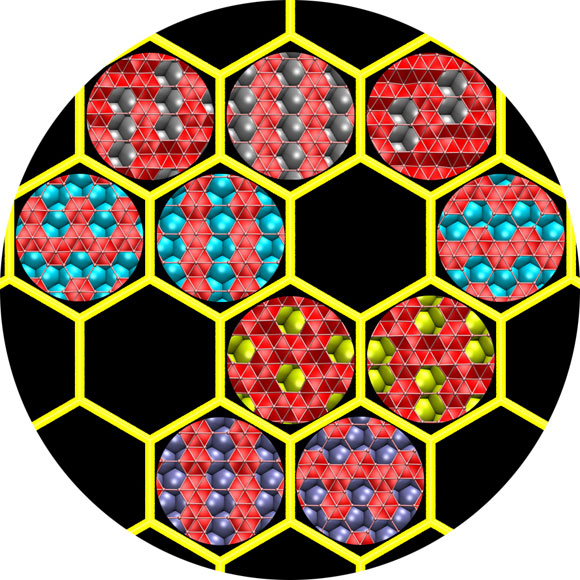
    Theorists Show Flat Boron Form Would Depend on Metal Substrates
    Two-dimensional boron would take different forms, depending on the substrate used in chemical vapor deposition growth, according to Rice University researchers. Credit: Zhuzha Zhang/Rice University

    On gold and silver, they determined weak atomic interactions would allow the boron to buckle. In an extension, they theorized that naturally forming, 12-atom icosahedrons of boron would assemble into interconnected sheets on copper and nickel, if the boron supply were high enough.

    One remaining downside to 2D boron is that, unlike graphene, it will remain difficult to separate from its substrate, which is necessary for use in applications.

    But that strong adhesion may have a side benefit. Further calculations suggested boron on gold or nickel may rival platinum as a catalyst for hydrogen evolution reactions in applications like fuel cells.

    “In 2007 we predicted the possibility of pure boron fullerenes,” Yakobson said. “Seven years later, the first one was observed in a laboratory. This time, with the enormous attention researchers are giving to 2D materials, I’d hope some lab around the world will make 2D boron much sooner.”

    Co-authors of the paper are graduate student Yang Yang and Rice postdoctoral researcher Guoying Gao. Yakobson is Rice’s Karl F. Hasselmann Professor of Materials Science and NanoEngineering and a professor of chemistry.

    The Department of Energy Office of Basic Energy Sciences supported the research.

    Reference: “Two-Dimensional Boron Monolayers Mediated by Metal Substrates” by Zhuhua Zhang, Yang Yang, Guoying Gao and Boris I. Yakobson, 2 September 2015, Angewandte Chemie International Edition.
    DOI: 10.1002/anie.201505425

    Never miss a breakthrough: Join the SciTechDaily newsletter.
    Follow us on Google and Google News.

    Boron Materials Science Rice University
    Share. Facebook Twitter Pinterest LinkedIn Email Reddit

    Related Articles

    Scientists Create Dual-Purpose Film for Energy Storage

    Graphene Quantum Dots Outperform Platinum in Fuel Cells

    Graphene Nanoribbon Film Keeps Glass Ice-Free

    Experimental Evidence Shows New Boron Nanomaterial is Possible

    Atom-Thick Carbyne Nanorods May Be The Strongest Material Ever

    Researchers Increase the Stiffness of Silicone Liquid Crystal by 90 Percent

    PGClear Uses a Palladium-Gold Catalyst to Break Down Hazardous Compounds

    Defects in Graphene Will Reduce its Strength

    Graphene is Transparent to Water

    Leave A Reply Cancel Reply

    • Facebook
    • Twitter
    • Pinterest
    • YouTube

    Don't Miss a Discovery

    Subscribe for the Latest in Science & Tech!

    Trending News

    Could Low Vitamin D Be Making Your Pain Worse?

    Scientists Discover Once-Weekly Workout That Melts Belly Fat Surprisingly Effectively

    Scientists Just Tested a Thruster Powerful Enough for Human Missions to Mars

    Doctors Say Your Ice Pack Might Be Making Injuries Worse

    Scientists Discover 43-Foot Sea Reptile Twice the Size of a Great White Shark

    Bees and Birds Are Drinking Alcohol From Flowers

    Scientists Discover How Obesity May Trigger Alzheimer’s Disease

    Scientists Confirm Alcohol Causes Widespread Health Damage

    Follow SciTechDaily
    • Facebook
    • Twitter
    • YouTube
    • Pinterest
    • Newsletter
    • RSS
    SciTech News
    • Biology News
    • Chemistry News
    • Earth News
    • Health News
    • Physics News
    • Science News
    • Space News
    • Technology News
    Recent Posts
    • The Secret Behind Indigenous Andeans’ “Digestive Superpower” May Be Potatoes
    • Archaeologists Discover Mysterious Artificial Island Older Than Stonehenge in Scotland
    • Magnon Breakthrough Could Shrink Quantum Computers to the Size of a Penny
    • NASA Finds a “Goldilocks” Giant Planet Wrapped in Methane
    • Are There Aliens on the Famous Exoplanet K2-18b? Scientists Just Scanned It for Signals
    Copyright © 1998 - 2026 SciTechDaily. All Rights Reserved.
    • Science News
    • About
    • Contact
    • Editorial Board
    • Privacy Policy
    • Terms of Use

    Type above and press Enter to search. Press Esc to cancel.