
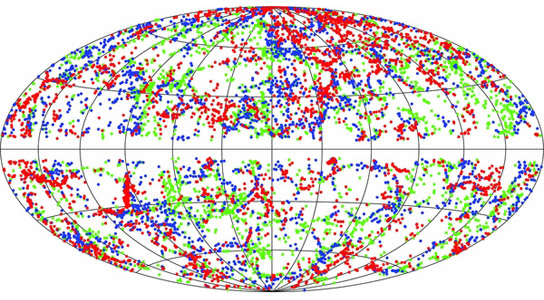
Once scientists realized that their understanding of the distribution of galaxies was incorrect, researchers began studying the large-scale structure of the universe to better understand the sum of all movements in relation to Earth. Now some forty years later, a newly published study gives an unprecedented account of all of the normal matter within roughly one billion light-years of Earth and it catalogs the morphological types of a nearly complete subsample of 20,860 galaxies.
The Earth is not at rest. It orbits the Sun, which in turn orbits the center of the Milky Way Galaxy, which in turn moves within the Local Group of Galaxies — a collection of about fifty-four galaxies in our “neighborhood” (that is, within about ten million light-years of Earth). The Local Group itself is “falling” toward the Virgo Cluster of Galaxies, a set of over one thousand galaxies about fifty million light-years away in the direction of the constellation of Virgo, and whose gravity pulls the Milky Way.
After the cosmic microwave background radiation was discovered in 1960, astronomers began searching for signs of these motions of Earth with respect to the background light. First hints came in the mid-1970s and 1980s, and signaled a serious problem: the measured motion of the Earth with respect to the cosmic background was considerably smaller than the sum of all the movements listed above. One possible solution was that our understanding of the distribution of galaxies was incorrect.
John P. Huchra, the distinguished CfA astronomer who tragically passed away eighteen months ago at the age of 61, was a pioneer in the study of the large-scale structure of the universe. Together with his colleagues, he helped map the locations in space of nearly 20,000 of the nearest galaxies, revealing that the universe was not uniformly sprinkled with galaxies. Instead, the local universe appears to have a structure dominated by tremendous filaments, sheets, and voids, including what became known as “the Great Wall,” a thin sheet of galaxies about 600 million light-years wide, 250 million light-years high, and 30 million light-years deep — one of the largest known structures in the universe.
The discovery helped resolve the mystery of the measured motion of Earth with respect to the cosmic background by finding these large structures and their gravitational influences. But even with this landmark effort, most of the galaxies in the larger neighborhood remained unstudied. Moreover, the precision of the results was considerably worse than the precision from newer cosmic background instruments, as breakthroughs like the acceleration of the universe helped confirm and fill out the larger cosmological picture.
During the ten years before his death, John had been working on another huge and significant project: studying each one of 44,599 galaxies seen in the infrared 2MASS survey to determine its distance, and so place it in an enlarged, much more complete and precise three-dimensional map of the universe near the Earth. This month that paper was published; his team of nineteen collaborators, to honor his leadership and scholarship, and his memory, made him the posthumous first author.
The paper uses new spectroscopic observations of eleven thousand galaxies, and archival spectra of the rest, to obtain a distance catalog that is 97.6% complete over 91% of the sky (to certain well-defined limits). It is an unprecedented accounting of all of the normal matter within about one billion light-years of Earth; in addition, it catalogs the morphological types of a nearly complete subsample of 20,860 galaxies. The result refines and completes the earlier work in an extremely uniform, deep, and unbiased survey of the nearby universe, and is a fitting tribute to the memory of this pioneering astronomer and admired colleague.
Never miss a breakthrough: Join the SciTechDaily newsletter.
Follow us on Google and Google News.
1 Comment
I want to thank the editors of SciTechDaily for republishing this article, I haven’t read it before very interesting seems to fit my way of thinking about our galaxy and universe.