
Close Menu
    Facebook X (Twitter) Instagram
    SciTechDaily
    • Biology
    • Chemistry
    • Earth
    • Health
    • Physics
    • Science
    • Space
    • Technology
    Facebook X (Twitter) Pinterest YouTube RSS
    SciTechDaily
    Home»Technology»High Voltage Electric Jolt to Carbon Makes Superior Water Purifier
    Technology

    High Voltage Electric Jolt to Carbon Makes Superior Water Purifier

    By Nagoya UniversityMarch 21, 2020No Comments3 Mins Read
    Facebook Twitter Pinterest Telegram LinkedIn WhatsApp Email Reddit
    Share
    Facebook Twitter LinkedIn Pinterest Telegram Email Reddit
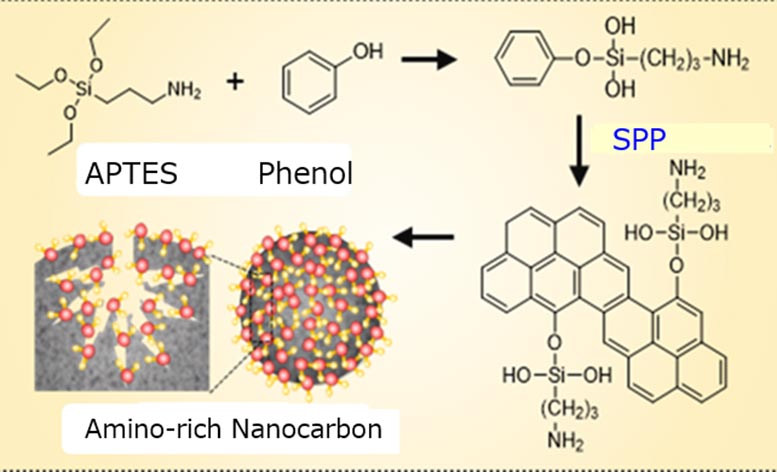
    Nanocarbon Adsorbent Synthesis Process
    Synthesis process of nanocarbon adsorbent. Credit: Nagahiro Saito

    Nanocarbons for purifying water get a lot more efficient by exposing a precursor mixture to high voltage.

    Nagoya University scientists have developed a one-step fabrication process that improves the ability of nanocarbons to remove toxic heavy metal ions from water. The findings, published in the journal ACS Applied Nano Materials, could aid efforts to improve universal access to clean water.

    Various nanocarbons are being studied and used for purifying water and wastewater by adsorbing dyes, gases, organic compounds, and toxic metal ions. These nanocarbons can adsorb heavy metal ions, like lead and mercury, onto their surfaces through molecular attraction forces. But this attraction is weak, so they aren’t very efficient adsorbents on their own.

    To improve adsorption, scientists are considering adding molecules to the nanocarbons, like amino groups, that form stronger chemical bonds with heavy metals. They are also trying to find ways to use all available surfaces on nanocarbons for metal ion adsorption, including the surfaces of their inner pores. This would enhance their capacity to adsorb more metal ions at a time.

    Materials scientist Nagahiro Saito of Nagoya University’s Institute of Innovation for Future Society and colleagues developed a new method for synthesizing an “amino-modified nanocarbon” that more efficiently adsorbs several heavy metal ions compared to conventional methods.

    They mixed phenol, as a source of carbon, with a compound called APTES, as a source of amino groups. This mixture was placed in a glass chamber and exposed to a high voltage, creating a plasma in liquid. The method they used, called “solution plasma process,” was maintained for 20 minutes. Black precipitates of amino-modified carbons formed and were collected, washed, and dried.

    A variety of tests showed that amino groups had evenly distributed over the nanocarbon surface, including into its slit-like pores.

    “Our single-step process facilitates the bonding of amino groups on both outer and inner surfaces of the porous nanocarbon,” says Saito. “This drastically increased their adsorption capacity compared to a nanocarbon on its own.”

    They put the amino-modified nanocarbons through ten cycles of adsorbing copper, zinc, and cadmium metal ions, washing them between each cycle. Although the capacity to adsorb metal ions decreased with repetitive cycles, the reduction was small, making them relatively stable for repetitive use.

    Finally, the team compared their amino-modified nanocarbons with five others synthesized by conventional methods. Their nanocarbon had the highest adsorption capacity for the metal ions tested, indicating there are more amino groups on their nanocarbon than the others.

    “Our process could help reduce the costs of water purification and bring us closer to achieving universal and equitable access to safe and affordable drinking water for all by 2030,” says Saito.

    Reference: “Liquid-Phase Plasma-Assisted in Situ Synthesis of Amino-Rich Nanocarbon for Transition Metal Ion Adsorption” by Mongkol Tipplook, Phuwadej Pornaroontham, Anyarat Watthanaphanit and Nagahiro Saito, 27 December 2019, ACS Applied Nano Materials.
    DOI: 10.1021/acsanm.9b01915

    This work was supported by JST-SICORP Grant JPMJSC18H1 and JST-OPERA Grant JPMJOP1843.

    Never miss a breakthrough: Join the SciTechDaily newsletter.
    Follow us on Google and Google News.

    Chemical Engineering Materials Science Nagoya University Nanotechnology Water
    Share. Facebook Twitter Pinterest LinkedIn Email Reddit

    Related Articles

    From Lab Curiosity to Industrial Reality: The New Dawn of Transition Metal Telluride Nanosheets

    MIT Engineers Create the “Impossible” – New Material That Is Stronger Than Steel and As Light as Plastic

    Making Seawater Drinkable in Minutes: A New Alternative Desalination Membrane

    Columbia Engineers Use DNA Nanotechnology to Build Tough 3D Nanomaterials

    Direct Solar Steam Generation: Harvesting the Sun’s Energy for Clean Drinking Water

    New 2-D Catalyst Fits Two Co-Catalysts on One Nanosheet for Better Water Purification

    MIT Develops Ultrafine High Performance Polyethylene Fibers

    New Material Provides an Elastic “Second Skin”

    3D Self-Assembling Polymer Materials Could Lead to New Microchips

    Leave A Reply Cancel Reply

    • Facebook
    • Twitter
    • Pinterest
    • YouTube

    Don't Miss a Discovery

    Subscribe for the Latest in Science & Tech!

    Trending News

    Scientists Uncover Potential Brain Risks of Popular Fish Oil Supplements

    Scientists Discover a Surprising Way To Make Bread Healthier and More Nutritious

    After 60 Years, Scientists Uncover Unexpected Brain Effects of Popular Diabetes Drug Metformin

    New Research Uncovers Hidden Side Effects of Popular Weight-Loss Drugs

    Scientists Rethink Extreme Warming After Surprising Ocean Discovery

    Landmark Study Links Never Marrying to Significantly Higher Cancer Risk

    Researchers Discover Unknown Beetle Species Just Steps From Their Lab

    Largest-Ever Study Finds Medicinal Cannabis Ineffective for Anxiety, Depression, PTSD

    Follow SciTechDaily
    • Facebook
    • Twitter
    • YouTube
    • Pinterest
    • Newsletter
    • RSS
    SciTech News
    • Biology News
    • Chemistry News
    • Earth News
    • Health News
    • Physics News
    • Science News
    • Space News
    • Technology News
    Recent Posts
    • Powerful Lasers Reveal How Matter Becomes Plasma in Trillionths of a Second
    • A Simpler Path to Super-Resolution: Scientists Reinvent Microscopy
    • Scientists Uncover Hidden Genetic Cause of Diabetes in Babies
    • Amazonian Chocolate Could Become the Next Superfood, Scientists Say
    • Challenging the Narrative: New Study Shows U.S. Life Expectancy Is Rising Across All States
    Copyright © 1998 - 2026 SciTechDaily. All Rights Reserved.
    • Science News
    • About
    • Contact
    • Editorial Board
    • Privacy Policy
    • Terms of Use

    Type above and press Enter to search. Press Esc to cancel.