
Close Menu
    Facebook X (Twitter) Instagram
    SciTechDaily
    • Biology
    • Chemistry
    • Earth
    • Health
    • Physics
    • Science
    • Space
    • Technology
    Facebook X (Twitter) Pinterest YouTube RSS
    SciTechDaily
    Home»Chemistry»“Opposite Action” Strategy Could Improve Industrial Gas Separation
    Chemistry

    “Opposite Action” Strategy Could Improve Industrial Gas Separation

    By Kyoto UniversityJune 7, 2021No Comments3 Mins Read
    Facebook Twitter Pinterest Telegram LinkedIn WhatsApp Email Reddit
    Share
    Facebook Twitter LinkedIn Pinterest Telegram Email Reddit
    Porous Coordination Polymer Incorporated With Amino Acid
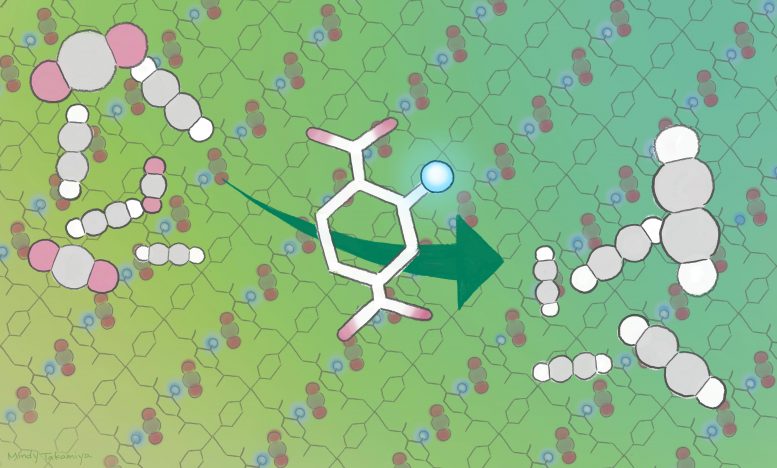
    A porous coordination polymer incorporated with amino acid directionally aligned in its pores preferentially adsorbs carbon dioxide to purify acetylene from a gaseous mixture. Credit: Mindy Takamiya/Kyoto University

    A Design Concept Changes How Materials Separate Gaseous Mixtures

    A more energy-efficient method improves how an industrial gas is purified by reversing the traditional process. The concept was developed and successfully tested by scientists at Kyoto University’s Institute for Integrated Cell-Material Sciences (iCeMS) in Japan and colleagues. The findings were reported in the journal Angewandte Chemie International Edition.

    Acetylene is a gas used in many industries, including as a fuel in welding and a chemical building block for materials like plastics, paints, glass and resins. To produce acetylene, it first needs to be purified from carbon dioxide. Traditionally, this is done by passing the acetylene/carbon dioxide gaseous mixture through a material. Carbon dioxide weakly interacts with the material and so passes through, while acetylene reacts strongly and becomes attached to it. The problem is that the subsequent removal of acetylene from the material takes several energy-consuming steps.

    Scientists have been looking for ways to reverse this process, so that acetylene becomes the gas that passes through the material and carbon dioxide is held back. But so far, this has been very challenging.

    “A problem is that both gases have similar molecular size, shape and boiling points,” explains iCeMS chemist Susumu Kitagawa, who led the study. “Adsorbents that favor carbon dioxide over acetylene do exist but are rare, especially those that work at room temperature.”

    Engineering the Material to Favor CO₂ Adsorption

    Kitagawa, iCeMS materials chemist Ken-ichi Otake and their colleagues improved carbon dioxide adsorption of a crystalline material called porous coordination polymers by modifying its pores. The team anchored amino groups into the pore channels of two porous coordination polymers. This provided additional sites for carbon dioxide to interact with and attach to the material. The additional interaction site also changed the way acetylene bound to the material, leaving less space for acetylene molecule attachment. This meant that more carbon dioxide and less acetylene was adsorbed compared to the same material that did not have the amino group anchors.

    These newly designed materials adsorbed more carbon dioxide and less acetylene compared to other currently available carbon dioxide adsorbents. They also functioned well around room temperature, and performed stably through several cycles.

    “This ‘opposite action’ strategy could be applicable to other gas systems, offering a promising design principle for porous materials with high performance for challenging recognition and separation systems,” says Kitagawa.

    Reference: “Host–Guest Interaction Modulation in Porous Coordination Polymers for Inverse Selective CO2/C2H2 Separation” by Dr. Yifan Gu, Prof. Jia-Jia Zheng, Prof. Ken-ichi Otake, Dr. Mohana Shivanna, Prof. Shigeyoshi Sakaki, Haruka Yoshino, Prof. Masaaki Ohba, Dr. Shogo Kawaguchi, Prof. Ying Wang, Prof. Fengting Li and Prof. Susumu Kitagawa, 17 February 2021, Angewadte Chemie International Edition.
    DOI: 10.1002/anie.202016673

    Never miss a breakthrough: Join the SciTechDaily newsletter.
    Follow us on Google and Google News.

    Chemical Engineering Industrial Engineering Kyoto University Materials Science
    Share. Facebook Twitter Pinterest LinkedIn Email Reddit

    Related Articles

    Increasing the Efficiency of Chemical Reactions To Help Decarbonize Fuels and Chemicals

    New Insulation Material Enables More Efficient Electricity Distribution

    A New Way to Synthesize Hydrocarbons Could Reduce Dioxide Emissions and Slash Costs of Chemical Manufacturing

    Solar Flow Battery: Single Device Generates, Stores and Redelivers Renewable Electricity From the Sun

    Revolutionary ‘Green’ Bricks Made From Recycled Plastic and Organic Waste

    This Ultra-Hard Material Is Resistant to Radioactivity – Now It’s Cheap to Make

    Atomic Layer Deposition Scaled Up to Large Surfaces With Lower Costs

    Converting Sunlight into Ionic Electricity for Direct Solar Desalination

    MIT Researchers Develop New Strategy for Stronger Polymers

    Leave A Reply Cancel Reply

    • Facebook
    • Twitter
    • Pinterest
    • YouTube

    Don't Miss a Discovery

    Subscribe for the Latest in Science & Tech!

    Trending News

    Your Blood Pressure Reading Could Be Wrong Because of One Simple Mistake

    Astronomers Stunned by Ancient Galaxy With No Spin

    Physicists May Be on the Verge of Discovering “New Physics” at CERN

    Scientists Solve 320-Million-Year Mystery of Reptile Skin Armor

    Scientists Say This Daily Walking Habit May Be the Secret to Keeping Weight Off After Dieting

    New Therapy Rewires the Brain To Restore Joy in Depression Patients

    Giant Squid Detected off Western Australia in Stunning Deep-Sea Discovery

    Popular Sugar-Free Sweetener Linked to Liver Disease, Study Warns

    Follow SciTechDaily
    • Facebook
    • Twitter
    • YouTube
    • Pinterest
    • Newsletter
    • RSS
    SciTech News
    • Biology News
    • Chemistry News
    • Earth News
    • Health News
    • Physics News
    • Science News
    • Space News
    • Technology News
    Recent Posts
    • Scientists Revive Ancient Chemistry Trick To Engineer Next-Generation Glass
    • Scientists Use AI To Supercharge Ultrafast Laser Simulations by More Than 250x
    • Scientists Just Found a Surprising Way To Destroy “Forever Chemicals”
    • Popular Supplement Ingredient Linked to Shorter Lifespan in Men
    • Scientists May Have Found a Way To Repair Nerve Damage in Multiple Sclerosis
    Copyright © 1998 - 2026 SciTechDaily. All Rights Reserved.
    • Science News
    • About
    • Contact
    • Editorial Board
    • Privacy Policy
    • Terms of Use

    Type above and press Enter to search. Press Esc to cancel.