
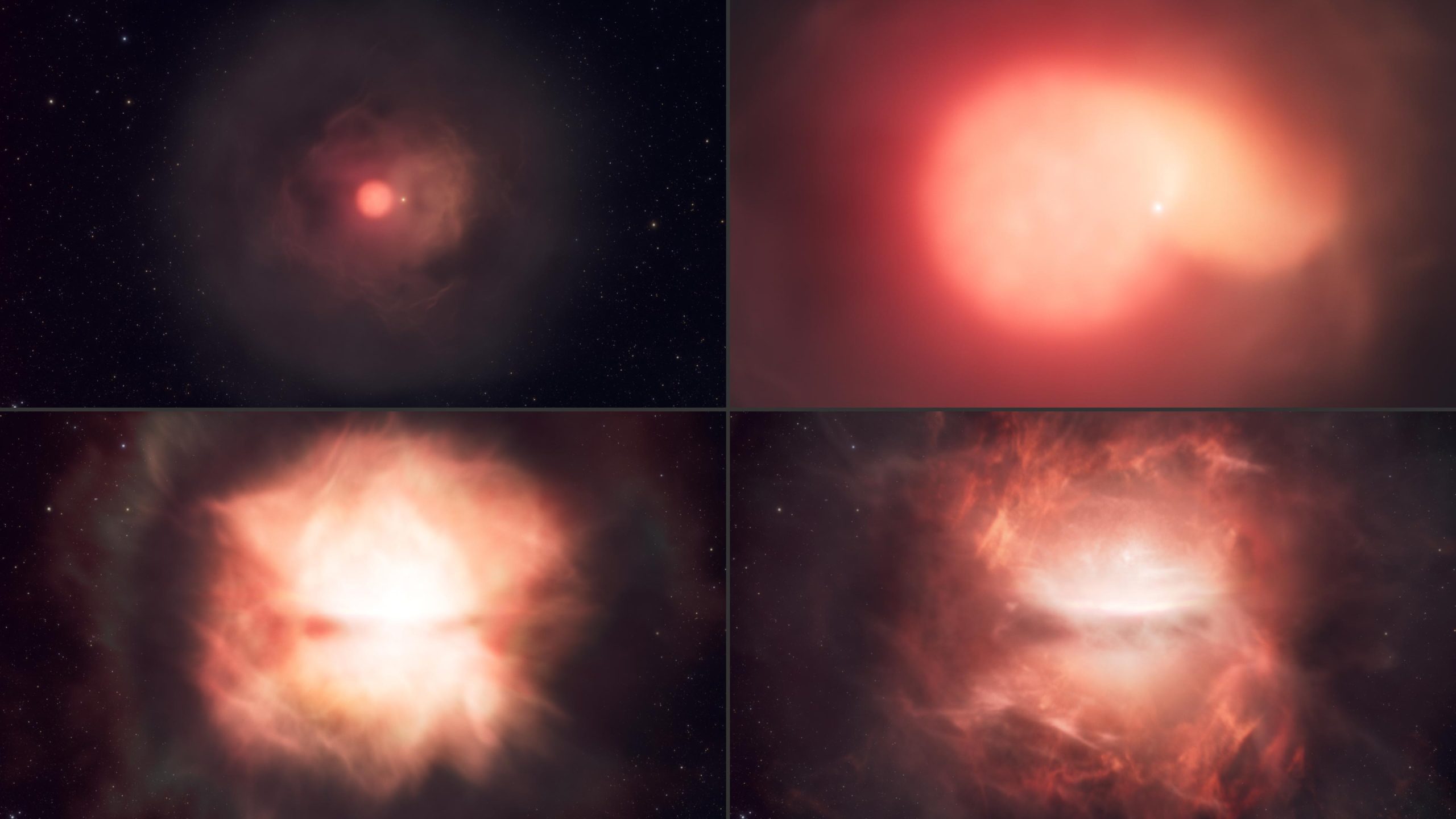
For thousands of years, two stars circled each other in Andromeda. Then one brushed against the other, and within seven orbits it was swallowed whole.
A star slightly smaller than the Sun brushed against a swollen supergiant in the outskirts of Andromeda. Seven orbits later, it plunged into the giant’s core, and the pair became a single star. Astronomers had been watching for two years when the system erupted in 2025, giving them a rare chance to see a stellar merger unfold.
The NASA-funded team nicknamed the resulting star Bao. Its study, published in Nature, combined observations from ground and space telescopes with a mid-infrared view from NASA’s James Webb Space Telescope. Webb observed the system 47 days after the eruption peaked, the earliest follow-up of a merger of this kind.
Seven Orbits From First Contact to Merger
The stars had circled each other for millennia before the smaller one began skimming the supergiant’s surface. From that first contact, their “unification” took just seven orbits (about seven years). In other observed mergers involving two smaller stars, that process took thousands of orbits.
“When a companion star begins to interact with the outer surface of the primary star, it produces a subtle effect, a slow brightening, which we clearly saw in Bao’s data,” said Kishalay De, a study co-author and assistant professor at Columbia University. “As the companion continues its orbit, it keeps peeling off the primary star’s outer layers, and that gas flows away into the surrounding space.”
The supergiant eventually engulfed its companion, leaving both stars inside a shared layer of gas called a common envelope. As the smaller star moved through the gas, drag drained energy from its orbit and sent it spiraling inward. The eruption that followed rose to its peak in about a week. “We thought an outburst from such an extended star would take years,” said Nadia Blagorodnova, a study co-author and associate professor at the University of Barcelona. “One day, its brightness started rising, and within a week, it peaked!”
How Big Bao Swallowed Little Bao
The researchers used Webb’s mid-infrared measurements of dust shed over centuries to find the simulation that best matched the system. Before the eruption, “Big Bao” was about seven times as massive as the Sun, with 350 times its radius and 18,000 times its luminosity. “It was an absolute beast of a star, completely outshining its companion in the data,” said Karel Temmink, a Ph.D. student at Radboud University in the Netherlands who led the simulations.
The model gave the team its first mass estimate for “Little Bao,” which was likely slightly smaller and dimmer than the Sun and less massive (about 0.7 solar masses). The initial energy calculations left open the possibility that the companion could “flee” the shared envelope. Further analysis showed it had spiraled all the way into Big Bao’s core. The encounter was “almost like a bomb exploding inside a living star,” De said.
The Telescopes That Caught Bao Erupting
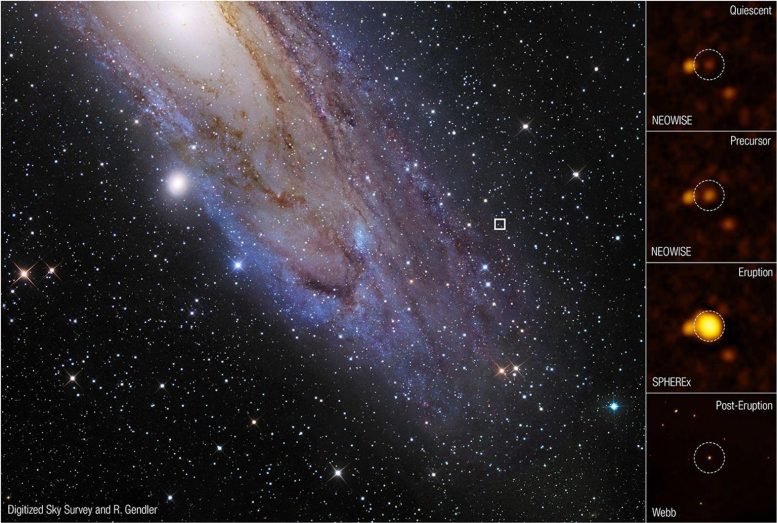
Bao first drew the team’s attention in February 2023, when they spotted an unusual variable star in data from NASA’s retired NEOWISE (Near-Earth Object Wide-Field Infrared Survey Explorer) mission. Its luminosity had been steady before 2018. By September 2024, the Wide-field Infrared Transient Explorer (WINTER) showed that the system was brightening and shedding dust. (In fact, they published their first paper right before the eruption in 2025.)
In July 2025, a routine survey by NASA’s SPHEREx (Spectro-Photometer for the History of the Universe, Epoch of Reionization and Ices Explorer) picked up an infrared brightening as the system rapidly faded in visible light. On October 17, the Zwicky Transient Facility detected the eruption as the system brightened and heated rapidly. NASA’s now-retired Neil Gehrels Swift Observatory and NOIRLab’s Gemini North telescope in Hawaii followed up in November. Webb observed Bao on December 24 through a Director’s Discretionary Time program.
“Stellar mergers are very, very difficult to observe in real time because they are hard to predict,” said lead author Viraj Karambelkar, a NASA Hubble Fellow at Columbia University. “However, we noticed something unusual was going on in 2023 and continued to monitor the system to see what it would do. Then, in 2025, it erupted! Webb observed Bao only 47 days after the stars’ eruption peaked, the earliest ever follow-up of an event like this. The telescope’s data helped us characterize what the system looked like before, during, and immediately after the merger, which is absolutely mind-blowing.”
When Two Stars Survive A Shared Envelope
Using Webb’s measurements and earlier observations spanning ultraviolet, visible, and near-infrared light, the team estimated how much gas the stars ejected and how efficiently their orbital energy drove that mass loss. Astronomers often have to reconstruct this stage from systems that went through it hundreds or even millions of years ago.
Some pairs eject enough of the shared envelope for both stars to survive in a tight orbit. Those systems can go on to produce supernovae and leave behind neutron stars or black holes. Some give rise to millisecond pulsars, and compact pairs that eventually merge can send out ripples in space-time called gravitational waves.
Future observations of Bao, formally known as AT 2025abao, could reveal how much mass the potentially “rejuvenated” star retains as it settles. NASA’s Nancy Grace Roman Space Telescope could help astronomers catch more systems in the act. Its publicly available surveys, including the Galactic Bulge Time-Domain Survey, are expected to detect many events that change in brightness over time. “There’s going to be a large influx of similar discoveries just ahead,” Karambelkar said.
Reference: “An inspiral of a star inside a common envelope with its giant companion” by Viraj Karambelkar, Kishalay De, Karel D. Temmink, Brian D. Metzger, Nadejda Blagorodnova, G. C. Anupama, Sudhanshu Barway, Judhajeet Basu, Eric C. Bellm, Varun Bhalerao, Aleksandra Bochenek, Shatakshi Chamoli, Kaustav Das, Christoffer Fremling, Danielle Frostig, Marco A. Gómez-Muñoz, Steven L. Groom, K-Ryan Hinds, Joahan Castaneda Jaimes, Jacob Jencson, David Jones, Mansi Kasliwal, Grace Katusiime, Rubina Kotak, S. R. Kulkarni, Ryan Lau, Chang Liu, Nathan P. Lourie, Morgan MacLeod, Keiichi Maeda, Zoe McGrath, Geoffrey Mo, Gerard Garcia-Moreno, Josiah Purdum, Nabeel Rehemtulla, R. Michael Rich, Reed L. Riddle, Sam Rose, Robert A. Simcoe, Jesper Sollerman, Robert Stein, Hugo Tranin, Maxime Wavasseur, Simon de Wet and Jacob Wise, 18 November 2026, Nature.
DOI: 10.1038/s41586-026-11221-z
This work is funded in part by a grant from NASA’s Astrophysics Data Analysis Program.
Never miss a breakthrough: Join the SciTechDaily newsletter.
Follow us on Google and Google News.