

Scientists Determine Atmospheric Makeup of Small, Hot, Gassy Sub-Neptune Planet
Sub-Neptunes, planets smaller than gas giants and cooler than hot Jupiters, have long been elusive targets for astronomers. Despite being the most common type of exoplanet in our galaxy, they don’t exist in our own solar system, and until recently, we knew very little about them. Their relatively small size and cooler temperatures made them especially difficult to study — at least, until NASA’s James Webb Space Telescope changed the game.
Adding to the challenge, most sub-Neptunes are cloaked in thick clouds or hazes that block the chemical signatures of their atmospheres. But that’s exactly what makes the recent observation of TOI-421 b so exciting. With Webb’s powerful instruments, scientists were finally able to pierce the haze and reveal the planet’s atmospheric composition.
The findings raise big questions: Did TOI-421 b form differently than the cooler sub-Neptunes we’ve studied before? Could it represent a whole new class of hot, haze-free sub-Neptunes? Or are we simply beginning to uncover the incredible diversity of planets beyond our solar system? Thanks to Webb, researchers are now closer than ever to finding out.
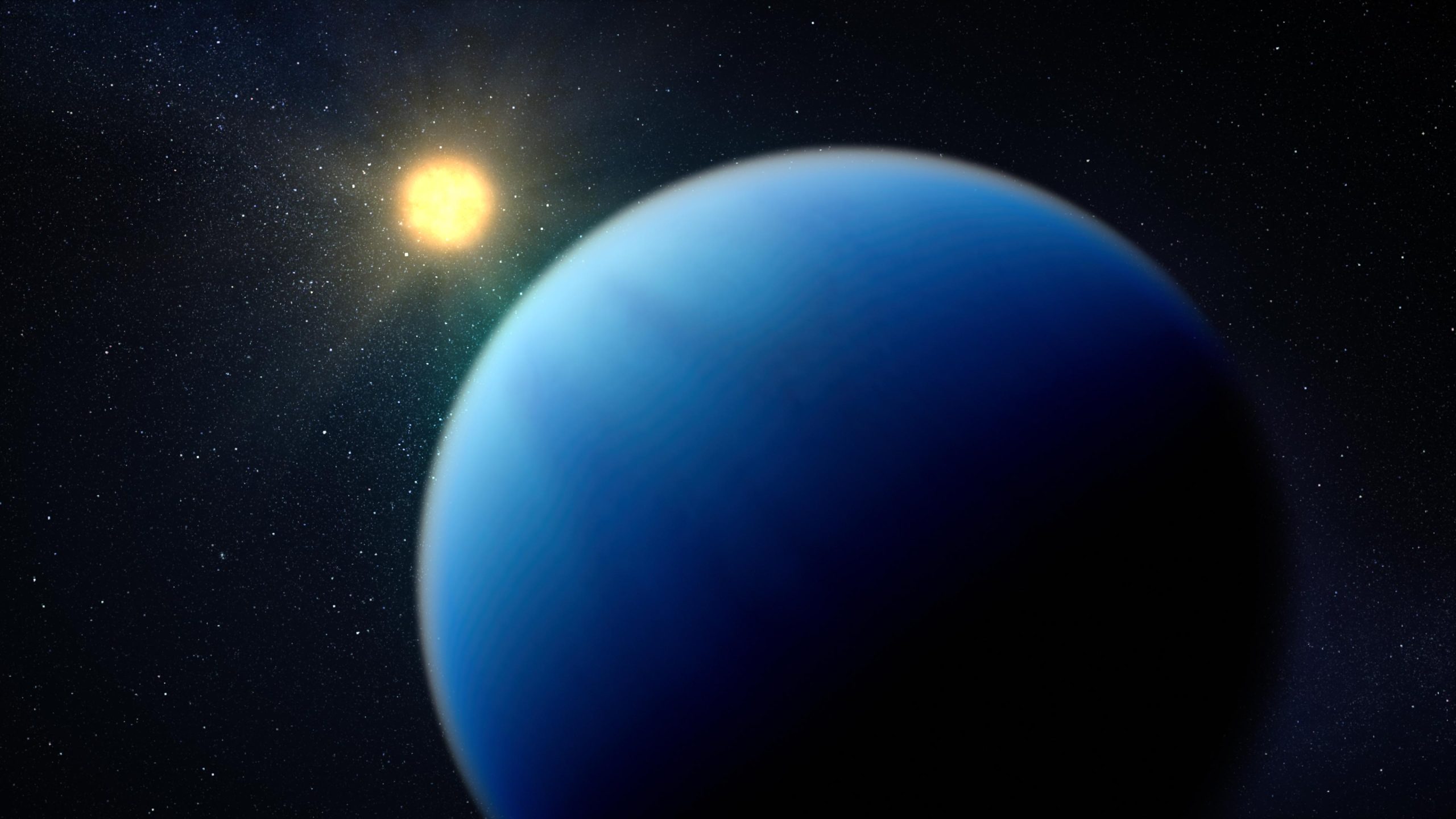
Webb Space Telescope Lifts Veil on Common but Mysterious Type of Exoplanet
Although no sub-Neptunes orbit around our Sun, they are the most common type of exoplanet, or planet outside our solar system, that have been observed in the Milky Way. These compact, gas-rich worlds are often hidden beneath thick hazes, keeping their true nature out of reach—until now. Using the James Webb Space Telescope to examine the hot sub-Neptune TOI-421 b, scientists have begun to probe these planets in detail for the first time.
“I had been waiting my entire career for Webb so that we could meaningfully characterize the atmospheres of these smaller planets,” said principal investigator Eliza Kempton of the University of Maryland, College Park. “By studying their atmospheres, we’re getting a better understanding of how sub-Neptunes formed and evolved, and part of that is understanding why they don’t exist in our solar system.”
Sub-Neptunes: Common Yet Mysterious
Astronomers didn’t even know sub-Neptunes existed until NASA’s Kepler mission uncovered them over the past decade. Although a few times larger than Earth, they are far smaller than gas giants and usually cooler than hot Jupiters, making them difficult to study with earlier telescopes.
Before Webb, scientists had very little information on them. While sub-Neptunes are a few times larger than Earth, they are still much smaller than gas-giant planets and typically cooler than hot Jupiters, making them much more challenging to observe than their gas-giant counterparts.
A key finding prior to Webb was that most sub-Neptune atmospheres had flat or featureless transmission spectra. This means that when scientists observed the spectrum of the planet as it passed in front of its host star, instead of seeing spectral features – the chemical fingerprints that would reveal the composition of the atmosphere – they saw only a flat-line spectrum. Astronomers concluded from all of those flat-line spectra that at least certain sub-Neptunes were probably very highly obscured by either clouds or hazes.

A Hot, Haze-Free Candidate Emerges
“Why did we observe this planet, TOI-421 b? It’s because we thought that maybe it wouldn’t have hazes,” said Kempton. “And the reason is that there were some previous data that implied that maybe planets over a certain temperature range were less enshrouded by haze or clouds than others.”
That temperature threshold is about 1,070 degrees Fahrenheit. Below that, scientists hypothesized that a complex set of photochemical reactions would occur between sunlight and methane gas, and that would trigger the haze. But hotter planets shouldn’t have methane and therefore perhaps shouldn’t have haze.
The temperature of TOI-421 b is about 1,340 degrees Fahrenheit, well above the presumed threshold. Without haze or clouds, researchers expected to see a clear atmosphere – and they did!
A Surprising Finding
“We saw spectral features that we attribute to various gases, and that allowed us to determine the composition of the atmosphere,” said the University of Maryland’s Brian Davenport, a third-year Ph.D. student who conducted the primary data analysis. “Whereas with many of the other sub-Neptunes that had been previously observed, we know their atmospheres are made of something, but they’re being blocked by haze.”
The team found water vapor in the planet’s atmosphere, as well as tentative signatures of carbon monoxide and sulfur dioxide. Then there are molecules they didn’t detect, such as methane and carbon dioxide. From the data, they can also infer that a large amount of hydrogen is in TOI-421 b’s atmosphere.
The lightweight hydrogen atmosphere was the big surprise to the researchers. “We had recently wrapped our mind around the idea that those first few sub-Neptunes observed by Webb had heavy-molecule atmospheres, so that had become our expectation, and then we found the opposite,” said Kempton. This suggests TOI-421 b may have formed and evolved differently from the cooler sub-Neptunes observed previously.
A Light, Hydrogen-Rich Atmosphere
The hydrogen-dominated atmosphere is also interesting because it mimics the composition of TOI-421 b’s host star. “If you just took the same gas that made the host star, plopped it on top of a planet’s atmosphere, and put it at the much cooler temperature of this planet, you would get the same combination of gases. That process is more in line with the giant planets in our solar system, and it is different from other sub-Neptunes that have been observed with Webb so far,” said Kempton.
Aside from being hotter than other sub-Neptunes previously observed with Webb, TOI-421 b orbits a Sun-like star. Most of the other sub-Neptunes that have been observed so far orbit smaller, cooler stars called red dwarfs.
Is TOI-421b emblematic of hot sub-Neptunes orbiting Sun-like stars, or is it just that exoplanets are very diverse? To find out, the researchers would like to observe more hot sub-Neptunes to determine if this is a unique case or a broader trend. They hope to gain insights into the formation and evolution of these common exoplanets.
A New Frontier for Exploration
“We’ve unlocked a new way to look at these sub-Neptunes,” said Davenport. “These high-temperature planets are amenable to characterization. So by looking at sub-Neptunes of this temperature, we’re perhaps more likely to accelerate our ability to learn about these planets.”
The team’s findings were published on May 5 in The Astrophysical Journal Letters.
Reference: “TOI-421 b: A Hot Sub-Neptune with a Haze-free, Low Mean Molecular Weight Atmosphere” by Brian Davenport, Eliza M.-R. Kempton, Matthew C. Nixon, Jegug Ih, Drake Deming, Guangwei Fu, E. M. May, Jacob L. Bean, Peter Gao, Leslie Rogers and Matej Malik, 5 May 2025, The Astrophysical Journal Letters.
DOI: 10.3847/2041-8213/adcd76
The James Webb Space Telescope (JWST) is NASA’s most powerful space observatory, designed to explore the universe in unprecedented detail by observing infrared light. Launched in December 2021, it orbits around the Sun at a stable point known as Lagrange Point 2, about a million miles from Earth. Webb is equipped with a suite of advanced instruments that allow it to peer through cosmic dust, study the atmospheres of exoplanets, and look back over 13 billion years to observe the earliest galaxies and stars. As the successor to the Hubble Space Telescope, Webb is transforming our understanding of the cosmos, from the origins of planets to the evolution of the universe itself.
Never miss a breakthrough: Join the SciTechDaily newsletter.
Follow us on Google and Google News.
4 Comments
Sure is a Beautiful plant of Blues looks like a Blue moon love them colors
Oh, boy! I think I surprised myself when I came upon this site!! I’m not sure where I am but it’s very interesting!…
I will look a bit further another time! …interesting!!!
[email protected]
At least there won’t be any Uranus jokes.
Interesting stuff here! Out of time to search tonite but I will be back…
[email protected]