

New population census answers the question: How small can you go when forming stars and brown dwarfs?
The Flame Nebula, part of the Orion Molecular Cloud Complex, is a well-studied region where new stars are born. Telescopes like NASA’s Hubble Space Telescope have observed it for years, but the smallest stars hidden deep within its dense, dusty core have remained out of reach—until now. Using its powerful infrared capabilities, NASA’s James Webb Space Telescope has, for the first time, detected and counted the faintest and smallest objects in the region, helping astronomers pinpoint the minimum mass needed to form brown dwarfs.
Webb Space Telescope Peers Deeper into Mysterious Flame Nebula
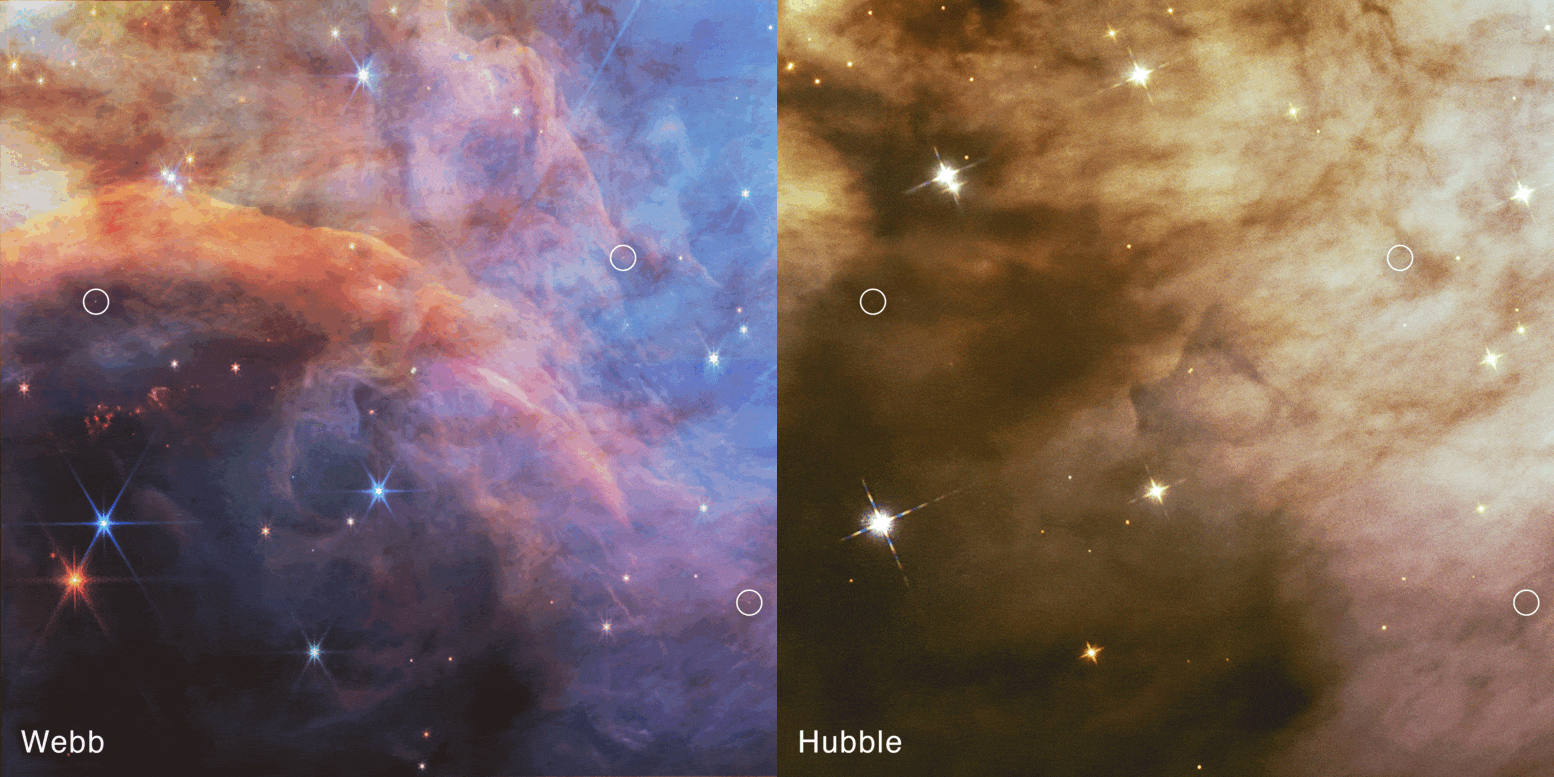
Discovering Brown Dwarfs in the Flame Nebula
The Flame Nebula, located about 1,400 light-years from Earth, is a young and active region of star formation—less than a million years old. Within this stellar nursery, astronomers have identified extremely small objects that lack the mass needed to ignite hydrogen fusion in their cores. These are known as brown dwarfs.
Often called “failed stars,” brown dwarfs gradually cool and fade over time, becoming much dimmer and harder to detect than regular stars. Because of this, most telescopes struggle to observe them, even when they’re relatively close to our Sun. However, when brown dwarfs are very young, they are still warm and bright enough to be spotted—despite being hidden within thick clouds of dust and gas like those in the Flame Nebula.

Webb Telescope’s Unprecedented Infrared Vision
NASA’s James Webb Space Telescope can see through that dense dust, capturing the faint infrared glow of these newborn brown dwarfs. Using Webb’s powerful capabilities, a team of astronomers set out to study how small these free-floating objects can be. They detected objects with masses around two to three times that of Jupiter, and the telescope was sensitive enough to detect objects as small as half a Jupiter mass.
“The goal of this project was to explore the fundamental low-mass limit of the star and brown dwarf formation process. With Webb, we’re able to probe the faintest and lowest mass objects,” said lead study author Matthew De Furio of the University of Texas at Austin.
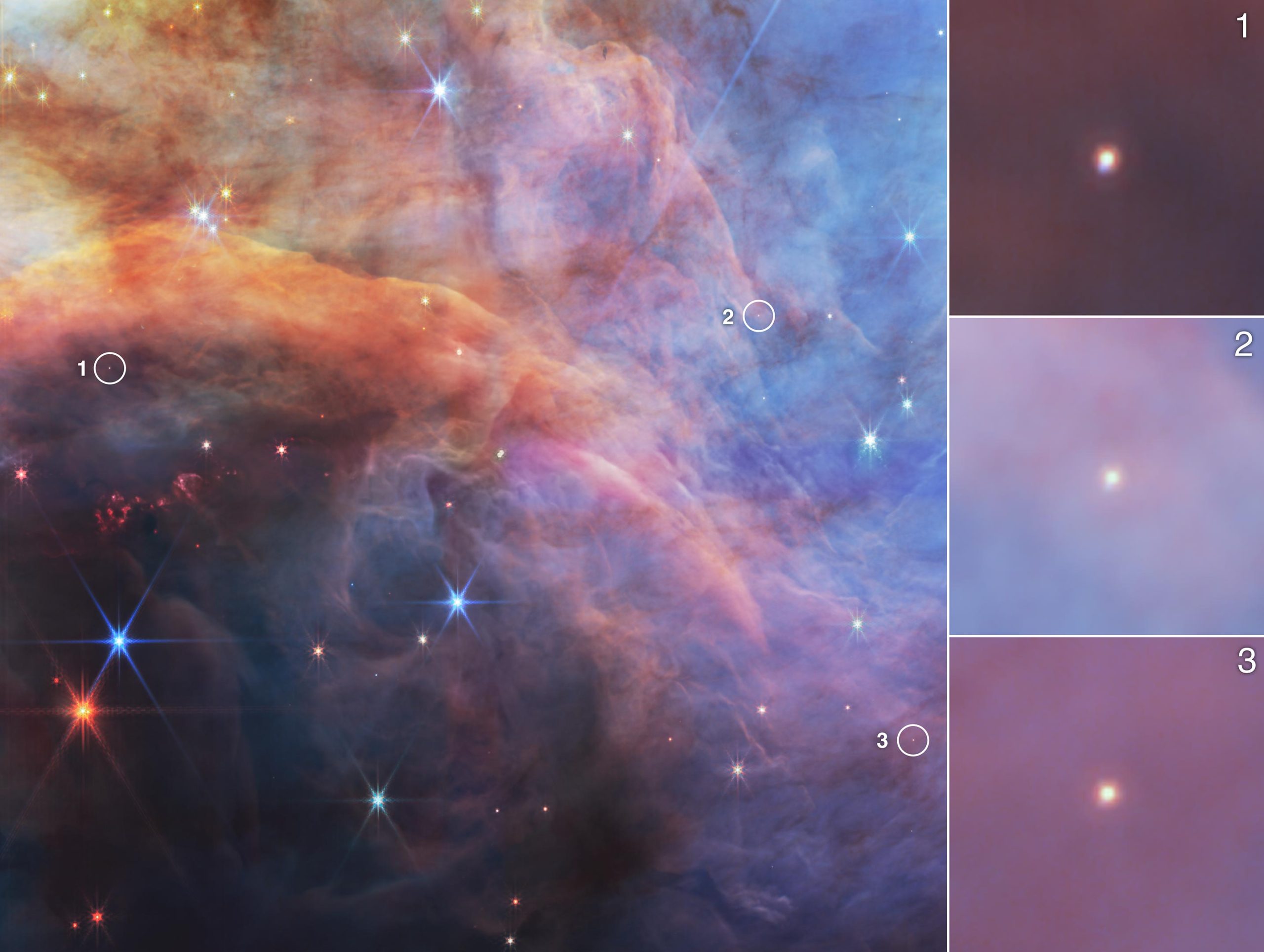
The Webb images represent light at wavelengths of 1.15 microns and 1.4 microns (filters F115W and F140M) as blue, 1.82 microns (F182M) as green, 3.6 microns (F360M) as orange, and 4.3 microns (F430M) as red.
Credit: NASA, ESA, CSA, STScI, Michael Meyer (University of Michigan)
How Fragmentation Shapes Star and Brown Dwarf Formation
The low-mass limit the team sought is set by a process called fragmentation. In this process, large molecular clouds, from which both stars and brown dwarfs are born, break apart into smaller and smaller units, or fragments.
Fragmentation is highly dependent on several factors with the balance between temperature, thermal pressure, and gravity being among the most important. More specifically, as fragments contract under the force of gravity, their cores heat up. If a core is massive enough, it will begin to fuse hydrogen. The outward pressure created by that fusion counteracts gravity, stopping collapse and stabilizing the object (then known as a star). However, fragments whose cores are not compact and hot enough to burn hydrogen continue to contract as long as they radiate away their internal heat.

The north and east compass arrows show the orientation of the image on the sky. Note that the relationship between north and east on the sky (as seen from below) is flipped relative to direction arrows on a map of the ground (as seen from above).
Credit: NASA, ESA, CSA, STScI, Michael Meyer (University of Michigan), Matthew De Furio (UT Austin), Massimo Robberto (STScI), Alyssa Pagan (STScI)
Cooling, Collapse, and the Fragmentation Threshold
“The cooling of these clouds is important because if you have enough internal energy, it will fight that gravity,” says Michael Meyer of the University of Michigan. “If the clouds cool efficiently, they collapse and break apart.”
Fragmentation stops when a fragment becomes opaque enough to reabsorb its own radiation, thereby stopping the cooling and preventing further collapse. Theories placed the lower limit of these fragments anywhere between one and ten Jupiter masses. This study significantly shrinks that range as Webb’s census counted up fragments of different masses within the nebula.
The Drop-Off in Tiny Brown Dwarfs
“As found in many previous studies, as you go to lower masses, you actually get more objects up to about ten times the mass of Jupiter. In our study with the James Webb Space Telescope, we are sensitive down to 0.5 times the mass of Jupiter, and we are finding significantly fewer and fewer things as you go below ten times the mass of Jupiter,” De Furio explained. “We find fewer five-Jupiter-mass objects than ten-Jupiter-mass objects, and we find way fewer three-Jupiter-mass objects than five-Jupiter-mass objects. We don’t really find any objects below two or three Jupiter masses, and we expect to see them if they are there, so we are hypothesizing that this could be the limit itself.”
Meyer added, “Webb, for the first time, has been able to probe up to and beyond that limit. If that limit is real, there really shouldn’t be any one-Jupiter-mass objects free-floating out in our Milky Way galaxy, unless they were formed as planets and then ejected out of a planetary system.”
Webb Picks Up Where Hubble Left Off
Brown dwarfs, given the difficulty of finding them, have a wealth of information to provide, particularly in star formation and planetary research given their similarities to both stars and planets. NASA’s Hubble Space Telescope has been on the hunt for these brown dwarfs for decades.
Even though Hubble can’t observe the brown dwarfs in the Flame Nebula to as low a mass as Webb can, it was crucial in identifying candidates for further study. This study is an example of how Webb took the baton—decades of Hubble data from the Orion Molecular Cloud Complex—and enabled in-depth research.
A Quantum Leap in Understanding
“It’s really difficult to do this work, looking at brown dwarfs down to even ten Jupiter masses, from the ground, especially in regions like this. And having existing Hubble data over the last 30 years or so allowed us to know that this is a really useful star-forming region to target. We needed to have Webb to be able to study this particular science topic,” said De Furio.
“It’s a quantum leap in our capabilities between understanding what was going on from Hubble. Webb is really opening an entirely new realm of possibilities, understanding these objects,” explained astronomer Massimo Robberto of the Space Telescope Science Institute.
Next Steps: Planets or Brown Dwarfs?
This team is continuing to study the Flame Nebula, using Webb’s spectroscopic tools to further characterize the different objects within its dusty cocoon.
“There’s a big overlap between the things that could be planets and the things that are very, very low mass brown dwarfs,” Meyer stated. “And that’s our job in the next five years: to figure out which is which and why.”
These results are accepted for publication in The Astrophysical Journal Letters.
Reference: “Identification of a Turnover in the Initial Mass Function of a Young Stellar Cluster Down to 0.5 MJ” by Matthew De Furio, Michael R. Meyer, Thomas Greene, Klaus Hodapp, Doug Johnstone, Jarron Leisenring, Marcia Rieke, Massimo Robberto, Thomas Roellig, Gabriele Cugno, Eleonora Fiorellino, Carlo F. Manara, Roberta Raileanu and Sierk van Terwisga, 10 March 2025, The Astrophysical Journal Letters.
DOI: 10.3847/2041-8213/adb96a
The James Webb Space Telescope is the world’s premier space science observatory. Webb is solving mysteries in our solar system, looking beyond to distant worlds around other stars, and probing the mysterious structures and origins of our universe and our place in it. Webb is an international program led by NASA with its partners, ESA (European Space Agency) and CSA (Canadian Space Agency).
Never miss a breakthrough: Join the SciTechDaily newsletter.
Follow us on Google and Google News.