
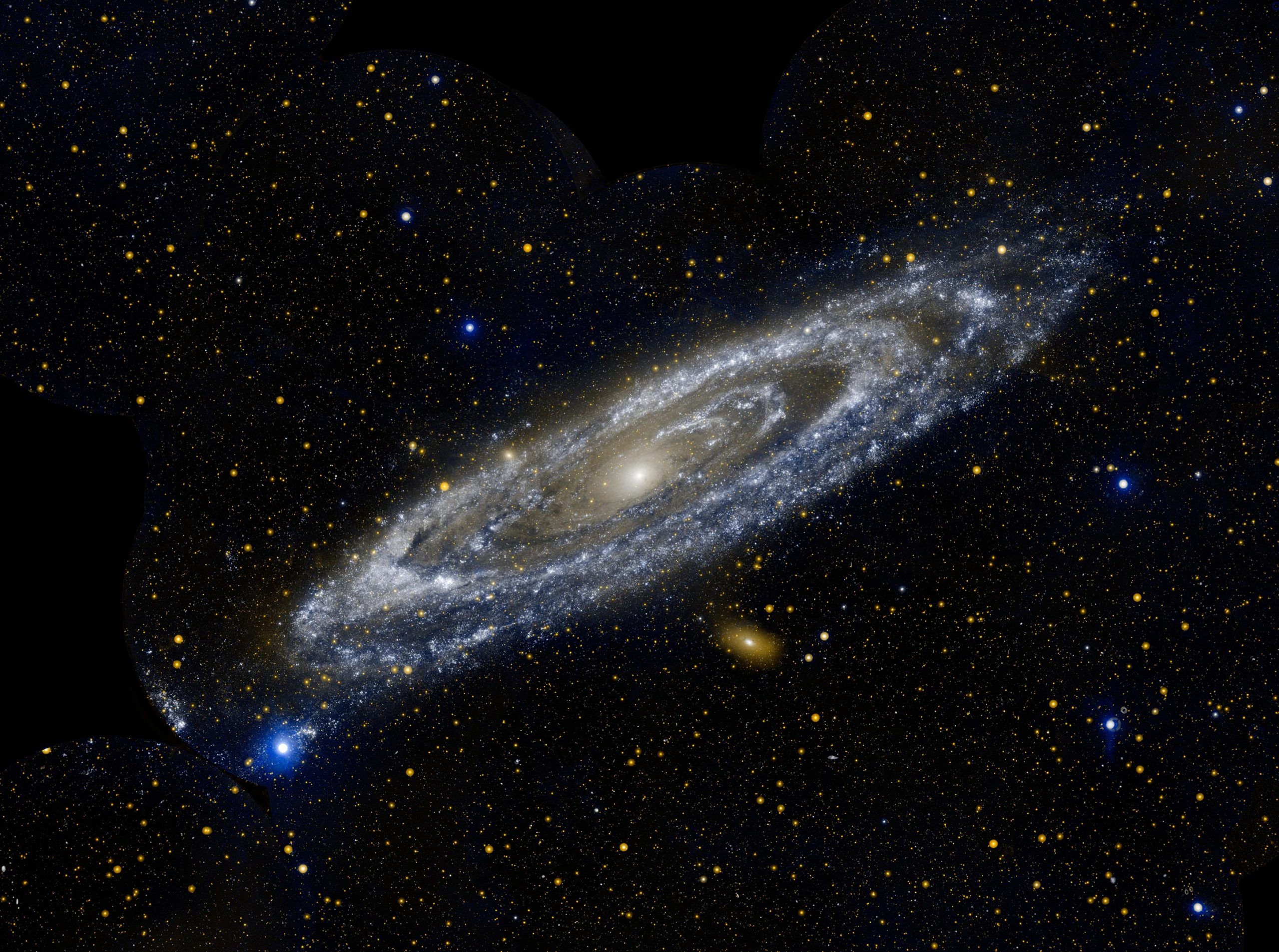
A Swarm of Dwarf Galaxies Buzz Around Our Milky Way’s Twin
Imagine the Milky Way and Andromeda as two massive aircraft carriers, each surrounded by a fleet of smaller warships. These “warships” represent dwarf galaxies, which are much smaller in size and mass than their giant spiral hosts.
The Milky Way has about 70 known dwarf galaxies, while Andromeda appears to have three times as many. These small galaxies offer valuable clues about how both systems have evolved over billions of years. But their histories tell very different stories. The Milky Way has had a relatively calm existence, while Andromeda has experienced a more chaotic past, including a major collision with another galaxy a few billion years ago.
To better understand Andromeda’s unusual satellite system, astronomers conducted an ambitious survey using the Hubble Space Telescope to create a comprehensive inventory of its known dwarf galaxies. This work is helping scientists piece together the dynamical history of our nearest galactic neighbor.

Credit: NASA, ESA, Alessandro Savino (UC Berkeley), Joseph DePasquale (STScI), Akira Fujii DSS2
Hubble Space Telescope Provides Bird’s-Eye View of Andromeda Galaxy’s Ecosystem
The Andromeda Galaxy, located 2.5 million light-years away, appears to the naked eye as a faint, spindle-shaped blur about the same size as the full Moon. But beyond what backyard observers can see, Andromeda is surrounded by nearly three dozen tiny satellite galaxies, orbiting it like bees around a hive.
NASA’s Hubble Space Telescope has been studying this swarm of dwarf galaxies in unprecedented detail. As part of an ambitious Hubble Treasury Program, astronomers used data from over 1,000 Hubble orbits to create a precise 3D map of Andromeda’s satellite system. This study also reconstructs how efficiently these small galaxies have formed stars throughout the nearly 14-billion-year history of the universe.
A Tale of Two Galaxies
Published in The Astrophysical Journal, Hubble’s findings reveal that Andromeda’s satellite system is markedly different from the Milky Way’s. This difference offers clues about how both galaxies evolved. While the Milky Way has remained relatively calm, Andromeda’s turbulent history (likely shaped by a major collision with another galaxy a few billion years ago) could explain why it has a larger and more diverse collection of dwarf galaxies. Andromeda is also up to twice as massive as the Milky Way, which may have influenced its satellite system’s evolution.
Studying satellite galaxies around the Milky Way in such detail is challenging because we are inside it. Other massive galaxies beyond Andromeda, like M81 (which lies nearly 12 million light-years away), are too far to examine their satellite systems in comparable depth. This makes Andromeda the best laboratory for understanding how small galaxies interact with a much larger host galaxy.
This animation begins with a view of the neighboring Andromeda galaxy. We zoom through a scattering of foreground stars and enter the inky blackness of intergalactic space. We cross 2.5 million light-years to reach the Andromeda system, consisting of 36 dwarf satellite galaxies orbiting the giant spindle-shaped Andromeda galaxy at image center. An ambitious survey by the Hubble Space Telescope was made to plot the galaxy locations in three-dimensional space. In this video, we circle around a model of the Andromeda system based on real Hubble observational data. Credit: NASA, ESA, Christian Nieves (STScI), Alessandro Savino (UC Berkeley), Joseph DePasquale (STScI), Frank Summers (STScI), Robert Gendler
Deciphering Andromeda’s Cosmic Influence
This bird’s-eye view of Andromeda’s satellite system allows us to decipher what drives the evolution of these small galaxies. “We see that the duration for which the satellites can continue forming new stars really depends on how massive they are and on how close they are to the Andromeda galaxy,” said lead author Alessandro Savino of the University of California at Berkeley. “It is a clear indication of how small-galaxy growth is disturbed by the influence of a massive galaxy like Andromeda.”
“Everything scattered in the Andromeda system is very asymmetric and perturbed. It does appear that something significant happened not too long ago,” said principal investigator Daniel Weisz of the University of California at Berkeley. “There’s always a tendency to use what we understand in our own galaxy to extrapolate more generally to the other galaxies in the universe. There have always been concerns about whether what we are learning in the Milky Way applies more broadly to other galaxies. Or is there more diversity among external galaxies? Do they have similar properties? Our work has shown that low-mass galaxies in other ecosystems have followed different evolutionary paths than what we know from the Milky Way satellite galaxies.”
The Mystery of Andromeda’s Orbiting Satellites
For example, half of the Andromeda satellite galaxies all seem to be confined to a plane, all orbiting in the same direction. “That’s weird. It was actually a total surprise to find the satellites in that configuration and we still don’t fully understand why they appear that way,” said Weisz.
The brightest companion galaxy to Andromeda is Messier 32 (M32). This is a compact ellipsoidal galaxy that might just be the remnant core of a larger galaxy that collided with Andromeda a few billion years ago. After being gravitationally stripped of gas and some stars, it continued along its orbit. Galaxy M32 contains older stars, but there is evidence it had a flurry of star formation a few billion years ago. In addition to M32, there seems to be a unique population of dwarf galaxies in Andromeda not seen in the Milky Way. They formed most of their stars very early on, but then they didn’t stop. They kept forming stars out of a reservoir of gas at a very low rate for a much longer time.
Unraveling the Puzzle of Star Formation
“Star formation really continued to much later times, which is not at all what you would expect for these dwarf galaxies,” continued Savino. “This doesn’t appear in computer simulations. No one knows what to make of that so far.”
“We do find that there is a lot of diversity that needs to be explained in the Andromeda satellite system,” added Weisz. “The way things come together matters a lot in understanding this galaxy’s history.”
Hubble’s Time Machine for Andromeda
Hubble is providing the first set of imaging where astronomers measure the motions of the dwarf galaxies. In another five years, Hubble or NASA’s James Webb Space Telescope will be able to get the second set of observations, allowing astronomers to do a dynamical reconstruction for all 36 of the dwarf galaxies, which will help astronomers to rewind the motions of the entire Andromeda ecosystem billions of years into the past.
Reference: “The Hubble Space Telescope Survey of M31 Satellite Galaxies. IV. Survey Overview and Lifetime Star Formation Histories” by Alessandro Savino, Daniel R. Weisz, Andrew E. Dolphin, Meredith J. Durbin, Nitya Kallivayalil, Andrew Wetzel, Jay Anderson, Gurtina Besla, Michael Boylan-Kolchin, Thomas M. Brown, James S. Bullock, Andrew A. Cole, Michelle L. M. Collins, M. C. Cooper, Alis J. Deason, Aaron L. Dotter, Mark Fardal, Annette M. N. Ferguson, Tobias K. Fritz, Marla C. Geha, Karoline M. Gilbert, Puragra Guhathakurta, Rodrigo Ibata, Michael J. Irwin, Myoungwon Jeon, Evan N. Kirby, Geraint F. Lewis, Dougal Mackey, Steven R. Majewski, Nicolas Martin, Alan McConnachie, Ekta Patel, R. Michael Rich, Evan D. Skillman, Joshua D. Simon, Sangmo Tony Sohn, Erik J. Tollerud and Roeland P. van der Marel, 28 January 2025, The Astrophysical Journal.
DOI: 10.3847/1538-4357/ada24f
The Hubble Space Telescope has been operating for over three decades and continues to make ground-breaking discoveries that shape our fundamental understanding of the universe. Hubble is a project of international cooperation between NASA and ESA (European Space Agency). NASA’s Goddard Space Flight Center in Greenbelt, Maryland, manages the telescope and mission operations. Lockheed Martin Space, based in Denver, also supports mission operations at Goddard. The Space Telescope Science Institute in Baltimore, which is operated by the Association of Universities for Research in Astronomy, conducts Hubble science operations for NASA.
Never miss a breakthrough: Join the SciTechDaily newsletter.
Follow us on Google and Google News.
2 Comments
Most astronomers and physicists are stuck on the notion that a galaxy core is a supermassive Black Hole. A view of String Theory suggests that the core may be a dimensional membrane (brane), much different than a Black Hole but with just as much gravity. Going that way, the reason for the thin plane of dwarf galaxies can be explained, and why those dwarfs spin much faster than they’re supposed to (not mentioned in the above article, but true). You can find a nice video of all this by looking up the YouTube “Dwarf Galaxies – A String Theory Way”.
1st pic looks almost like a portal I dreamt of darker blue blk outside stars around white tiny many 2 months ago so Cool Cosmos Universe Thks.