

Lakes play an important role in regulating Earth’s carbon cycle, and scientists warn that environmental changes occurring across many lakes at once could amplify global climate risks.
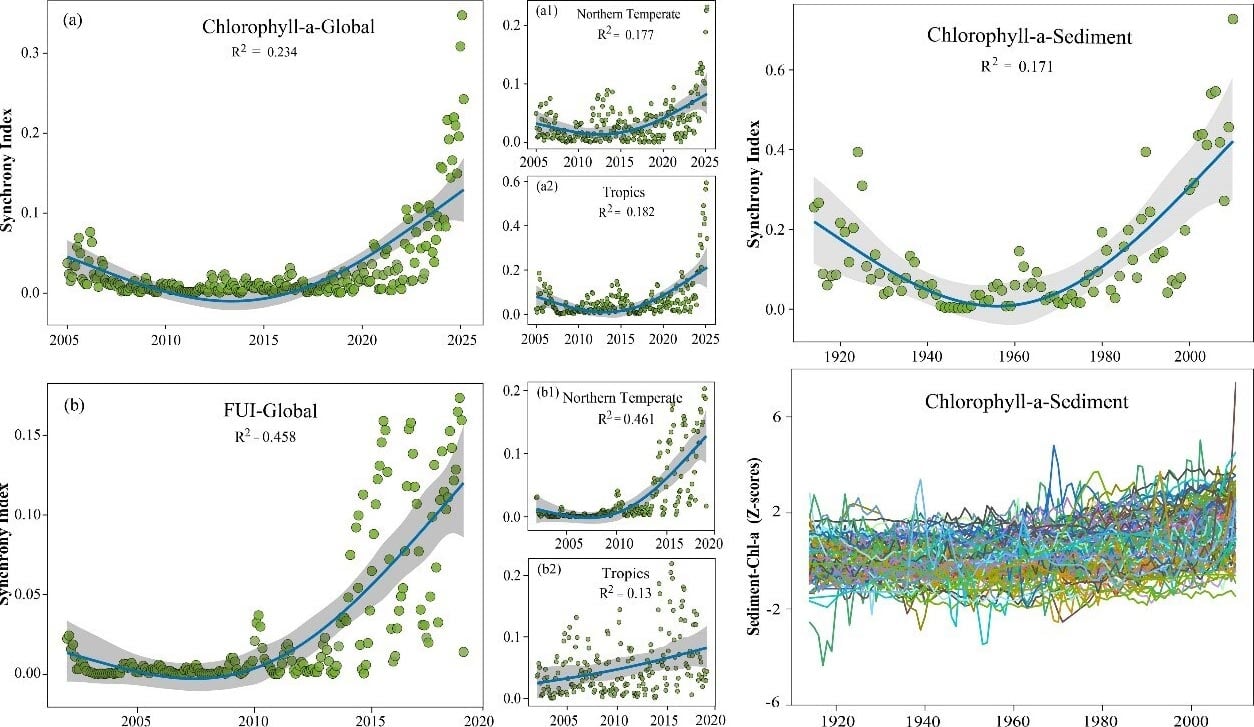
Lakes around the world are increasingly changing in step, a trend that could weaken a natural buffer against environmental disruption. A new study found that this synchronization has accelerated markedly since 2000.
The characteristics of a lake’s watershed, the land that drains into it, have historically helped buffer its ecosystem against broader environmental changes. Lakes fluctuated independently, a pattern known as “spatial asynchrony” that spread ecological disturbances across time and space.
Distant lakes are increasingly changing together
A team led by Prof. Ke Zhang of the Nanjing Institute of Geography and Limnology of the Chinese Academy of Sciences (NIGLAS) combined century-scale sediment records with continuous satellite observations from approximately 2,000 lakes. Alongside growing synchrony, the researchers found a significant decline in network modularity, meaning the lake network was becoming less divided into groups with distinct patterns of change.
The researchers used water clarity and phytoplankton biomass, the mass of microscopic organisms that use sunlight to make food, as proxies for lake metabolic activity. These indicators provide an indirect view of how lake ecosystems process energy and nutrients. Their growing synchrony suggests that the underlying carbon, nutrient, and biodiversity dynamics they reflect may also be becoming more synchronized.
The study attributes this shift to environmental telecoupling, connections through which climate extremes such as heatwaves and socioeconomic pressures link changes across distant regions. The authors describe this increasingly linked response to large-scale environmental change as a new hallmark of the Anthropocene, a term used to describe a world profoundly shaped by human activity.
Synchronized lakes could amplify global risks
Although lakes cover less than 2% of Earth’s surface, they help regulate global carbon and nutrient cycles and biodiversity. Losing the differences in how they respond to environmental pressures could therefore have consequences well beyond individual watersheds.
“This loss of buffering capacity transforms lakes from passive, regionally distinct systems into active amplifiers of global environmental risks. Synchronized lakes can concentrate biophysical fluxes, potentially triggering high-amplitude global pulses, such as simultaneous greenhouse gas emissions or widespread aquatic hypoxia, thereby exacerbating the triple planetary crisis,” Zhang said.
Aquatic hypoxia means a shortage of oxygen in the water. The “triple planetary crisis” refers to climate change, biodiversity loss, and pollution.
Managing lakes as a shared system
Water management has traditionally treated lakes as isolated local resources, creating what the researchers describe as a “scale mismatch” between governance and the processes shaping these ecosystems. Zhang and his co-authors propose treating interconnected lake networks as a dynamically coupled “Planetary Commons.” Their objective is to protect the local ecological processes that maintain variation across landscapes, without seeking to eliminate synchrony.
To put that idea into practice, the team introduced a framework called Strategic Planetary Lake Areas (SPLAs). By tracking large-scale measures of synchrony and modularity, policymakers could identify priority regions, including regional groups of lakes whose behavior is rapidly converging. These areas could become candidates for targeted polycentric governance, an approach involving multiple centers of decision-making.
“This research not only redefines the critical importance of inland waters in global change studies but also introduces a macroscale dimension to international sustainable development agendas,” Zhang said. “The work emphasizes that preserving the diversity of ecological responses is essential for maintaining long-term Earth-system stability in an increasingly interconnected world.”
Reference: “Global lake synchrony signals rising planetary-scale ecological coupling” by Ke Zhang, Yaoyao Han, Lindsey Gillson, Xiaoling Zhang, Suzanne McGowan, Michael E. Meadows, Yuan Jin, Luki Subehi, John A. Dearing, David P. Hamilton, Yan Zhao, Lian Pin Koh and David Taylor, 16 November 2026, Proceedings of the National Academy of Sciences.
DOI: 10.1073/pnas.2611874123
Never miss a breakthrough: Join the SciTechDaily newsletter.
Follow us on Google and Google News.