

New research suggests that the brain’s response to ultraprocessed foods may depend on age.
Just two weeks of eating ultraprocessed foods may be enough to alter how the developing brain responds to rewarding foods. In a Virginia Tech study, adults ages 18 to 21 showed reduced activity in a brain region involved in food rewards and decision-making after following a diet rich in ultraprocessed products. Participants aged 22 to 25 showed no significant changes.
“Among the younger participants, consuming a diet high in ultraprocessed foods for just two weeks was associated with decreased brain response to a rewarding food — a milkshake — in the orbitofrontal cortex,” said Emma Leslie, the study’s first author. The findings, published in the journal Obesity, suggest that sensitivity to ultraprocessed foods may vary even within a relatively narrow age range.
Why the Developing Brain May Be More Sensitive
The orbitofrontal cortex helps the brain evaluate rewards, make decisions, and regulate eating behavior. It is also among the last brain regions to fully mature, with development continuing into the mid to late 20s. “The orbitofrontal cortex is still undergoing development in all of our participants, but the younger you are, the more rapid the development,” said neuroscientist Alex DiFeliceantonio of Virginia Tech’s Fralin Biomedical Research Institute at VTC. “It’s also an area of the brain that has been shown to be active in people who are dieting or who are trying to reduce their craving for high-calorie foods.”
The brain findings build on earlier results from the same experiment. Researchers previously found that participants ages 18 to 21 consumed more calories after following the ultraprocessed diet, even when they were not hungry. Older participants did not show the same pattern. “This was especially interesting given our previous findings showing that younger participants also consumed more calories at a buffet-style meal after the ultraprocessed diet,” Leslie said. “Together, these findings raise interesting questions about whether certain developmental periods may be particularly sensitive to ultraprocessed food exposure.”
A Controlled Experiment Separates Processing From Nutrition
To investigate the effects of food processing, researchers recruited 22 adults ages 18 to 25, including seven who were 21 or younger. Each participant completed two dietary interventions lasting two weeks each, separated by a four-week break. The order of the diets was randomly assigned.
One diet contained no ultraprocessed foods, while the other supplied 81 percent of calories from ultraprocessed products. Both provided identical proportions of carbohydrates (50 percent), fat (35 percent), and protein (15 percent). Researchers also matched fiber, added sugar, saturated fat, sodium, energy density, and overall nutritional quality. Calorie intake was adjusted to maintain each participant’s weight, allowing the team to examine the effects of food processing without major differences in nutritional composition or weight change.
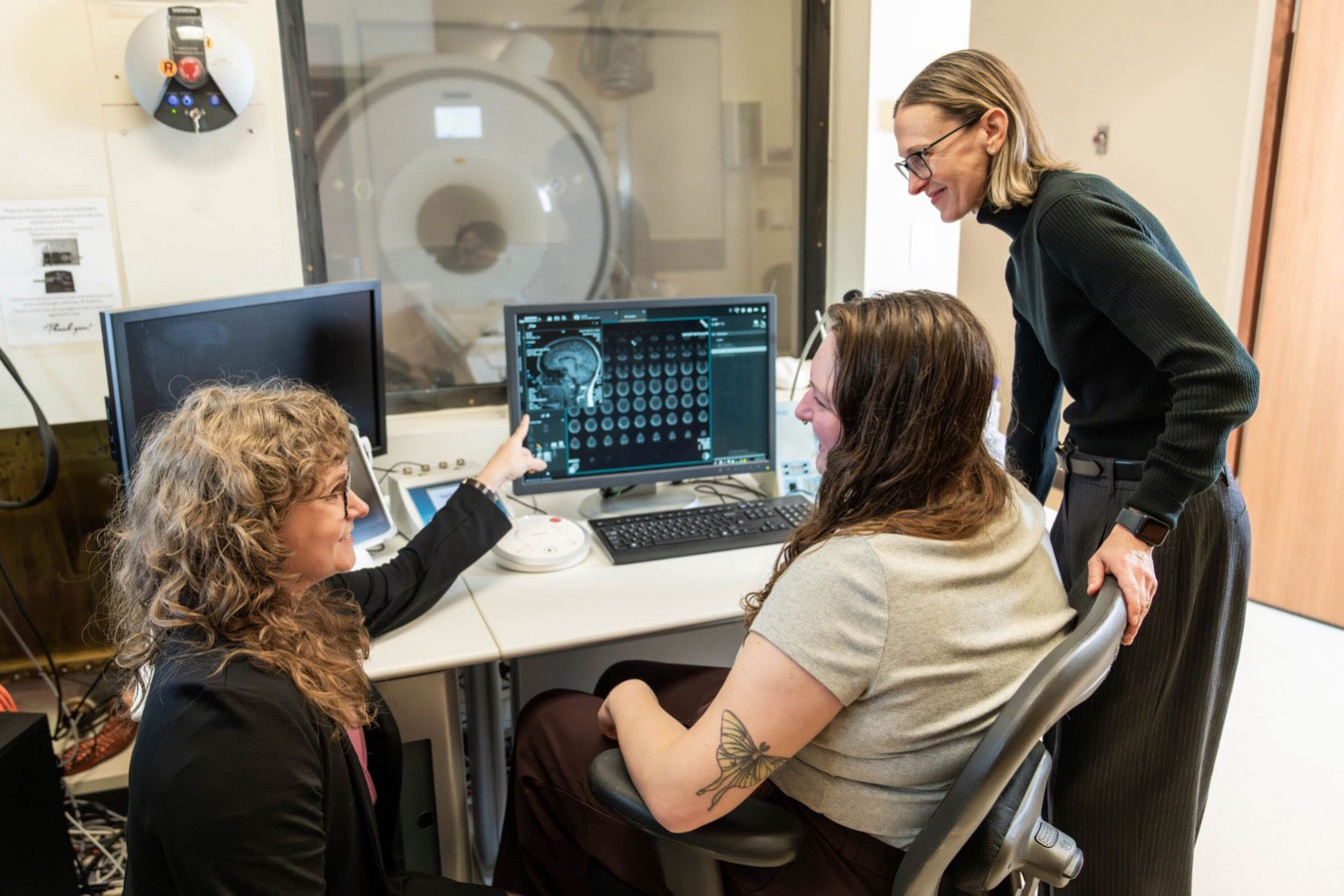
Before and after each dietary period, participants underwent functional magnetic resonance imaging (fMRI), which measures changes in blood oxygenation associated with brain activity. During the scans, a pump delivered either a highly processed milkshake or a tasteless solution through a straw-like device. Among younger participants, the orbitofrontal cortex responded less strongly to the milkshake after the ultraprocessed diet, but its response increased after the diet without ultraprocessed foods. Neither diet produced significant changes in the older group.
What Makes Ultraprocessed Foods Different?
Because the diets were closely matched nutritionally, conventional measures of dietary quality did not readily explain the observed differences. “The diets were matched on macronutrients, energy density, and micronutrients, so it’s something other than nutrition that is leading to changes in the brain and behavior,” DiFeliceantonio said. “Could it be additives? Chemicals produced during the processing itself? It’s an open question.”
Ultraprocessed foods often contain industrially manufactured ingredients or additives that are uncommon in home kitchens. Researchers have not determined whether particular ingredients, processing methods, or combinations of factors explain the brain changes observed in this trial. In the United States, ultraprocessed products account for more than half of young adults’ diets. Their consumption has also been associated with metabolic syndrome, cardiovascular problems, and other health conditions, although such associations do not establish that processing itself causes those outcomes.
How Food Processing Could Affect Eating Behavior
The orbitofrontal cortex is involved not only in evaluating food rewards but also in decisions that can influence when someone stops eating. “This study is important because you have this change in an area of the brain known to govern self-control and potentially put a stop to eating,” DiFeliceantonio said. “This is giving us insight into how ultraprocessed foods are affecting the bodies and brains of younger people, who might be especially vulnerable to their effects. And that’s important to know for things like dietary guidelines, doctor recommendations, and policy decisions.”
However, the researchers found no association between participants’ diet-related changes in brain responses and changes in how much they ate. Although younger adults showed differences in both measures, the study did not establish that altered orbitofrontal activity caused increased calorie consumption. The neurological and behavioral effects could involve separate or overlapping mechanisms that require further investigation.
Important Limitations and Unanswered Questions
The study included only 22 participants, and just seven belonged to the younger age group. The age-related findings were exploratory, meaning they were identified through analyses that require confirmation in larger studies. Researchers also cannot yet determine whether the observed brain changes persist, reverse after dietary changes, or influence eating habits over longer periods.
“The intervention lasted only two weeks, so we don’t know whether these changes persist over time or translate into long-term differences in eating behavior,” Leslie said. Future experiments will need to examine whether the effects remain after participants resume their usual diets and whether similar changes occur consistently across larger and more diverse populations.
Could Teenagers Be Even More Vulnerable?
DiFeliceantonio and Virginia Tech nutrition researcher Brenda Davy hope to extend their work to people younger than 18, whose brains are undergoing more rapid development. “In the U.S., adolescents have the poorest overall dietary quality and consume more ultraprocessed foods than any other age group,” Davy said. “Dietary habits are established early in life and typically persist into adulthood. We hope to continue to study how highly processed foods affect young people’s eating habits and health, which ultimately could impact dietary guidelines for this age group.”
Leslie, who completed her doctorate at Virginia Tech and continued her research as a postdoctoral associate at the University of Michigan, is also examining how ultraprocessed foods influence reward-related behavior. “I’ll be investigating the addictive potential of ultraprocessed foods and exploring food policy strategies to address challenges in the modern food environment,” Leslie said. “Ultimately, I hope this work will help identify who may be most vulnerable, why, and how we can better support healthier eating behaviors.”
Reference: “Effects of Controlled Diets High in and Free of Ultraprocessed Food on the Brain of Emerging Adults” by Emma H. Leslie, Maria L. M. Rego, Monica Ahrens, Wenjing Yu, Mary Elizabeth Baugh, Anastasia Groccia, Rhianna M. Sullivan, Han Lee, Ryann Kolb, Delbert L. Herald, Collin Gregg, Valisa E. Hedrick, Kevin P. Davy, Benjamin Katz, Brenda M. Davy and Alexandra G. DiFeliceantonio, 18 November 2026, Obesity.
DOI: 10.1002/oby.70341
The research was supported by a grant to DiFeliceantonio and Davy from the Eunice Kennedy Shriver National Institute of Child Health and Human Development, part of the National Institutes of Health. Leslie was also supported with an exercise health sciences graduate fellowship from Dr. Ray A. Gaskins.
Never miss a breakthrough: Join the SciTechDaily newsletter.
Follow us on Google and Google News.