
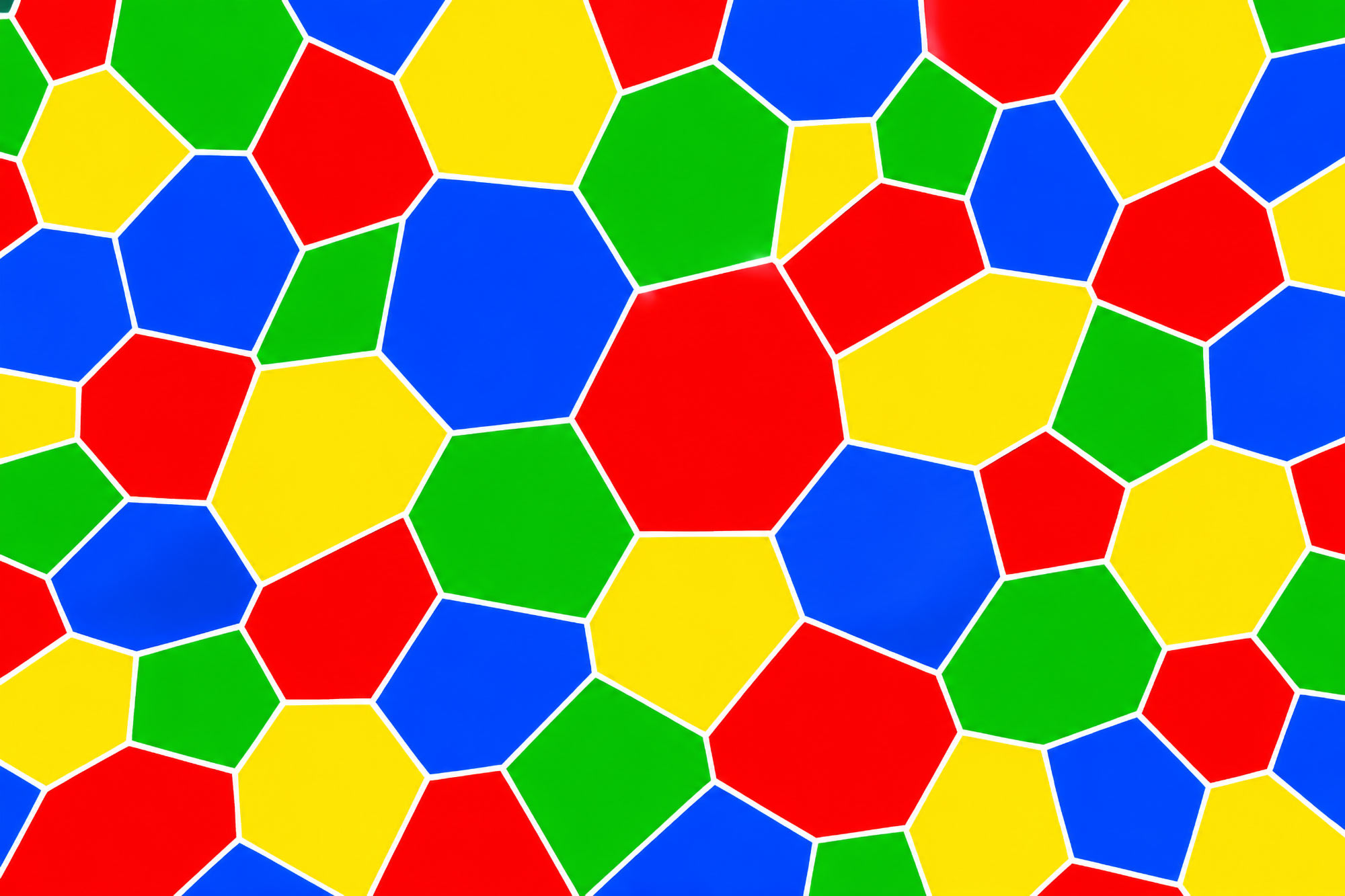
A faster way to color maps using only four colors has revealed hidden mathematical patterns that could help solve puzzles involving far more complex shapes.
In 1852, English mathematician Francis Guthrie noticed something curious while drawing a map of England’s counties. He needed only four colors to ensure that no two neighboring counties shared the same color. Could the same be true of every flat map, regardless of how complicated its borders were?
What seemed like a simple observation became one of the most famous problems in mathematics. It took 124 years to prove Guthrie right and another half century to discover the most efficient way to assign those four colors. In solving the latter problem, an international team of mathematicians has uncovered something previously unknown about the mathematical structures underlying maps.
A proof without a fast solution
The history of the Four Color Problem is filled with frustrated attempts. A proof presented in 1879 stood for 11 years before an error was discovered. When mathematicians finally succeeded in 1976, their proof was controversial because it relied heavily on computer calculations that were difficult for others to verify. A more accessible proof followed in 1997, although finding a suitable coloring for large maps remained computationally demanding.
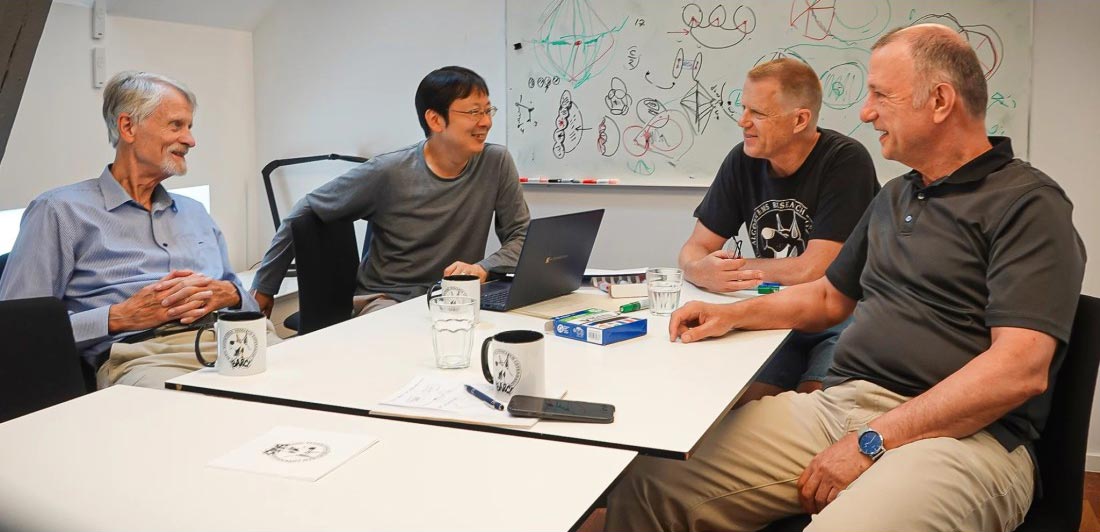
“The previous proofs showed that it is always possible to color a map using four colors. But they are not very good at actually finding the colors for each individual region on a map. The new algorithm is efficient and provides a much faster way of coloring,” says Professor Mikkel Thorup from the Department of Computer Science at the University of Copenhagen.
The achievement marks the first major breakthrough on the problem in nearly 30 years. The first part of the research paper was presented at FOCS’26, one of the world’s leading conferences in theoretical computer science, where it received the Best Paper Award.
Hidden patterns speed up coloring
Mathematicians can represent a flat map using what is known as a planar graph. Imagine replacing each country or county with a dot and drawing lines between those that share a border. The challenge then becomes assigning colors to the dots so that no two connected dots have the same color.
Within these graphs are small arrangements called reducible configurations, which allow mathematicians to simplify the coloring problem. The researchers discovered that graphs contain far more of these useful arrangements than anyone previously realized.
“Think of reducible configurations as handles you can grab hold on to start four coloring. We show that graphs do not contain just one handle, but an astonishing number of them. Nobody knew that before,” says Professor and co-author Carsten Thomassen from DTU.

Where earlier methods could often identify only one suitable starting point, the researchers can now work from many different parts of a graph. The advantage becomes particularly pronounced as maps grow larger.
“We have gone from what mathematicians call quadratic time to linear time. This means that if a map contains ten times as many regions, the computation only becomes about ten times slower. With the previous algorithm, it would have become about 100 times slower,” explains Carsten Thomassen.
A decade of mathematical obsession
Finding this solution occupied Thorup and his colleagues, including Thomassen, Ken-ichi Kawarabayashi, and Bojan Mohar, for around a decade. Thorup has a name for the peculiar fascination that has kept mathematicians returning to the problem for 174 years: “the four-color disease.”
“The disease is believing that there must be a simple proof for such a simple statement. I would guess that at least 1,000 mathematicians have caught the four-color disease, spending months trying to make it work but never quite succeeding. It is the disease people have suffered from since 1852.”
Thorup is equally candid about the appeal of devoting years to an apparently modest mathematical puzzle.
“Because mathematicians are slightly crazy. Most of what mathematicians work on consists of very nerdy questions. We become obsessed with this type of problem because it challenges the human intellect. And if we find the answer, we’ll probably also find answers to other mathematical puzzles,” says Mikkel Thorup.
Beyond the flat map
That possibility is already emerging from the team’s work. The abundance of reducible configurations could help mathematicians investigate more complex graphs and surfaces whose geometry differs considerably from that of an ordinary map.
“The remarkable thing is that because there are so many handles, the idea can also be applied to other kinds of surfaces besides a flat map. For example, surfaces with holes, such as a swim ring or a piece of Emmental cheese. That is why we believe the result could have significance far beyond the Four Color Theorem,” says Mikkel Thorup.
Reference: “The Four Color Theorem with Linearly Many Reducible Configurations and Near-Linear Time Coloring” by Yuta Inoue, Ken-ichi Kawarabayashi, Atsuyuki Miyashita, Bojan Mohar, Carsten Thomassen and Mikkel Thorup, September 30, 2026, arXiv.
DOI: 2603.24880
Never miss a breakthrough: Join the SciTechDaily newsletter.
Follow us on Google and Google News.