
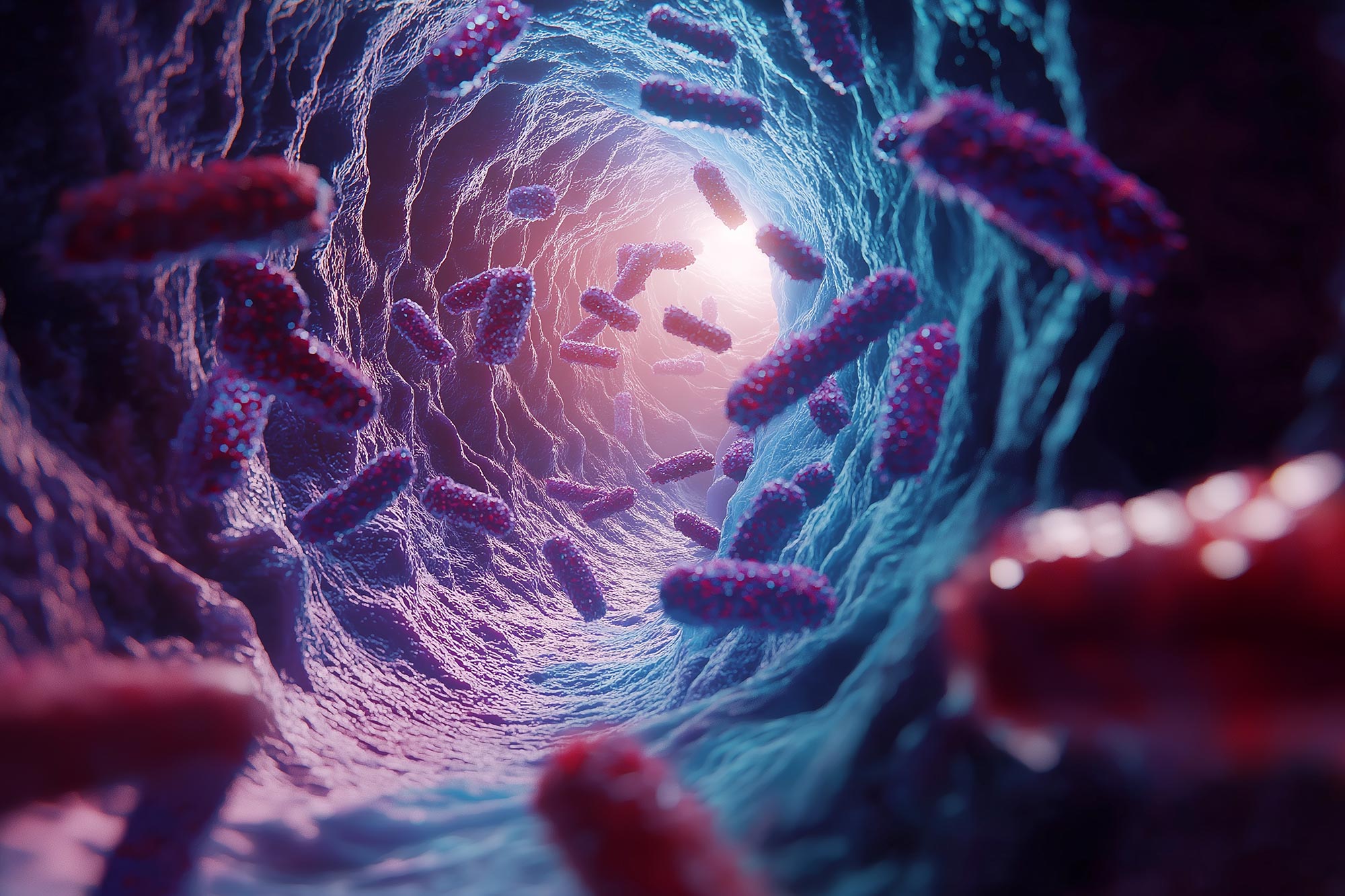
Many gut viruses were found at lower levels in people with irritable bowel syndrome, offering new clues to a poorly understood condition that affects roughly one in ten people.
Scientists have identified more than 116,000 groups of viruses living in the human gut, over 99% of which had no close match in the largest existing catalog of gut viruses. These largely unexplored microbes could offer new clues to how the digestive system functions and why it changes in people with conditions such as irritable bowel syndrome (IBS).
Research into the gut microbiome has traditionally focused on bacteria, leaving much less understood about bacteriophages, viruses that infect bacteria. Scientists from King’s College London, Helmholtz Munich, and the University of Nottingham are now filling that gap with two studies published on November 17, 2026, in Nature Communications and Gut.
Professor Ana Valdes and Dr. Afroditi Kouraki from the University of Nottingham said, “For a long time the viral part of the gut microbiome has been a kind of dark matter: we knew it was there but couldn’t see it. Advances in sequencing and computational methods mean we can now start to map it properly, and this study shows just how much has been hidden.”
The hidden ties between viruses and bacteria
For the Nature Communications study, researchers analyzed genetic material from stool samples collected from more than 1,000 participants in TwinsUK, the largest twin registry in the United Kingdom. Using data on gut bacteria, health measurements, and diet, they examined how populations of viruses and bacteria varied together. Certain viruses were consistently more abundant alongside particular bacteria, while others showed the opposite pattern.
Dr. Panayiotis Louca, a research associate at King’s College London who led the study, said, “Gut viruses are difficult to study, so most of what we found simply isn’t in existing catalogs. What stands out is how closely they track with gut bacteria and with the chemicals those bacteria produce. We can’t yet say whether the viruses are driving that, and testing it is our next step.”
Studying twins also allowed researchers to estimate how much genetics and the environment shape the gut’s viral community. Genetic factors accounted for an estimated 47% of the variation in overall viral diversity, although most individual viral populations appeared to be influenced primarily by environmental factors.
The researchers also discovered a small group of viruses carrying genes linked to harmful bacterial behavior. These viruses were more commonly found alongside bacteria that can sometimes cause infections and less commonly alongside bacteria that break down dietary fiber.
50 viral groups linked to IBS
Such relationships could be relevant to IBS, a condition that affects around 10% of the population and can significantly disrupt daily life. Its underlying causes remain poorly understood.
In the second study, published in Gut, researchers used TwinsUK data to identify 50 viral groups associated with IBS, most of which were less abundant in people with the condition. Relationships between bacteria and viruses also differed, with many viruses infecting bacteria previously linked to IBS. This suggests that the condition may involve changes across the wider microbial community rather than in bacteria alone.
Senior author Dr. Cristina Menni, who leads the metabolomics research group at the Department of Twin Research, Ageing and Genomic Epidemiology at King’s College London, said, “Our research highlights that to fully understand the gut microbiome and its links to health and disease, we need to look beyond bacteria and consider the viruses that live alongside them. We reveal a fascinating and largely unexplored dimension of the gut microbiome—discovering that viruses are not only closely associated with bacterial communities, but also with the metabolites that connect the microbiome to our health. This opens exciting new avenues for understanding how the gut ecosystem works.”
Can viruses alter bacterial activity?
Future research will examine whether gut viruses actively influence bacterial metabolism and how these interactions change in health and disease. Understanding these relationships could eventually help researchers develop better biological markers and treatments for IBS, as well as more personalized approaches to gut health.
Dr. Louca added: “The study is observational, so it cannot show that the viruses cause these effects, but it provides greater understanding of a largely unexplored area of the human gut. It would also be beneficial to replicate the study on a more diverse cohort, as participants were mostly older women of European ancestry.”
References:
“Population-level characterization of the human gut phageome and its association with microbial metabolites” by Panayiotis Louca, Mohammadali Khan Mirzaei, Afroditi Kouraki, Erfan Khamespanah, Yu Lin, Xue Peng, Robert Pope, Alessia Visconti, Francesco Asnicar, Daniel Kirk, Ricardo Costeira, Nicola Segata, Mario Falchi, Jordana T. Bell, Tim D. Spector, Lindsey A. Edwards, Li Deng, Ana M. Valdes and Cristina Menni, 17 November 2026, Nature Communications.
DOI: 10.1038/s41467-026-79230-0
“Large-scale shotgun metagenomic analysis of gut bacteria–phage interactions in IBS” by Daniel Kirk, Erfan Khamespanah, Panayiotis Louca, Alessia Visconti, Robert Pope, Francesco Asnicar, Sarah E Berry, Jonathan Wolf, Nicola Segata, Tim D Spector, Mario Falchi, Frances M K Williams, Mohammadali Khan Mirzaei, Li Deng and Cristina Menni, 16 November 2026, Gut.
DOI: 10.1136/gutjnl-2026-338807
This research was funded by the Chronic Disease Research Foundation (CDRF) and in part by the Wellcome and Medical Research Council (MRC).
Never miss a breakthrough: Join the SciTechDaily newsletter.
Follow us on Google and Google News.