
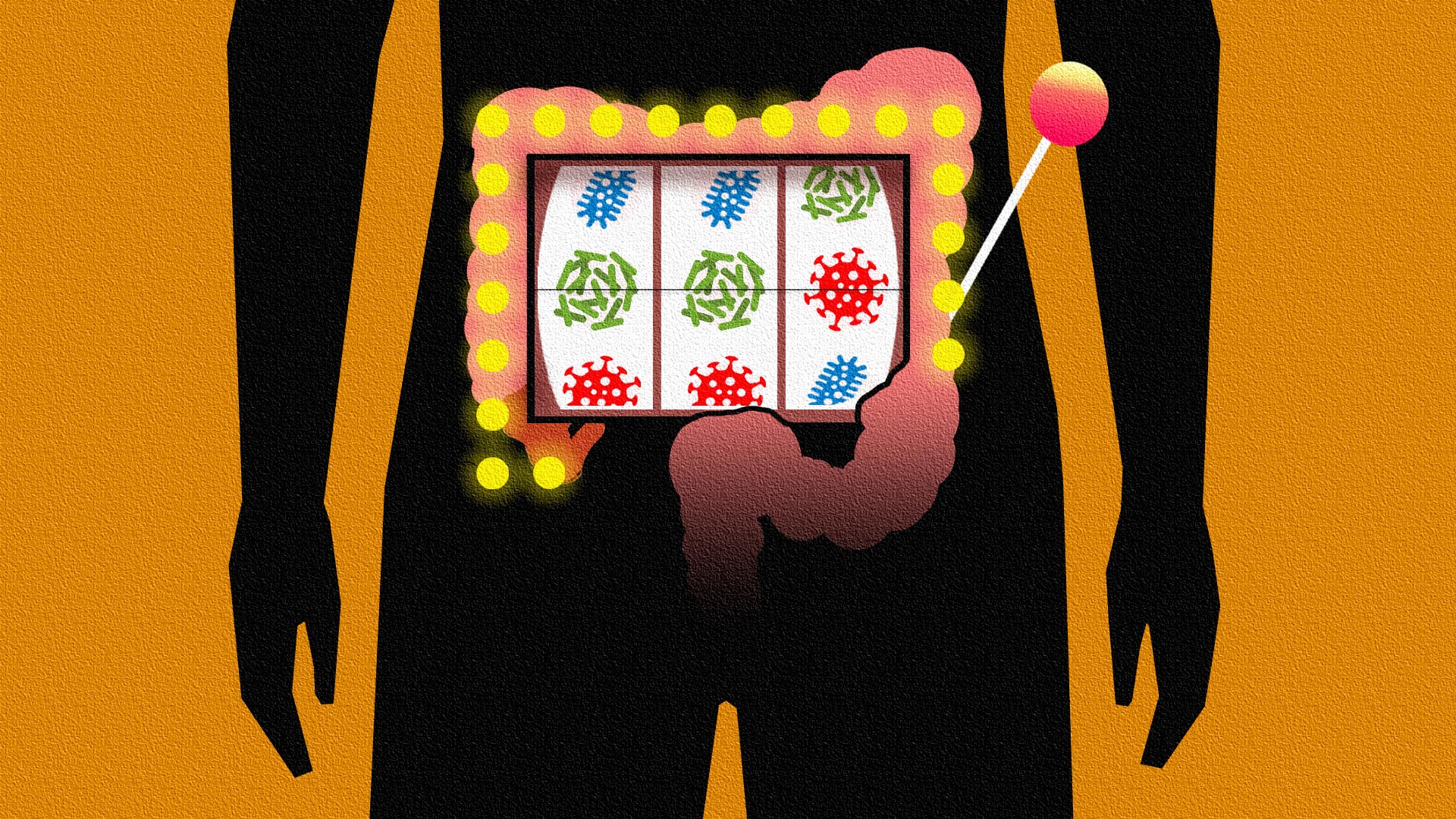
The role of chance in microbiome composition.
The gut microbiome is an ecosystem of hundreds to thousands of microbial species living within the human body. These populations affect our health, fertility, and even our longevity. But how do they get there in the first place?
New collaborative work led by Carnegie’s William Ludington reveals crucial details about how the bacterial communities that comprise each of our individual gut microbiomes are acquired. These findings, published in the Proceedings of the National Academy of Sciences, have major implications for treatments such as fecal transplants and probiotic administration.
Diversity and Chance in Microbiome Formation
“There is a huge amount of variation in microbiome composition between individuals,” Ludington explained. “For example, if you look at the sum total of all of the bacterial species that are adapted to live in the gastrointestinal systems of humans, most of these are not present in a majority of people. That’s how incredibly diverse these gut microbial populations are.”
A combination of elements, including genetics, diet, and environment contribute to the differences between our microbiomes. But there isn’t a direct line between these inputs and the species that successfully colonize our guts. There’s an element of chance at play each time we are exposed to a new microbe as to whether it will be acquired and become a member of our gut ecosystem. Ludington and his collaborators set out to understand the factors that shape the odds of this colonization process.
A Novel Ecological Model
Although many researchers have studied microbiome compositions in natural populations, there have been few attempts to use a controlled environment to reveal the process by which new species successfully join the gut microbial ecosystem. Ludington and his collaborators—Eric Jones and David Sivak of Simon Fraser University and Jean Carlson of UC Santa Barbara—developed a new ecological model to understand how we acquire the specific mix of microbes that are individual to our own particular gut communities.
Working in the comparatively much less complicated microbiomes of fruit flies, the team showed that exposure to a microbial species does not guarantee its successful incorporation into the microbiome ecosystem. They found that the state of the microbiome, and interactions between existing microbiome member species, sets the odds for whether a newly encountered bacteria is added into the mix.
“Even among genetically identical flies that lived in the same housing and were fed the same diets, we saw variations in microbiome composition,” Sivak said.
Mathematical Models and Microbiome Dynamics
The researchers then used these results to build mathematical models that could probe increasingly complex scenarios by which new microbiome species could be acquired, leading to their breakthrough understanding of the community factors that shape membership in the microbiome ecosystem.
“Think of microbiome composition as a big party where the social dynamics determine who leaves early and who stays until dawn,” said Ludington.
Added Jones, the paper’s first author: “Bacterial colonization depends on a number of complicated factors that we’re just starting to understand. We showed, for example, that some groups of species facilitate each other’s colonization and are therefore more likely to coexist.”
These group interactions have exciting implications for how microbiomes are transmitted between individuals, including how medical professionals might drive a person’s microbiome towards a desired composition.
“The beauty of the mathematical approach we deployed is that it acknowledges that colonization is a roll of the dice, but we are now able to attribute the weighting of the dice to biological interactions with a molecular basis that has been honed by evolution,” said Carlson.
The team’s findings provide a framework for quantitatively examining the mechanisms that therapies such as fecal transplants and probiotics depend upon, advancing toward the eventual goal of personalized microbiome medicine.
Reference: “Stochastic microbiome assembly depends on context” by Eric W. Jones, Jean M. Carlson, David A. Sivak and William B. Ludington, 8 February 2022, Proceedings of the National Academy of Sciences.
DOI: 10.1073/pnas.2115877119
This work was supported by the Banting Postdoctoral Fellowship, the Pacific Institute for the Mathematical Sciences Postdoctoral Fellowship, the David and Lucile Packard Foundation, the Institute for Collaborative Biotechnologies, the U.S. Army Research Office, a Natural Sciences and Engineering Research Council of Canada Discovery Grant, the Canada Research Chairs program, a National Institutes of Health grant, National Science Foundation Integrative Organismal Systems award, the Carnegie Institution for Science endowment, and a Carnegie Institution of Canada grant.
Never miss a breakthrough: Join the SciTechDaily newsletter.
Follow us on Google and Google News.
1 Comment
It’s great to see the many studies on “the gut”! More and more we realize that we, personally, can change our health, our lives, by paying attention to our gut. Personally I prevented colon cancer by taking a parasite cleanse, and cured my hands of a bad psoriasis by changing my diet, no sugar, no breads or pasta in 3 weeks! I am hoping doctors will understand this instead of prescribing medicines that just treat the symptoms.