
Close Menu
    Facebook X (Twitter) Instagram
    SciTechDaily
    • Biology
    • Chemistry
    • Earth
    • Health
    • Physics
    • Science
    • Space
    • Technology
    Facebook X (Twitter) Pinterest YouTube RSS
    SciTechDaily
    Home»Science»Gentle Giants of Chajnantor – ALMA Antenna Transporters
    Science

    Gentle Giants of Chajnantor – ALMA Antenna Transporters

    By Richard Hook, ESOJune 12, 2018No Comments2 Mins Read
    Facebook Twitter Pinterest Telegram LinkedIn WhatsApp Email Reddit
    Share
    Facebook Twitter LinkedIn Pinterest Telegram Email Reddit
    ALMA Transporters
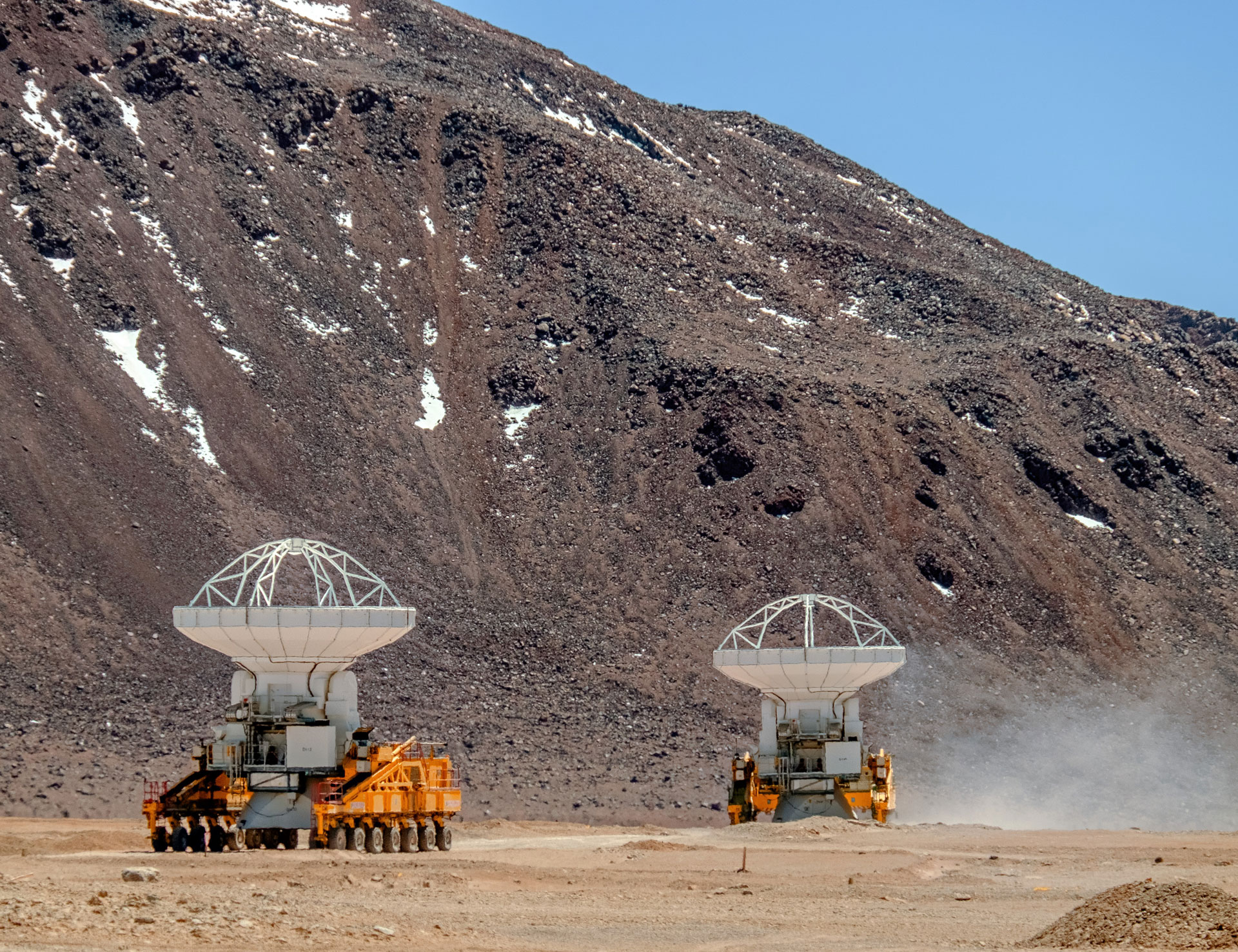
    ALMA Transporters possess impressive features; at 20 meters (66 feet) long, 10 meters (33 feet) wide, and with 28 wheels each, these machines are built not just to survive in the harsh environment of the Atacama Desert, but to thrive in it! Credit: A. Russell/ESO

    Many telescopes are formed of multiple mirrors or antennas, not just one. ESO’s Very Large Telescope (VLT), located at ESO’s Paranal Observatory in Chile, is a prime example. The VLT comprises four main telescopes, and four smaller, movable auxiliary telescopes — eight individual structures in total. However, even this is dwarfed by the Atacama Large Millimeter/submillimeter Array (ALMA), which sits atop the Chajnantor plateau in the Chilean Andes — and comprises a whopping 66 antennas!

    Even individually, the ALMA antennas are impressive in size. The Chajnantor plateau itself is also located at an altitude of 5,000 meters (16,000 feet), with its Operations Support Facility (OSF) at a (still considerable) altitude of 2,900 meters (9,500 feet). As the antennas are not built up on the plateau, this required an entirely new approach to transporting each of the constituent antennas from the OSF up to Chajnantor. Enter Otto and Lore!

    Designed and built especially for the job, Otto and Lore are the names of the two ALMA transporters — the two yellow vehicles pictured here. The duo possess impressive features; at 20 meters (66 feet) long, 10 meters (33 feet) wide, and with 28 wheels each, these machines are built not just to survive in the harsh environment of the Atacama Desert, but to thrive in it! While rugged and powerful, they also possess a delicate touch, and are able to position each antenna with astonishing millimeter accuracy.

    Never miss a breakthrough: Join the SciTechDaily newsletter.
    Follow us on Google and Google News.

    Antenna European Southern Observatory
    Share. Facebook Twitter Pinterest LinkedIn Email Reddit

    Related Articles

    New Exoplanet-Hunting Facility (NGTS) Achieves First Light

    Leave A Reply Cancel Reply

    • Facebook
    • Twitter
    • Pinterest
    • YouTube

    Don't Miss a Discovery

    Subscribe for the Latest in Science & Tech!

    Trending News

    Black Hole Collisions May Follow a Surprisingly Simple Rule

    The Eye Has a Hidden Cleanup System and Scientists Just Discovered It

    The Truth About Vikings Is More Complicated Than Museums Admit

    New Catalyst Turns Stubborn Plant Waste Into Valuable Chemicals

    Quantum Gravity May Be Far Less Quantum Than Physicists Expected

    New Tool Supercharges Immunotherapy Against Prostate Cancer

    The Hidden Cancer Risk of Ketogenic Diets

    One Asteroid Collision May Have Rocked Earth, Mars, and the Moon

    Follow SciTechDaily
    • Facebook
    • Twitter
    • YouTube
    • Pinterest
    • Newsletter
    • RSS
    SciTech News
    • Biology News
    • Chemistry News
    • Earth News
    • Health News
    • Physics News
    • Science News
    • Space News
    • Technology News
    Recent Posts
    • Scientists Crack the Code for Making “Impossible” Nanocrystals
    • Earth’s Hidden Thermostat Has Regulated Climate for 60 Million Years
    • This 518-Million-Year-Old Creature Reveals How Spiders Got Their Bite
    • Forgotten for 20 Years, This 240-Million-Year-Old Fossil Reveals a New Reptile Species
    • 190-Year-Old Museum Specimen Solves a Pangolin Mystery
    Copyright © 1998 - 2026 SciTechDaily. All Rights Reserved.
    • Science News
    • About
    • Contact
    • Editorial Board
    • Privacy Policy
    • Terms of Use

    Type above and press Enter to search. Press Esc to cancel.