

The weird shapes and colors of the tiny Martian moons Phobos and Deimos have inspired a long-standing debate about their origins.
The dark faces of the moons resemble the primitive asteroids of the outer solar system, suggesting the moons might be asteroids caught long ago in Mars’ gravitational pull. But the shapes and angles of the moons’ orbits do not fit this capture scenario.
A fresh look at 20-year-old data from the Mars Global Surveyor mission lends support to the idea the moons of Mars formed after a large impact on the planet threw a lot of rock into orbit, according to a new study in the Journal of Geophysical Research: Planets, a publication of the American Geophysical Union.
The dataset held unplumbed clues to the stuff Phobos is made of, which may be more similar to the crust of the Red Planet than it appears, according to the study’s authors.
“The fun part for me has been taking a poke at some of the ideas out there using an old dataset that’s has been underutilized,” said Tim Glotch, a geoscientist at Stony Brook University in New York and the lead author of the new study.
Marc Fries, a planetary scientist and curator of cosmic dust at NASA’s Johnson Space Center, who was not involved in the new study, said the inability to explain the genesis of two moons around a neighboring planet is a glaring shortcoming in scientists’ understanding of moon formation. Clearing it up will help with interpretations of how other moons and planets formed in our solar system and beyond. The new study does not clinch the mystery, but it is a step in the right direction, he said.
“The issue of the origins of Phobos and Deimos is a fun sort of mystery, because we have two competing hypotheses that cannot both be true,” Fries said. “I would not consider this to be a final solution to the mystery of the moons’ origin, but it will help keep the discussion moving forward.”
Dark objects
The debate over the origin of Mars’ moons has split scientists for decades, since the early days of planetary science. In visible light, Phobos and Deimos look much darker than Mars, lending weight to the adoption hypothesis.
Scientists study the mineral composition of objects by breaking the light they reflect into component colors with a spectrophotometer, creating distinctive visual “fingerprints.” By comparing the spectral fingerprints of planetary surfaces to a library of spectra for known materials, they can infer the composition of these distant objects. Most of the research into the composition of asteroids has examined their spectra in visible light and in near-infrared light, which is just beyond human vision on the red side of the visible spectrum.
In visible and near-infrared light, Phobos and D-class asteroids look much the same—that is, both their spectra are nearly featureless because they are so dark. D-class asteroids are nearly black as coal because, like coal, they contain carbon. This dark aspect of Phobos led to the hypothesis that the moon is a captive asteroid that flew a little too close to Mars.
But scientists looking at the orbits of Mars’ moons argued they could not have been captured. These scientists believe the moons must have formed at the same time as Mars, or resulted from a massive impact on the planet during its formative millennia.
“If you talk to the people who are really good at orbital dynamics and figuring out why certain bodies orbit the way they do, they say that, given the inclination and the details of Phobos’ orbit, it’s almost impossible that it was captured. So you have the spectroscopists saying one thing and the dynamicists saying something else,” Glotch said.
Heat fingerprints
Glotch decided to look at the problem in a different light: the mid-infrared, which is in the same range as body temperature. He looked at the heat signature of Phobos captured in 1998 by an instrument he describes as a fancy thermometer carried on the Mars Global Surveyor. The robotic spacecraft spent most of its lifetime looking down at Mars, but took a quick look at Phobos when it passed near the moon before settling into a closer orbit around the planet.
Heat energy, like visible light, can be split into a spectrum of “colors.” Even objects that look black in visible light may glow in a distinctive infrared spectrum. Although Phobos is very cold, its heat spectrum has a discernible signature.
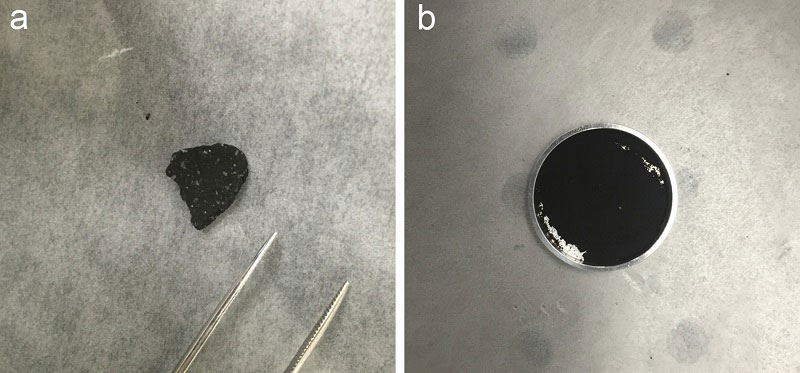
Glotch and his students compared the mid-infrared spectra of Phobos glimpsed by the Mars Global Explorer to samples of a meteorite that fell to Earth near Tagish Lake, British Columbia, which some scientists have suggested is a fragment of a D-class asteroid, and other rock types. In the lab, they subjected their samples to Phobos-like conditions of cold vacuum, heating them from above and below to simulate the extreme changes in temperature from the sunny to the shady sides of airless objects in space.
“We found, at these wavelength ranges, the Tagish Lake meteorite doesn’t look anything like Phobos, and in fact what matches Phobos most closely, or at least one of the features in the spectrum, is ground-up basalt, which is a common volcanic rock, and it’s what most of the Martian crust is made out of,” Glotch said. “That leads us to believe that perhaps Phobos might be a remnant of an impact that occurred early on in Martian history.”
Planetary crust baked in?
The new study does not argue Phobos is made entirely of material from Mars, but the new results are consistent with the moon containing a portion of the planet’s crust, perhaps as an amalgamation of debris from the planet and the remnants of the impacting object.
Fries, the scientist who was not involved in the new study, said the Tagish Lake meteorite is unusual, and perhaps not the best example of a D-class asteroid available for a compelling comparison with Phobos. Fries added the new study was unlikely to be able to produce a definitive answer because Phobos is subject to space weathering, which affects its reflectance spectrum and is difficult to replicate in the lab.
But Fries said he found it interesting that a mix of basalt and carbon-rich material made an appropriate match for Phobos. Another possibility is that carbon-rich space dust in the vicinity of Mars has collected on the close-orbiting moons, darkening their surfaces, he said.
Scientists may get their answer to Phobos’ origins in the next couple of years, if the Martian Moon eXploration spacecraft and the OSIRIS-Rex and Hayabusa2 asteroid explorers complete their missions to collect samples and return them to Earth for analysis. Hyabusa2 landed two mini robots on the asteroid known as Ryugu on September 21.
“The really cool thing is that this is a testable hypothesis, because the Japanese are developing a mission called MMX that is going to go to Phobos, collect a sample and bring it back to Earth for us to analyze,” Glotch said.
Reference: Timothy D. Glotch, et al., “MGS‐TES spectra suggest a basaltic component in the regolith of Phobos” by Timothy D. Glotch, Christopher S. Edwards, Mehmet Yesiltas, Katherine A. Shirley, Dylan S. McDougall, Alexander M. Kling, Joshua L. Bandfield and Christopher D. K. Herd, 24 September 2018, Journal of Geophysical Research: Planets.
DOI: 10.1029/2018JE005647
Never miss a breakthrough: Join the SciTechDaily newsletter.
Follow us on Google and Google News.