
Close Menu
    Facebook X (Twitter) Instagram
    SciTechDaily
    • Biology
    • Chemistry
    • Earth
    • Health
    • Physics
    • Science
    • Space
    • Technology
    Facebook X (Twitter) Pinterest YouTube RSS
    SciTechDaily
    Home»Space»Hubble Telescope Views a Glittering Ball of Stars
    Space

    Hubble Telescope Views a Glittering Ball of Stars

    By MATHIAS JÄGER, ESA/HUBBLEOctober 1, 2018No Comments2 Mins Read
    Facebook Twitter Pinterest Telegram LinkedIn WhatsApp Email Reddit
    Share
    Facebook Twitter LinkedIn Pinterest Telegram Email Reddit
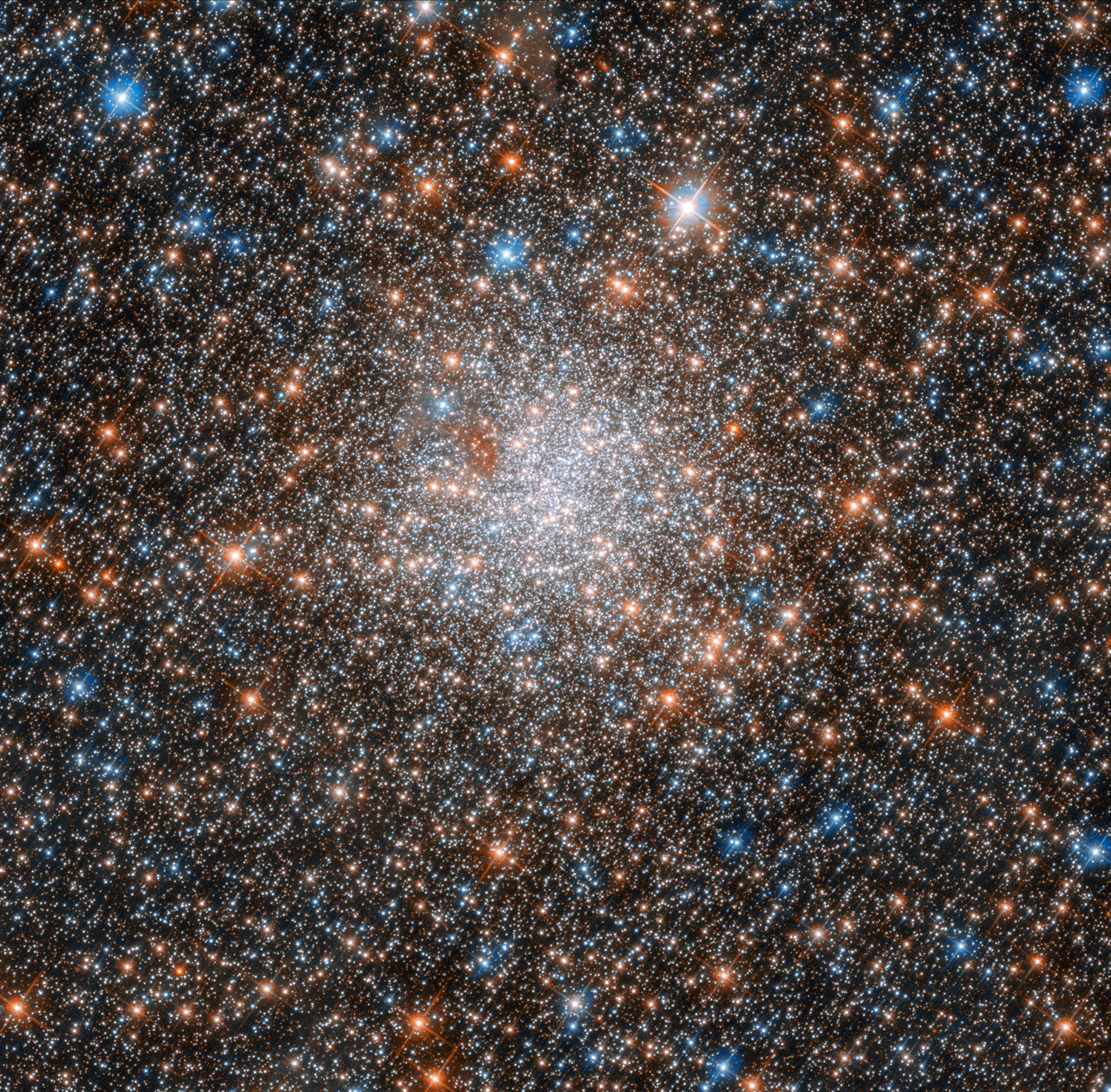
    Hubble Views Globular Cluster NGC 1898
    The globular cluster NGC 1898, captured by Hubble’s Advanced Camera for Surveys (ACS) and Wide Field Camera 3 (WFC3), is located at the center of the Large Magellanic Cloud, one of our nearest cosmic neighbors. Credit: ESA/Hubble & NASA

    This glittering ball of stars is the globular cluster NGC 1898, which lies towards the center of the Large Magellanic Cloud — one of our closest cosmic neighbors. The Large Magellanic Cloud is a dwarf galaxy that hosts an extremely rich population of star clusters, making it an ideal laboratory for investigating star formation.

    Discovered in November 1834 by British astronomer John Herschel, NGC 1898 has been scrutinized numerous times by the NASA/ESA Hubble Space Telescope. Today we know that globular clusters belong to the oldest known objects in the Universe and that they are relics of the first epochs of galaxy formation. While we already have a pretty good picture on the globular clusters of the Milky Way — still with many unanswered questions — our studies on globular clusters in nearby dwarf galaxies just started. The observations of NGC 1898 will help to determine if their properties are similar to the ones found in the Milky Way, or if they have different features, due to being in a different cosmic environment.

    This image was taken by Hubble’s Advanced Camera for Surveys (ACS) and Wide Field Camera 3 (WFC3). The WFC3 observes light ranging from near-infrared to near-ultraviolet wavelengths, while the ACS explores the near-infrared to the ultraviolet.

    Never miss a breakthrough: Join the SciTechDaily newsletter.
    Follow us on Google and Google News.

    Astronomy Hubble Space Telescope
    Share. Facebook Twitter Pinterest LinkedIn Email Reddit

    Related Articles

    A Morphing Spiral Galaxy Amongst Friends

    Hubble Views Magnificent Lopsided Galaxy NGC 2276

    Hubble Captures Fantastic Detail of Eponymous Spiral Galaxy NGC 691

    Spectacular Image Captured by Hubble Shows a Strangely Contorted Spiral Galaxy

    A Distant Spiral in Virgo: Extraordinary Detail Seen in a Galaxy 150 Million Light-Years Away From Earth

    Magnetic Monsters: Hubble Tracks Down Location of Mysterious Radio Signals From Intergalactic Space

    A Menagerie of Galaxies: Hubble Captures a Cluster With Galaxies of All Shapes and Sizes

    How Habitable Are Planets That Orbit Red Dwarfs – The Most Common Type of Stars in the Galaxy?

    Cosmic Silver Lining: Hubble Spots V565 Surrounded by Four Prominent Diffraction Spikes

    Leave A Reply Cancel Reply

    • Facebook
    • Twitter
    • Pinterest
    • YouTube

    Don't Miss a Discovery

    Subscribe for the Latest in Science & Tech!

    Trending News

    Earth’s Oceans Were Slowly Suffocating Millions of Years Before a Devastating Mass Extinction

    Why Are Men Twice As Likely To Develop Parkinson’s? Scientists Discover a Hidden Clue in the Brain

    Scientists Finally Identify Mysterious Creature Nearly 90 Years After It Was First Found

    Einstein’s Equations Reveal an Unusual New Way Space-Time Can Transfer Energy

    Scientists Say This Medication Could Be the Next “Wonder Drug”

    A Mysterious Explosion in Space Just Did Something Scientists Didn’t Expect

    A Nutrient Found in Red Meat Could Make Dangerous Inflammation Even Worse

    Scientists Discover How Dead Stars Could Break One of Physics’ Most Famous Limits

    Follow SciTechDaily
    • Facebook
    • Twitter
    • YouTube
    • Pinterest
    • Newsletter
    • RSS
    SciTech News
    • Biology News
    • Chemistry News
    • Earth News
    • Health News
    • Physics News
    • Science News
    • Space News
    • Technology News
    Recent Posts
    • New Research Reveals That Honey Beehives Act as a Living Immune System
    • “Schrödinger’s Penguin”: Scientists Discover a Bizarre Paradox Among Endangered Penguins
    • A Devastating Disease Is Threatening the World’s Chocolate Supply – but Scientists May Have Found the Answer
    • Researchers Discover Earth May Have Made Its Own Water 4.5 Billion Years Ago
    • NASA’s Parker Solar Probe Discovers Something Unexpected Hidden in the Chaos of Space
    Copyright © 1998 - 2026 SciTechDaily. All Rights Reserved.
    • Science News
    • About
    • Contact
    • Editorial Board
    • Privacy Policy
    • Terms of Use

    Type above and press Enter to search. Press Esc to cancel.