
Close Menu
    Facebook X (Twitter) Instagram
    SciTechDaily
    • Biology
    • Chemistry
    • Earth
    • Health
    • Physics
    • Science
    • Space
    • Technology
    Facebook X (Twitter) Pinterest YouTube RSS
    SciTechDaily
    Home»Space»Hubble Space Telescope Captures the Ghost of Cassiopeia
    Space

    Hubble Space Telescope Captures the Ghost of Cassiopeia

    By Ray Villard, Space Telescope Science InstituteOctober 26, 2018No Comments2 Mins Read
    Facebook Twitter Pinterest Telegram LinkedIn WhatsApp Email Reddit
    Share
    Facebook Twitter LinkedIn Pinterest Telegram Email Reddit
    Hubble Captures the Ghost of Cassiopeia
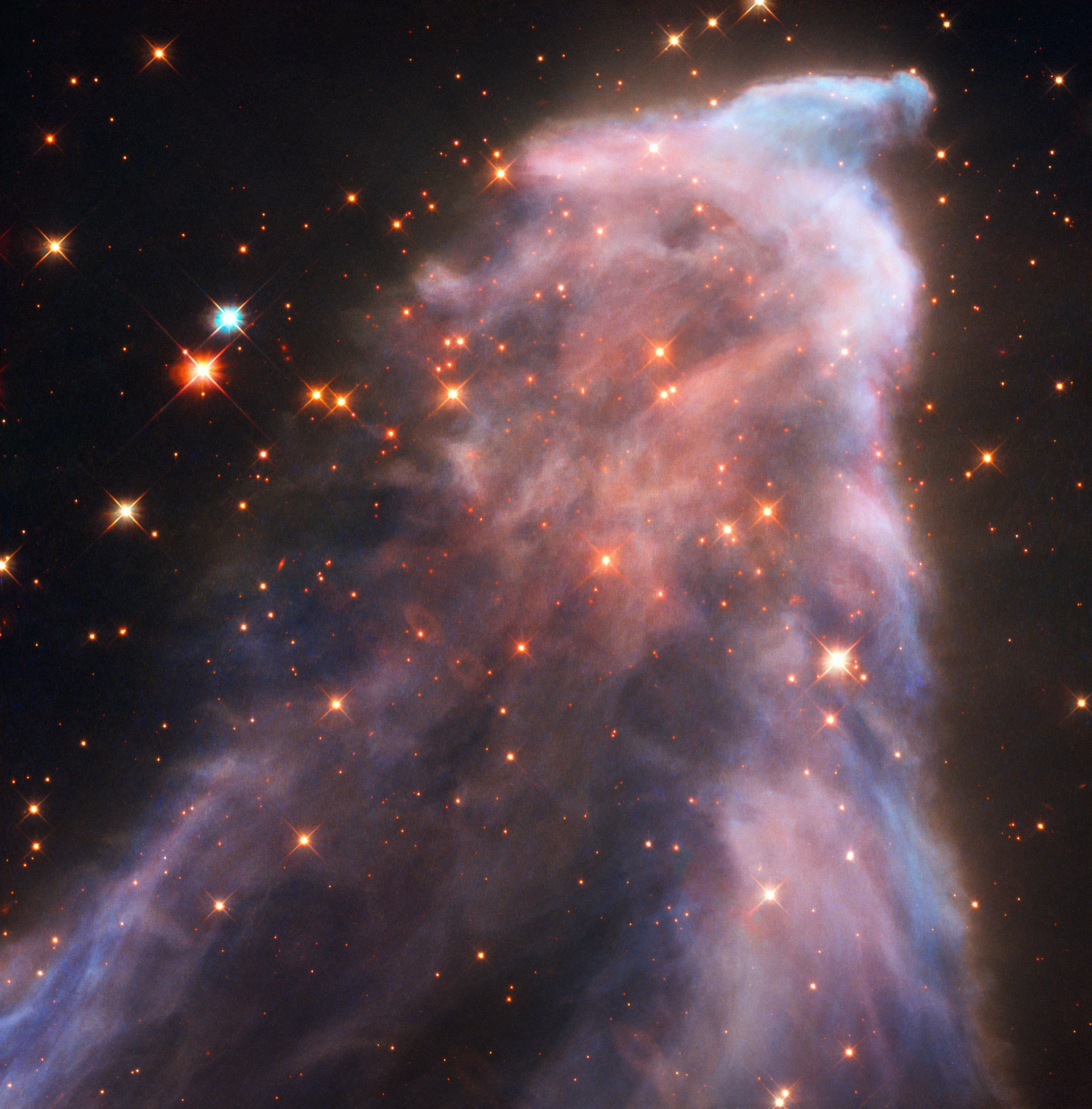
    IC 63, “the Ghost of Cassiopeia,” caotured by the Hubble Space Telescope. This striking nebula is located 550 light-years away in the constellation Cassiopeia the Queen. Credit: NASA, ESA and STScI; Acknowledgment: H. Arab (University of Strasbourg)

    Powerful gushers of energy from seething stars can sculpt eerie-looking figures with long, flowing veils of gas and dust. One striking example is “the Ghost of Cassiopeia,” officially known as IC 63, located 550 light-years away in the constellation Cassiopeia the Queen.

    The nebula’s ethereal glow might remind people of apparitions such as those reported by paranormal investigators. In reality, it’s simply hydrogen that is being bombarded with ultraviolet radiation from the nearby, blue-giant star Gamma Cassiopeiae (not seen here), causing it to glow in red light. The blue color is from light reflected off of the nebula’s dust.

    The IC 63 nebula is not the only object under the influence of the blinding star, which unleashes as much energy as 34,000 suns. The Ghost Nebula is part of a much larger nebulous region surrounding Gamma Cassiopeiae that measures approximately two degrees on the sky — roughly four times as wide as the full Moon.

    The constellation Cassiopeia is visible every clear night from mid-northern and higher latitudes. Its distinctive “W” asterism, which forms the queen’s throne, is best seen high in the sky on autumn and winter evenings. Gamma Cassiopeiae, the middle star in the W, is visible to the unaided eye, but a large telescope is needed to see IC 63.

    Hubble photographed IC 63 in August 2016.

    The Hubble Space Telescope is a project of international cooperation between NASA and ESA (European Space Agency). NASA’s Goddard Space Flight Center in Greenbelt, Maryland, manages the telescope. The Space Telescope Science Institute (STScI) in Baltimore, Maryland, conducts Hubble science operations. STScI is operated for NASA by the Association of Universities for Research in Astronomy, in Washington, D.C.

    Never miss a breakthrough: Join the SciTechDaily newsletter.
    Follow us on Google and Google News.

    Astronomy Hubble Space Telescope
    Share. Facebook Twitter Pinterest LinkedIn Email Reddit

    Related Articles

    A Morphing Spiral Galaxy Amongst Friends

    Hubble Views Magnificent Lopsided Galaxy NGC 2276

    Hubble Captures Fantastic Detail of Eponymous Spiral Galaxy NGC 691

    Spectacular Image Captured by Hubble Shows a Strangely Contorted Spiral Galaxy

    A Distant Spiral in Virgo: Extraordinary Detail Seen in a Galaxy 150 Million Light-Years Away From Earth

    Magnetic Monsters: Hubble Tracks Down Location of Mysterious Radio Signals From Intergalactic Space

    A Menagerie of Galaxies: Hubble Captures a Cluster With Galaxies of All Shapes and Sizes

    How Habitable Are Planets That Orbit Red Dwarfs – The Most Common Type of Stars in the Galaxy?

    Cosmic Silver Lining: Hubble Spots V565 Surrounded by Four Prominent Diffraction Spikes

    Leave A Reply Cancel Reply

    • Facebook
    • Twitter
    • Pinterest
    • YouTube

    Don't Miss a Discovery

    Subscribe for the Latest in Science & Tech!

    Trending News

    These Toads Are Surviving a Deadly Fungus – Scientists May Finally Know Why

    These Brain Cells May Explain Why We Eventually Have To Sleep

    Tomatoes Contain an Invisible Ingredient With Surprising Effects on Liver Health

    World’s First Heat-Powered Cooling System Turns Waste Heat Into Cold

    Antarctica Gained a Record 695 Billion Tons of Ice in Just Two Years

    Don’t Miss: A Brilliant Venus and Glowing Harvest Moon Light Up the Sky

    New Twist on the Einstein Problem Reveals Unexpected Physics

    JWST Captures Stunning Evidence of How Supermassive Black Holes Feed

    Follow SciTechDaily
    • Facebook
    • Twitter
    • YouTube
    • Pinterest
    • Newsletter
    • RSS
    SciTech News
    • Biology News
    • Chemistry News
    • Earth News
    • Health News
    • Physics News
    • Science News
    • Space News
    • Technology News
    Recent Posts
    • Scientists Find a New Way To Stop Aggressive Breast Cancer From Spreading
    • Scientists Discover Exercise Can Match One Key Benefit of Sleep for the Brain
    • Trying To Quit Smoking? One Method Outperformed Nicotine Patches and Gum
    • Princeton AI Tames Fusion Plasma Hotter Than the Sun
    • NASA Restarts Swift Telescope as It Slowly Falls Toward Earth
    Copyright © 1998 - 2026 SciTechDaily. All Rights Reserved.
    • Science News
    • About
    • Contact
    • Editorial Board
    • Privacy Policy
    • Terms of Use

    Type above and press Enter to search. Press Esc to cancel.