
Close Menu
    Facebook X (Twitter) Instagram
    SciTechDaily
    • Biology
    • Chemistry
    • Earth
    • Health
    • Physics
    • Science
    • Space
    • Technology
    Facebook X (Twitter) Pinterest YouTube RSS
    SciTechDaily
    Home»Space»Hubble Telescope Opens Its Eye Again
    Space

    Hubble Telescope Opens Its Eye Again

    By MATHIAS JÄGER, ESA/HUBBLEDecember 17, 20181 Comment2 Mins Read
    Facebook Twitter Pinterest Telegram LinkedIn WhatsApp Email Reddit
    Share
    Facebook Twitter LinkedIn Pinterest Telegram Email Reddit

    Image of the Day

    For three weeks in October, Hubble’s eyes on the Universe closed. On the evening of Friday, October 5, the orbiting observatory put itself into safe mode after one of its gyroscopes failed. The telescope stopped making science observations, oriented its solar panels toward the Sun, and waited for further instructions from the ground. Within hours the ground control team had activated a backup gyroscope. However, when that gyroscope did not work correctly, the long, hard work to get the telescope exploring the Universe once again began in earnest.

    The Hubble team had either to figure out how to get this backup gyroscope working, or to turn to a previously developed and tested one-gyroscope mode, which is proven to work. It took weeks of creative thinking, repeated tests, and minor setbacks to solve the problem of the misbehaving gyroscope.

    Members of the Hubble operations team and of the review board suspected there might be some sort of obstruction in the gyroscope affecting its readings. Attempting to dislodge such a blockage, the team repeatedly tried switching the gyroscope between different operational modes and rotating the spacecraft by large amounts. In response, the extremely high rotation rates from the gyroscope gradually fell until they were close to normal. Encouraged but cautious, the team uploaded new software safeguards to Hubble to protect the telescope in case the gyroscope should again report unduly high rates, and then sent the telescope through some practice maneuvers to simulate real science observations. They kept a close watch to make sure everything on the spacecraft performed correctly. It did.

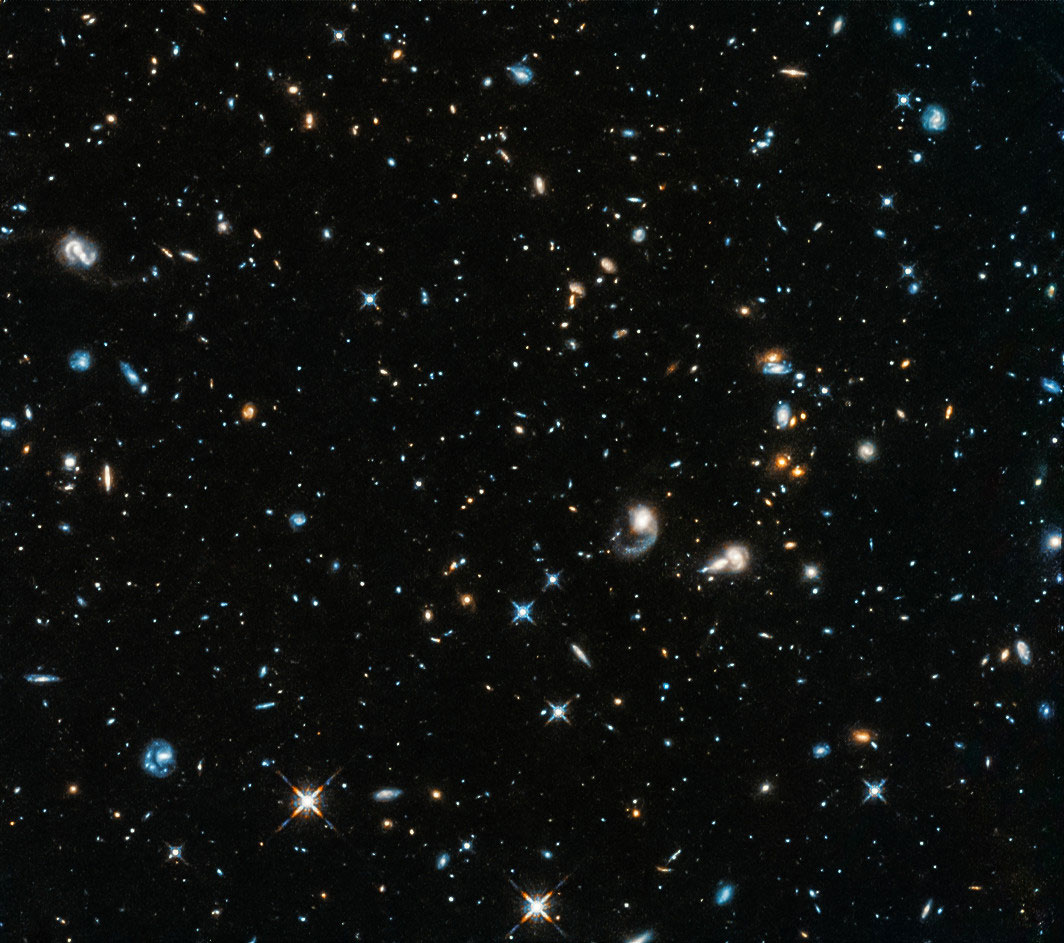
    In the early morning of October 27 Hubble captured its first image since slipping into safe mode at the beginning of the month. The observations targeted star-forming galaxies 11 billion light-years away in the constellation Pegasus. Astronomers hope to use observations like this to answer the question of how the Universe was reionized between 150 million and one billion years after the Big Bang.

    Never miss a breakthrough: Join the SciTechDaily newsletter.
    Follow us on Google and Google News.

    Astronomy Hubble Space Telescope
    Share. Facebook Twitter Pinterest LinkedIn Email Reddit

    Related Articles

    A Morphing Spiral Galaxy Amongst Friends

    Hubble Views Magnificent Lopsided Galaxy NGC 2276

    Hubble Captures Fantastic Detail of Eponymous Spiral Galaxy NGC 691

    Spectacular Image Captured by Hubble Shows a Strangely Contorted Spiral Galaxy

    A Distant Spiral in Virgo: Extraordinary Detail Seen in a Galaxy 150 Million Light-Years Away From Earth

    Magnetic Monsters: Hubble Tracks Down Location of Mysterious Radio Signals From Intergalactic Space

    A Menagerie of Galaxies: Hubble Captures a Cluster With Galaxies of All Shapes and Sizes

    How Habitable Are Planets That Orbit Red Dwarfs – The Most Common Type of Stars in the Galaxy?

    Cosmic Silver Lining: Hubble Spots V565 Surrounded by Four Prominent Diffraction Spikes

    1 Comment

    1. Hector on December 19, 2018 9:42 am

      Place Hubble there and it will look at another 11 billion light years. Repeat it forever or what may be forever. The question that has no answer is ” how did ” space ” polluted itself “.

      Reply
    Leave A Reply Cancel Reply

    • Facebook
    • Twitter
    • Pinterest
    • YouTube

    Don't Miss a Discovery

    Subscribe for the Latest in Science & Tech!

    Trending News

    Invisible Black Holes Could Be Triggering Supernovae

    Scientists Discover the First Contagious Cancer in a Freshwater Animal

    THC-CBD Treatment Dramatically Reduces Agitation in Dementia Trial

    Scientists Say Love Follows Mathematical Patterns

    “Zombie Cells” Reveal a Hidden Weakness That Could Help Fight Aging

    Alien Signals May Be Hiding in a Radio Band SETI Has Barely Explored

    Earth’s Hidden Thermostat Has Regulated Climate for 60 Million Years

    This 518-Million-Year-Old Creature Reveals How Spiders Got Their Bite

    Follow SciTechDaily
    • Facebook
    • Twitter
    • YouTube
    • Pinterest
    • Newsletter
    • RSS
    SciTech News
    • Biology News
    • Chemistry News
    • Earth News
    • Health News
    • Physics News
    • Science News
    • Space News
    • Technology News
    Recent Posts
    • Exercise Helps Hip Arthritis but the Relief May Be Hard to Notice
    • Rare Bourbon Virus Confirmed in New York for the First Time
    • Scientists Tested an 8-Hour Eating Window and Found a Surprising Brain Benefit
    • Scientists Reveal the Climate “Perfect Storm” Behind an Ancient Civilizational Collapse
    • Archaeology Students Discover Rare 400-Year-Old Intact Pot
    Copyright © 1998 - 2026 SciTechDaily. All Rights Reserved.
    • Science News
    • About
    • Contact
    • Editorial Board
    • Privacy Policy
    • Terms of Use

    Type above and press Enter to search. Press Esc to cancel.