
Close Menu
    Facebook X (Twitter) Instagram
    SciTechDaily
    • Biology
    • Chemistry
    • Earth
    • Health
    • Physics
    • Science
    • Space
    • Technology
    Facebook X (Twitter) Pinterest YouTube RSS
    SciTechDaily
    Home»Physics»Physicists Trace Communication Interception Through Meteor Trails
    Physics

    Physicists Trace Communication Interception Through Meteor Trails

    By Larisa Busil, Kazan UniversityDecember 24, 2018No Comments2 Mins Read
    Facebook Twitter Pinterest Telegram LinkedIn WhatsApp Email Reddit
    Share
    Facebook Twitter LinkedIn Pinterest Telegram Email Reddit
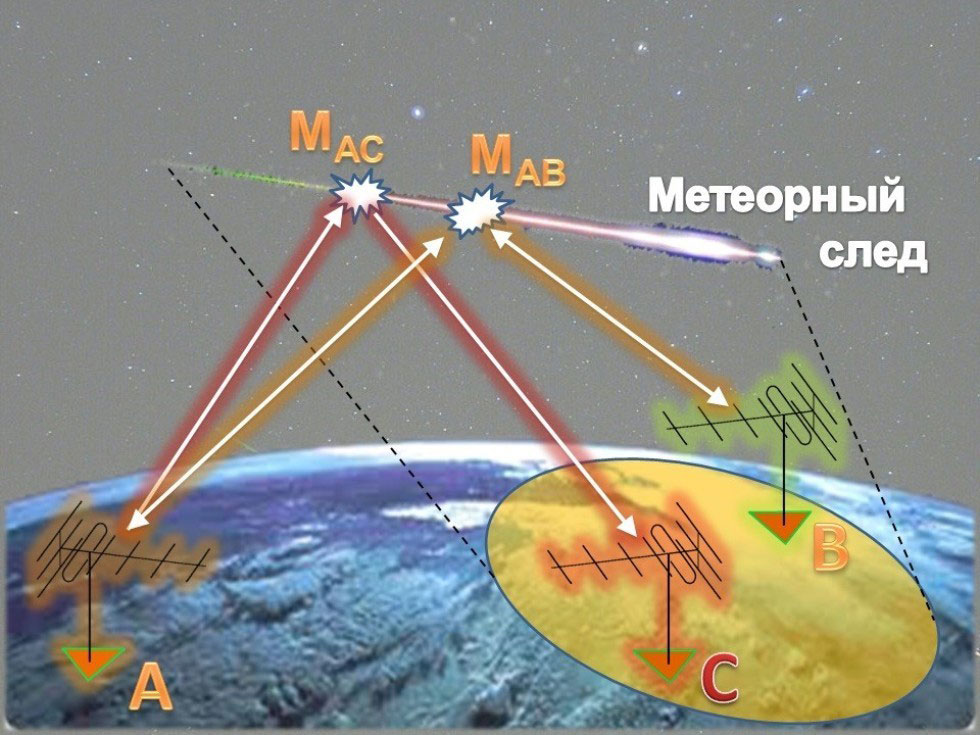
    Communication Interception Through Meteor Trails
    Meteor burst communication (Russian legend). Kazan Federal University

    Kazan University physicists created a refined simulation of a joint reception area of meteor radio reflections. The paper appeared in IEEE Transactions on Antennas and Propagation.

    Meteor burst communication is based on using meteors as cryptography assistants. Meteor trails reflect radio waves, which makes them suitable for radio transmissions at distances of up to 2,000 kilometers (1,200 miles). The unpredictable nature of meteors poses a significant hindrance to signal interception.

    Associate Professor Amir Sulimov explains, “Each meteor trail forms a kind of shadow resembling an ellipse on the Earth’s surface. All communication stations within that area can tune in on the channel. Meteor trails help determine a specific area where potential malefactors can try to intercept the signal.”

    Traditionally, it was theorized that the longest radius of interception lies along the radio line between legal points A and D, while the shortest radius, conversely, is perpendicular to that axis.

    “In our research, we are the first to show that this trend may not be persistent in meteor systems, especially on short lines of less than 500 km (310 miles). Because of the random nature of meteor arrivals, orientations of the large and small radiuses can differ significantly. And the degree of that difference also varies, depending on seasonal and daily meteor cycles. Such regularities make meteor communication interception quite difficult.”

    “Experiments and models showed that the practical possibility of intercepting a meteor channel disappears at 30 kilometers (19 miles) distances, but theoretical chances persist at distances of up 300 km (190 miles) along small radiuses and 850 kilometers (530 miles) along large radiuses,” concludes Sulimov.

    The obtained data may be used for meteor cryptography. Further research should show the distances at which partial interception of cryptographic keys is feasible.

    Publication: “Analysis of Joint Channel Coexistence Time at Space-Diversity Radio Reception of Meteor Reflections” by Amir I. Sulimov, Arkadiy V. Karpov, Sergei A. Kalabanov and Oleg N. Sherstyukov, 21 November 2018, IEEE Transactions on Antennas and Propagation.
    DOI:10.1109/TAP.2018.2882591

    Never miss a breakthrough: Join the SciTechDaily newsletter.
    Follow us on Google and Google News.

    Cryptography Kazan University Meteorites
    Share. Facebook Twitter Pinterest LinkedIn Email Reddit

    Related Articles

    Scientists Harness 19th-Century Optics To Advance Quantum Encryption

    Scientists Use Cryptography To Unlock Secrets of Quantum Advantage

    Better Cybersecurity With a New Quantum Random Number Generator

    New Connection Discovered Between Two Weird Quantum Phenomena – Superposition and Entanglement

    Leave A Reply Cancel Reply

    • Facebook
    • Twitter
    • Pinterest
    • YouTube

    Don't Miss a Discovery

    Subscribe for the Latest in Science & Tech!

    Trending News

    1.4-Million-Year-Old Footprints Reveal a Giant Human Relative

    Astronomers May Have Found the First Moon Beyond Our Solar System

    Underwater Cameras Expose the Secret Lives of Whale Sharks

    Why Dreaming Leaves the Brain Running Low on Energy

    CERN Experiments Detect Signs of the Universe’s Primordial Matter

    Study Finds a Surprising Link Between Gut Microbes and Aging

    Frequent Cannabis Users Wake Up With More “Stress Hormone”

    Scientists Reveal Hidden DNA Traces in the Shroud of Turin

    Follow SciTechDaily
    • Facebook
    • Twitter
    • YouTube
    • Pinterest
    • Newsletter
    • RSS
    SciTech News
    • Biology News
    • Chemistry News
    • Earth News
    • Health News
    • Physics News
    • Science News
    • Space News
    • Technology News
    Recent Posts
    • Black Holes May Not Be the Bottomless Pits We Imagined
    • Perseverance Finds Organic Carbon Preserved Just Beneath the Martian Surface
    • Beetroot Juice May Ease Pregnancy’s Strain on the Kidneys
    • Tick Found in Austin Apartment Linked to Rare Relapsing Fever
    • Ozempic Changes Your Body, but Does It Change Your Life? A New Study Suggests Not
    Copyright © 1998 - 2026 SciTechDaily. All Rights Reserved.
    • Science News
    • About
    • Contact
    • Editorial Board
    • Privacy Policy
    • Terms of Use

    Type above and press Enter to search. Press Esc to cancel.