
Close Menu
    Facebook X (Twitter) Instagram
    SciTechDaily
    • Biology
    • Chemistry
    • Earth
    • Health
    • Physics
    • Science
    • Space
    • Technology
    Facebook X (Twitter) Pinterest YouTube RSS
    SciTechDaily
    Home»Space»Why So Many Planets Outside Our Solar System Have An Odd Configuration
    Space

    Why So Many Planets Outside Our Solar System Have An Odd Configuration

    By Jim Shelton, Yale UniversityMarch 4, 20192 Comments3 Mins Read
    Facebook Twitter Pinterest Telegram LinkedIn WhatsApp Email Reddit
    Share
    Facebook Twitter LinkedIn Pinterest Telegram Email Reddit
    Over Tilting Exoplanets
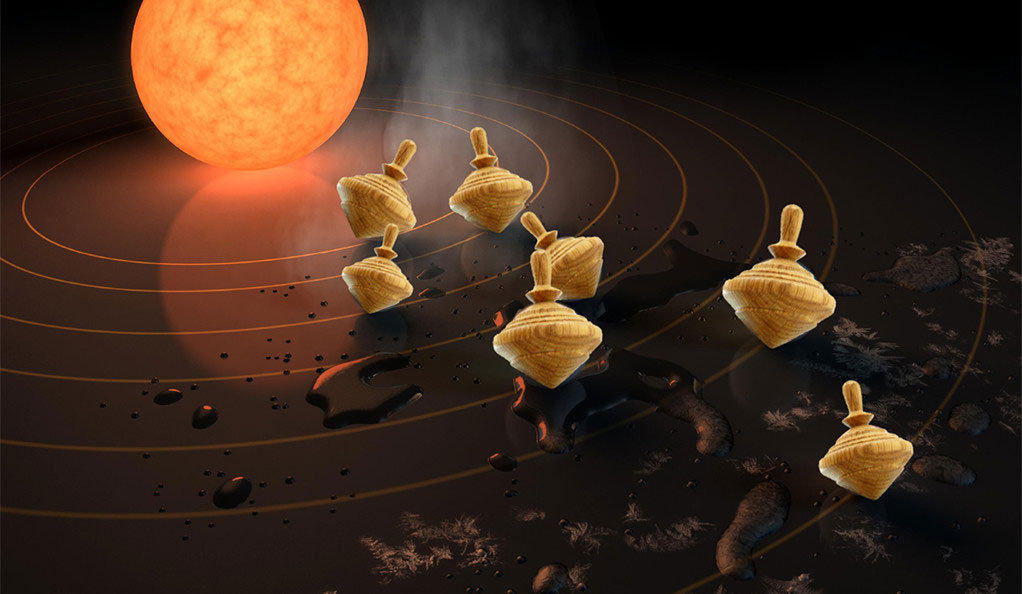
    Yale researchers have discovered a surprising link between the tilting of exoplanets and their orbit in space. The discovery may help explain a long-standing puzzle about exoplanetary orbital architectures. Credit: NASA/JPL-Caltech, Sarah Millholland

    For almost a decade, astronomers have tried to explain why so many pairs of planets outside our solar system have an odd configuration — their orbits seem to have been pushed apart by a powerful unknown mechanism. Yale researchers say they’ve found a possible answer, and it implies that the planets’ poles are majorly tilted.

    The finding could have a big impact on how researchers estimate the structure, climate, and habitability of exoplanets as they try to identify planets that are similar to Earth. The research appears in the March 4 online edition of the journal Nature Astronomy.

    NASA’s Kepler mission revealed that about 30% of stars similar to our Sun harbor “Super-Earths.” Their sizes are somewhere between that of Earth and Neptune, they have nearly circular and coplanar orbits, and it takes them fewer than 100 days to go around their star. Yet curiously, a great number of these planets exist in pairs with orbits that lie just outside natural points of stability.

    That’s where obliquity — the amount of tilting between a planet’s axis and its orbit — comes in, according to Yale astronomers Sarah Millholland and Gregory Laughlin.

    “When planets such as these have large axial tilts, as opposed to little or no tilt, their tides are exceedingly more efficient at draining orbital energy into heat in the planets,” said first author Millholland, a graduate student at Yale. “This vigorous tidal dissipation pries the orbits apart.”

    A similar, but not identical, situation exists between Earth and its moon. The moon’s orbit is slowly growing due to dissipation from tides, but Earth’s day is gradually lengthening.

    Laughlin, who is a professor of astronomy at Yale, said there is a direct connection between the over-tilting of these exoplanets and their physical characteristics. “It impacts several of their physical features, such as their climate, weather, and global circulations,” Laughlin said. “The seasons on a planet with a large axial tilt are much more extreme than those on a well-aligned planet, and their weather patterns are probably non-trivial.”

    Millholland said she and Laughlin already have started work on a follow-up study that will examine how these exoplanets’ structures respond to large obliquities over time.

    The NASA Astrobiology Institute and the National Science Foundation Research Fellowship Program supported the study.

    Reference: “Obliquity-driven sculpting of exoplanetary systems” by Sarah Millholland and Gregory Laughlin , 4 March 2019, Nature Astronomy.
    DOI: 10.1038/s41550-019-0701-7

    Never miss a breakthrough: Join the SciTechDaily newsletter.
    Follow us on Google and Google News.

    Astronomy Cosmology Planetary Science
    Share. Facebook Twitter Pinterest LinkedIn Email Reddit

    Related Articles

    Star Vanishes for 200 Days in One of the Longest Cosmic Dimming Events Ever Recorded

    Theoretical Study Suggests Most Earth-Like Worlds Have Yet to Be Born

    Astronomers Discover Jupiter-Like Planet 51 Eridani b

    11 Billion Year Old Stars Have Earth-like Planets

    Study Reveals Water on Earth is Older Than Our Sun

    Pebble-Size Particles May Represent a New Class of Interstellar Particles

    Grains Captured by NASA’s Stardust Spacecraft Are Likely from Interstellar Space

    New Study Reveals Amount of Water Present in the Moon May Have Been Overestimated

    Scientists Develop a New Way of Reading the Universe’s ‘Cosmic Barometer’

    2 Comments

    1. Scott on March 6, 2019 6:59 pm

      I don’t see that the article explained “why” the planets axes are tilted at all. The article simply explains an after effect of the tilt, dodging the point. The “Why” was after all, what the title claimed that the article was offering. Axial tilt is contrary to the evolutionary explanation of the nebular hypothesis and that a significant percentage of planets have tilted axes would argue against the nebular hypothesis and an evolutionary origin of the planets. In the beginning God created the heavens and the earth…and it appears that He tilted their axes just to prove it!

      Reply
    2. Alain Dubois on January 2, 2020 5:20 am

      I agree with Scott | March 6, 2019 at 6:59 pm. I have come to the point of just accepting that the title that gets you in is just typical of most things these days; like a sales gimmick without a proper product to sell.

      Reply
    Leave A Reply Cancel Reply

    • Facebook
    • Twitter
    • Pinterest
    • YouTube

    Don't Miss a Discovery

    Subscribe for the Latest in Science & Tech!

    Trending News

    FDA-Approved Drug Shows Promise for Reversing Osteoarthritis Damage

    11,000-Year-Old Grains Reveal a Surprise About the Origins of Agriculture

    This Common Type of Medication Is Linked to Slower Cognitive Decline

    Quantum Computer Solves a Problem in 15 Minutes That Classical Methods Can’t Practically Compute

    Taking the Stairs Could Cut Your Risk of Heart-Related Death by 39%

    Scientists Uncover a Surprising New Route for Stonehenge’s Most Mysterious Stone

    A Star Near the Milky Way’s Black Hole Is Losing Mass at an Astonishing Rate

    Scientists Solve a Vitamin B12 Mystery With an Unexpected Culprit

    Follow SciTechDaily
    • Facebook
    • Twitter
    • YouTube
    • Pinterest
    • Newsletter
    • RSS
    SciTech News
    • Biology News
    • Chemistry News
    • Earth News
    • Health News
    • Physics News
    • Science News
    • Space News
    • Technology News
    Recent Posts
    • Astronomers Discover a Ghostly River of Stars That Could Reveal Dark Matter
    • NASA Is Building a Moon Base – and the First Pieces Are Already Coming Together
    • Something Mysterious Just Passed Between Earth and a Distant Star
    • This Natural Gut Compound Could Point to Better Treatments for IBD
    • Your Liver Runs on a Clock – and It Could Change How We Treat Metabolic Disease
    Copyright © 1998 - 2026 SciTechDaily. All Rights Reserved.
    • Science News
    • About
    • Contact
    • Editorial Board
    • Privacy Policy
    • Terms of Use

    Type above and press Enter to search. Press Esc to cancel.