
Astronomers have reported one of the longest stellar dimming events ever recorded, with a Sun-like star fading by 97 percent for nearly 200 days.
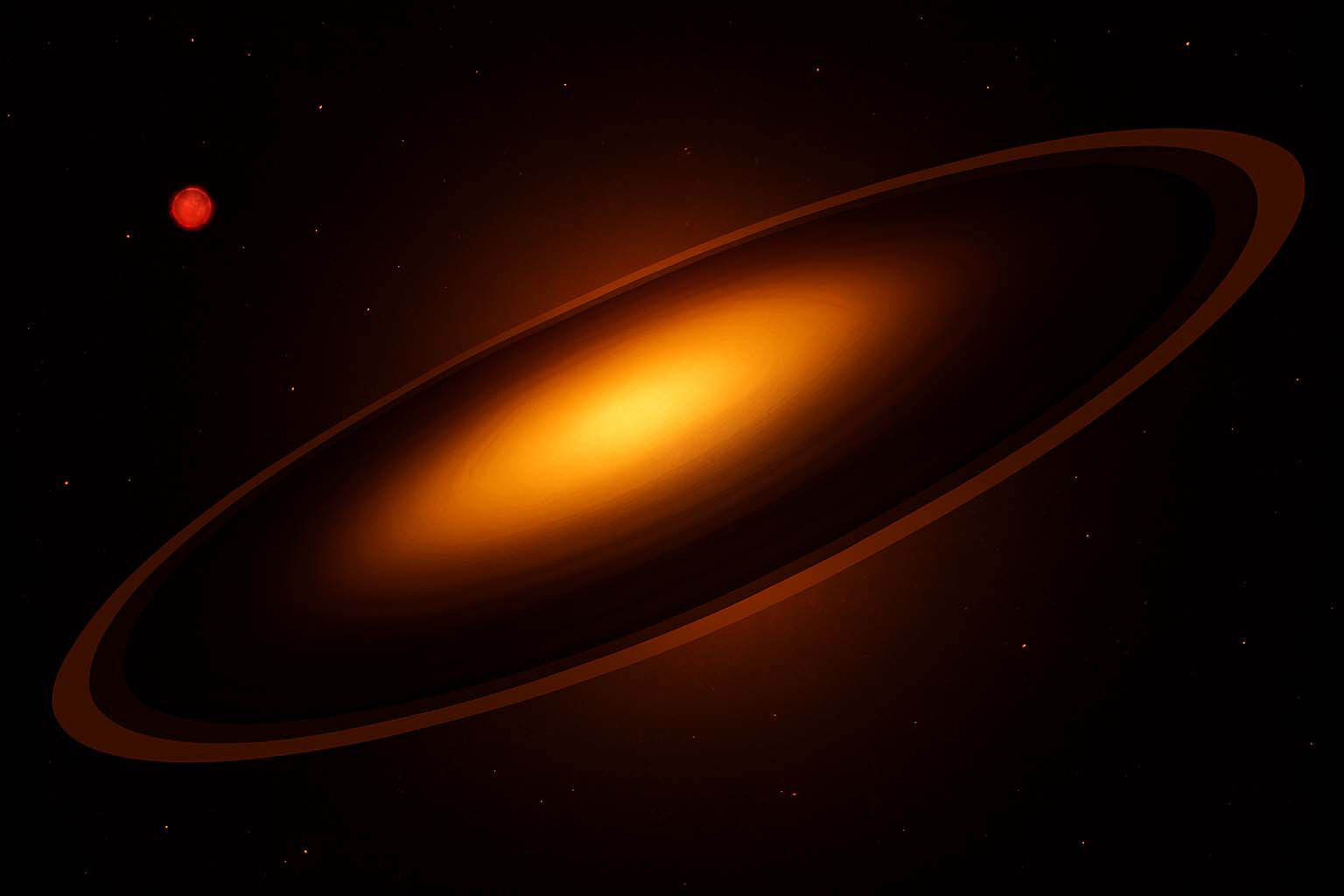
Astronomers believe one of the longest stellar dimming episodes ever recorded was caused by enormous, disk-shaped rings surrounding a hidden brown dwarf or a so-called ‘super-Jupiter’ that passed in front of its host star.
For decades, the star – located about 3,200 light-years from Earth and roughly twice the size of our Sun – showed no unusual behavior. Then, in late 2024, its brightness suddenly dropped.
Instead of recovering quickly, the star stayed faint for more than nine months. Such a prolonged dip is highly unusual, leaving scientists puzzled and searching for an explanation behind what they described as an “extremely rare” event.
In a study published in Monthly Notices of the Royal Astronomical Society, an international team now reports that they may have identified the cause of the strange behavior in the Monoceros constellation star known as ASASSN-24fw.
A Giant Ring System Comes Into View
The researchers conclude that the most likely explanation is a brown dwarf encircled by rings similar to Saturn’s, which blocked about 97 percent of the star’s light as they crossed in front of it.
The proposed ring system is immense, stretching about 0.17 astronomical units from its central object. That distance is roughly half the span between the Sun and Mercury.
Brown dwarfs occupy a middle ground between planets and stars. They are too massive to be classified as planets, yet they lack enough mass to sustain the nuclear fusion that powers true stars.
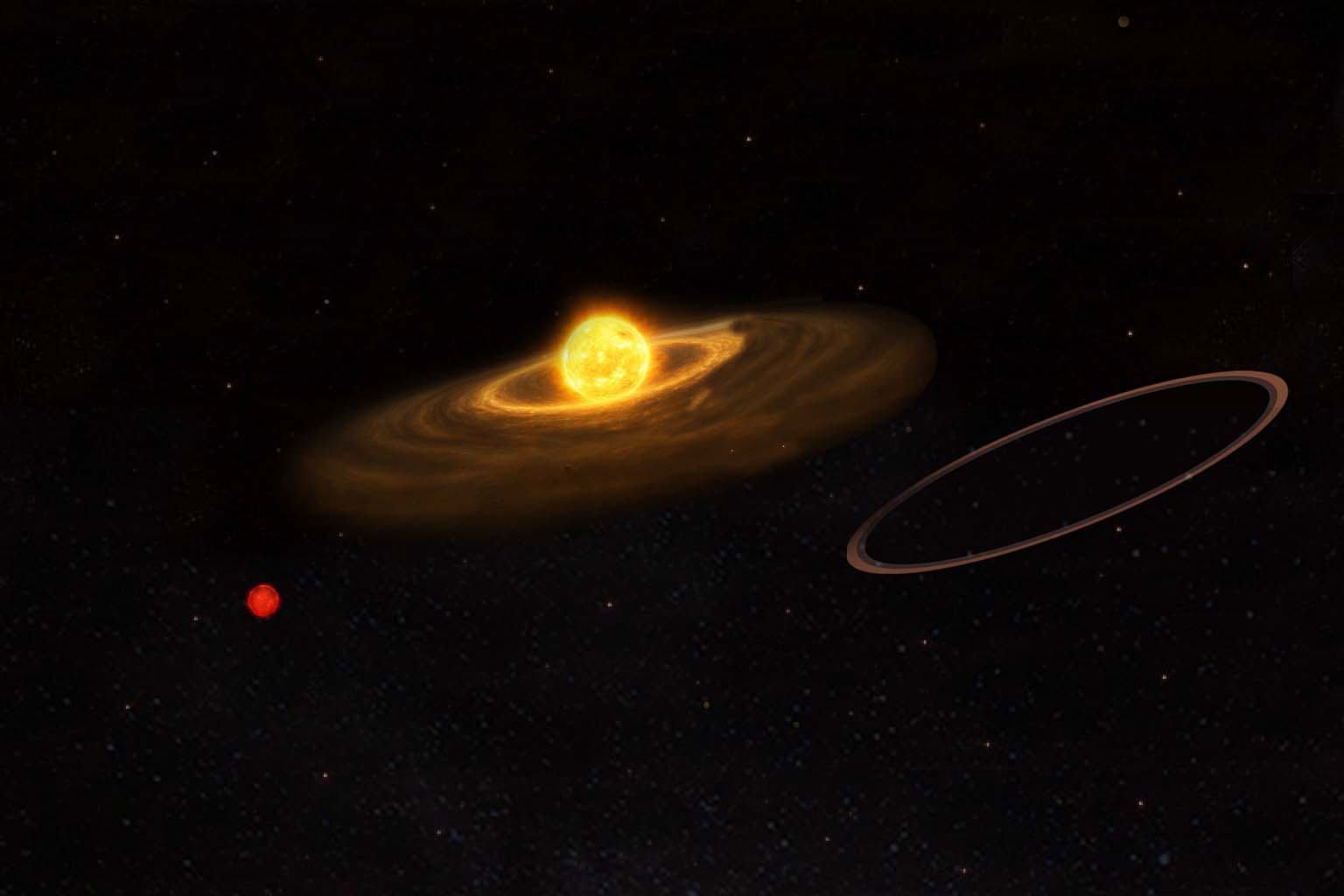
Scientists also considered another possibility. The dimming object could have been a super-Jupiter – defined as massive gas giant exoplanets which exceed the mass of Jupiter and bridge the gap between brown dwarfs and planets.
The discovery provides insight into large, planet-sized structures outside our Solar System and offers a new way to investigate how planets and ring systems take shape and change over time around distant stars.
An Exceptionally Long Eclipse
Most stellar eclipses last from a few days to several weeks. In contrast, this event continued for nearly 200 days, placing it among the longest ever documented.
“Various models made by our group show that the most likely explanation for the dimming is a brown dwarf – an object heavier than a planet but lighter than a star – surrounded by a vast and dense ring system. It is orbiting the star at a farther distance with the ring,” said lead author Dr Sarang Shah, a post-doctoral researcher at the Inter-University Centre for Astronomy and Astrophysics (IUCAA), in Pune, India.
“Long-lasting dimming events like this are exceptionally uncommon as they require very perfect line-ups. The dimming began gradually because the outer parts of the rings are thin, and only became obvious when the denser regions passed in front of the star.”
Measurements from photometric and spectroscopic observations indicate that the companion object has a mass exceeding three times that of Jupiter.
The data also reveal that ASASSN-24fw is surrounded by a circumstellar environment (possibly remnants from past or ongoing planetary collisions) located very close to the star. This feature is unusual for a system of its age (likely more than 1 billion years).
A Rare Opportunity for Deeper Study
“Large ring systems are expected around massive objects, but they are very difficult to observe directly to determine their characteristics,” said Dr Jonathan Marshall, an independent post-doctoral researcher affiliated with Academia Sinica, Taiwan, whose expertise is in circumstellar material and debris discs.
“This rare event allows us to study such a complex system in remarkable detail. In fact, while studying this dimming, we also serendipitously discovered that ASASSN-24fw also has a red dwarf star in its vicinity.”
The team of researchers now wants to measure the temperature, evolutionary status, chemical composition, and age of the star which dimmed.
They then hope to obtain more data from the European Southern Observatory’s Very Large Telescope in Chile and the James Webb Space Telescope to better understand the evolution of such systems and relate them to planetary formation theories.
The researchers expect the star to dim again in about 42 or 43 years’ time, at which point further analysis can be carried out to find out more about this fascinating system.
Reference: “The nature of ASASSN-24fw’s occultation: modelling the event as dimming by optically thick rings around a substellar companion” by Sarang Shah, Jonathan P Marshall, Carlos del Burgo, Gergely Hajdu, Isabel Rebollido, Bogumił Pilecki, Ashish Mahabal, Sascha T Zeegers, Bacham Eswar Reddy, Francisca Kemper, Mansi M Kasliwal, Viraj Karambelkar, Matthew J Graham, S G Djorgovski and Daniel Stern, 12 February 2026, Monthly Notices of the Royal Astronomical Society.
DOI: 10.1093/mnras/staf2251
Never miss a breakthrough: Join the SciTechDaily newsletter.
Follow us on Google and Google News.
2 Comments
what is it this
this is only about something passed in front of a star, but you are calling that star sun-like !!! I ask HOW IS A Class F main sequence star that is very faint SUN-LIKE…