
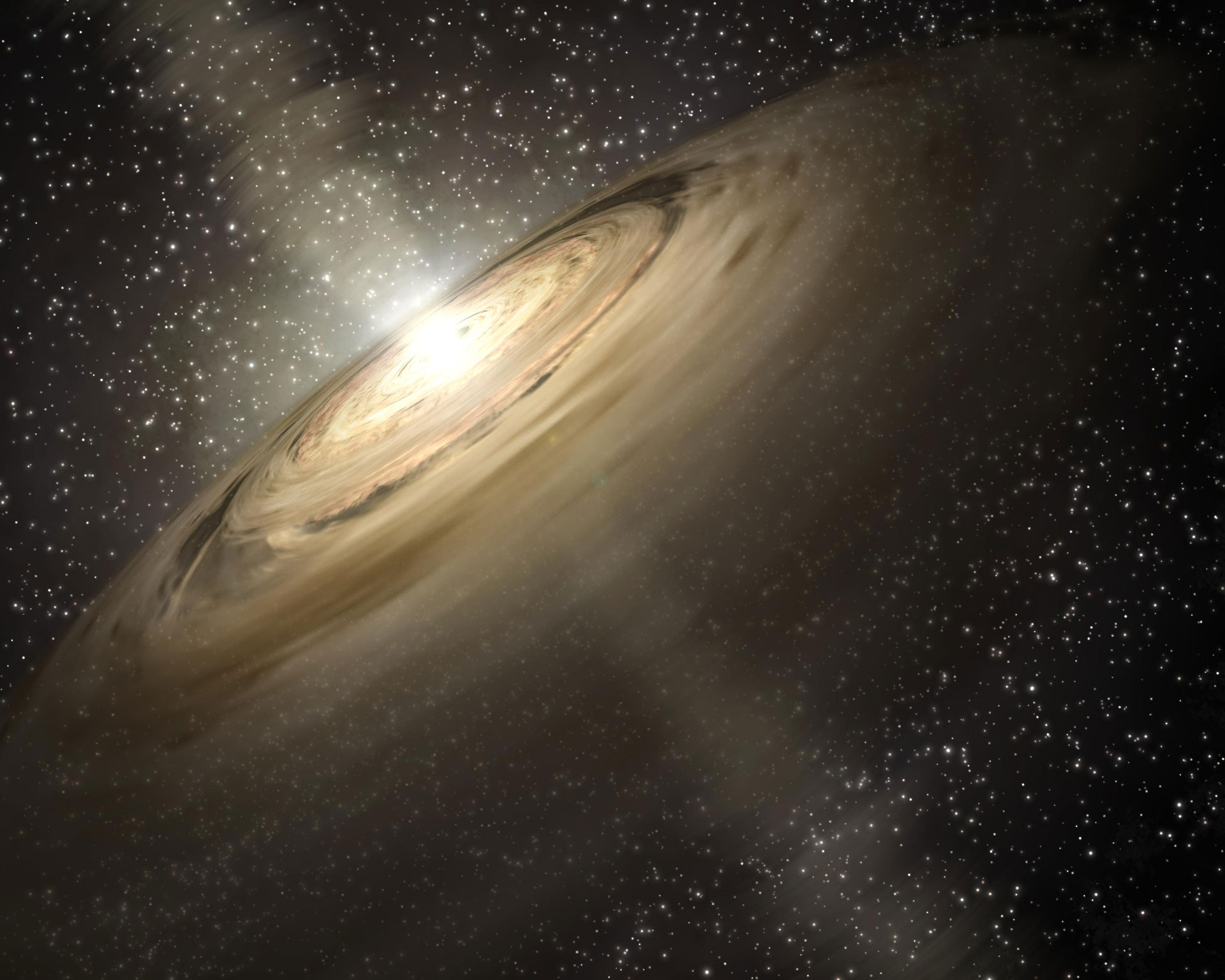
A new study being presented at National Astronomy Meeting in Llandudno shows that Earth-like planets orbiting other stars in the Milky Way are three times more likely to have the same type of minerals as Earth than astronomers had previously thought and that conditions for making the building blocks of Earth-like rocks are ubiquitous throughout the Milky Way.
The results of a new study of the chemical evolution of our galaxy are being presented today by Prof Brad Gibson of the University of Hull.
Minerals made from building blocks of carbon, oxygen, magnesium, and silicon are thought to control the landscape of rocky planets that form in solar systems around Sun-like stars. A subtle difference in mineralogy can have a big effect on plate tectonics, heating, and cooling of the planet’s surface, all of which can affect whether a planet is ultimately habitable. Until now, astronomers thought that rocky planets fell into three distinct groups: those with a similar set of building blocks to Earth, those that had a much richer concentration of carbon, and those that had significantly more silicon than magnesium.
“The ratio of elements on Earth has led to the chemical conditions ‘just right’ for life. Too much magnesium or too little silicon and your planet ends up having the wrong balance between minerals to form the type of rocks that make up the Earth’s crust,” said Gibson. “Too much carbon and your rocky planet might turn out to be more like the graphite in your pencil than the surface of a planet like the Earth.”
Gibson and team from the E.A. Milne Center for Astrophysics at the University of Hull have constructed a sophisticated simulation of the chemical evolution of the Milky Way, which results in an accurate recreation of the Milky Way as we see it today. This has allowed them to zoom in and examine the chemistry of processes, such as planetary formation, in detail. Their findings came as something of a surprise.
“At first, I thought we’d got the model wrong!” explained Gibson. “As an overall representation of the Milky Way, everything was pretty much perfect. Everything was in the right place; the rates of stars forming and stars dying, individual elements, and isotopes all matched observations of what the Milky Way is really like. But when we looked at planetary formation, every solar system we looked at had the same elemental building blocks as Earth, and not just one in three. We couldn’t find a fault with the model, so we went back and checked the observations. There we found some uncertainties that were causing the one-in-three result. Removing these, observations agreed with our predictions that the same elemental building blocks are found in every exoplanet system, wherever it is in the galaxy.”
The cloud out of which the solar system formed has approximately twice as many atoms of oxygen as carbon, and roughly five atoms of silicon for every six of magnesium. Observers trying to ascertain the chemical make-up of planetary systems have tended to look at large planets orbiting very bright stars, which can lead to uncertainties of 10 or 20 percent. In addition, historically the spectra of oxygen and nickel have been hard to differentiate. Improvements in spectroscopy techniques have cleaned up the oxygen spectra, providing data that matches the Hull team’s estimates.
“Even with the right chemical building blocks, not every planet will be just like Earth, and conditions allowing for liquid water to exist on the surface are needed for habitability,” said Gibson. “We only need to look to Mars and Venus to see how differently terrestrial planets can evolve. However, if the building blocks are there, then it’s more likely that you will get Earth-like planets – and three times more likely than we’d previously thought.”
Never miss a breakthrough: Join the SciTechDaily newsletter.
Follow us on Google and Google News.