
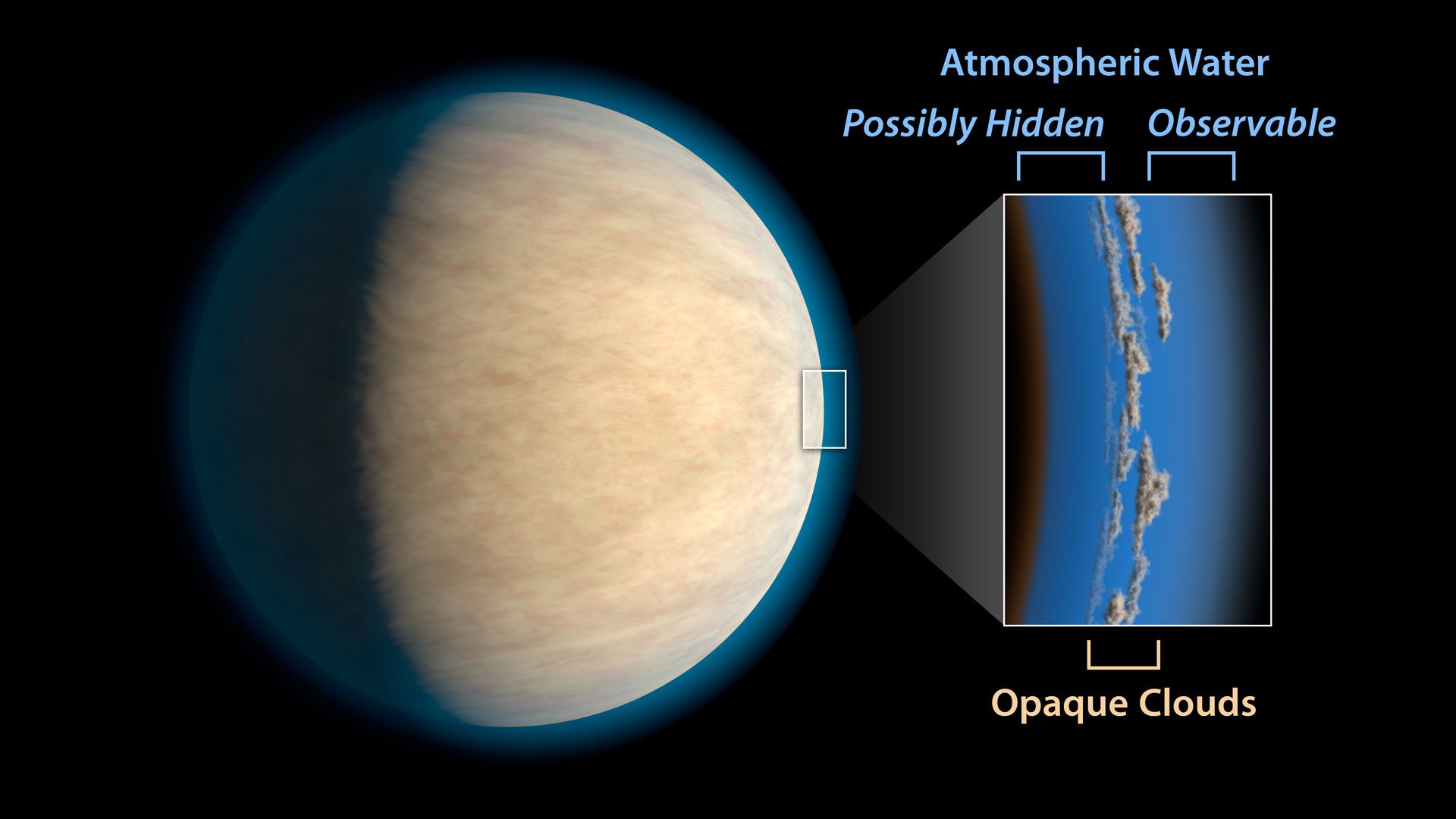
New research suggests that as much as half of the water in the atmospheres of exoplanets may be blocked by clouds or hazes.
Water is a hot topic in the study of exoplanets, including “hot Jupiters,” whose masses are similar to that of Jupiter, but which are much closer to their parent star than Jupiter is to the sun. They can reach a scorching 2,000 degrees Fahrenheit (1,100 degrees Celsius), meaning any water they host would take the form of water vapor.
Astronomers have found many hot Jupiters with water in their atmospheres, but others appear to have none. Scientists at NASA’s Jet Propulsion Laboratory, Pasadena, California, wanted to find out what the atmospheres of these giant worlds have in common.
Researchers focused on a collection of hot Jupiters studied by NASA’s Hubble Space Telescope. They found that the atmospheres of about half of the planets were blocked by clouds or haze.
“The motivation of our study was to see what these planets would be like if they were grouped together, and to see whether they share any atmospheric properties,” said Aishwarya Iyer, a JPL intern and master’s degree candidate at California State University, Northridge, who led the study.
The new study, published in the June 1 issue of the Astrophysical Journal, suggests that clouds or haze layers could be preventing a substantial amount of atmospheric water from being detected by space telescopes. The clouds themselves are likely not made of water, as the planets in this sample are too hot for water-based clouds.
“Clouds or haze seem to be on almost every planet we studied,” Iyer said. “You have to be careful to take clouds or haze into account, or else you could underestimate the amount of water in an exoplanet’s atmosphere by a factor of two.”
In the study, scientists looked at a set of 19 hot Jupiters previously observed by Hubble. The telescope’s Wide Field Camera 3 had detected water vapor in the atmospheres of 10 of these planets, and no water on the other nine. But that information was spread across more than a dozen studies. The methods of analysis and interpretation varied because the studies were conducted separately. There had not been one overarching analysis of all these planets.
To compare the planets and look for patterns, the JPL team had to standardize the data: Researchers combined the datasets for all 19 hot Jupiters to create an average overall light spectrum for the group of planets. They then compared these data to models of clear, cloud-free atmospheres and those with various cloud thicknesses.
The scientists determined that, for almost every planet they studied, haze or clouds were blocking half of the atmosphere, on average.
“In some of these planets, you can see water peeking its head up above the clouds or haze, and there could still be more water below,” Iyer said.
Scientists do not yet know the nature of these clouds or hazes, including what they are made of.
“Clouds or haze being on almost all these planets is pretty surprising,” said Robert Zellem, a postdoctoral fellow at JPL and co-author of the study.
The implications of this result agree with findings published in the December 14, 2015, issue of the journal Nature. The Nature study used data from NASA’s Hubble and Spitzer Space Telescopes to suggest that clouds or haze could be hiding undetected water in hot Jupiters. This new study uses exoplanet data from a single instrument on Hubble to uniformly characterize a larger group of hot Jupiters, and is the first to quantify how much of the atmosphere would be shielded as a result of clouds or haze.
The new research could have implications for follow-up studies with future space observatories, such as NASA’s James Webb Space Telescope. Exoplanets with thick cloud covers blocking the detection of water and other substances may be less desirable targets for more extensive study.
These results are also important for figuring out how planets form, scientists say.
“Did these planets form in their current positions or migrate toward their host stars from farther out? Understanding the abundances of molecules such as water helps us answer those questions,” Zellem said.
“This paper is an exciting step forward for the study of exoplanets and comparing their properties,” said Mark Swain, study co-author and group supervisor for the exoplanet discovery and science group at JPL.
Michael Line of the University of California, Santa Cruz, also contributed to the study. Other co-authors from JPL included Gael Roudier, Graca Rocha, and John Livingston.
Reference: “A Characteristic Transmission Spectrum dominated by H2O applies to the majority of HST/WFC3 exoplanet observations” by Aishwarya R. Iyer, Mark R. Swain, Robert T. Zellem, Michael R. Line, Gael Roudier, Graca Rocha and John H. Livingston, 27 May 2016, The Astrophysical Journal.
DOI: 10.3847/0004-637X/823/2/109
arXiv:1512.00151
Never miss a breakthrough: Join the SciTechDaily newsletter.
Follow us on Google and Google News.