
Close Menu
    Facebook X (Twitter) Instagram
    SciTechDaily
    • Biology
    • Chemistry
    • Earth
    • Health
    • Physics
    • Science
    • Space
    • Technology
    Facebook X (Twitter) Pinterest YouTube RSS
    SciTechDaily
    Home»Biology»Ants vs. Humans: Solving the Mystery of How Ants Manage Traffic So Well
    Biology

    Ants vs. Humans: Solving the Mystery of How Ants Manage Traffic So Well

    By CNRSOctober 22, 20191 Comment3 Mins Read
    Facebook Twitter Pinterest Telegram LinkedIn WhatsApp Email Reddit
    Share
    Facebook Twitter LinkedIn Pinterest Telegram Email Reddit

    Ant vs Humans Illustration

    Whether they occur on holiday routes or the daily commute, traffic jams affect cars as well as pedestrians. Scientists at the Research Center on Animal Cognition (CNRS/Université Toulouse III – Paul Sabatier) and the University of Arizona (United States) have demonstrated that ant colonies, however, are spared these problems and circulate easily, even in the event of extremely dense traffic, thus ensuring consistent efficiency in their foraging. These findings appear in the October 22, 2019, edition of eLife.
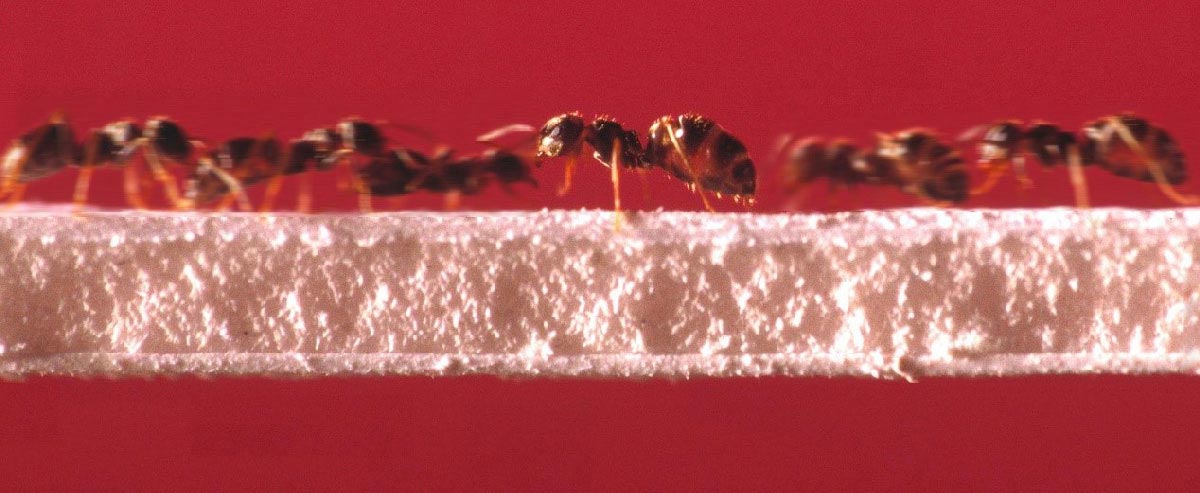
    Ants Running on a Bridge
    Ants running on a bridge. Credit: Emmanuel PERRIN/CRCA/CNRS Photothèque

    Traffic jams are a perfect example of what happens when too many individuals circulate together in the same space. Movements in large ant colonies, however, seem to sidestep this problem. To solve the mystery of how ants manage traffic so wonderfully, researchers conducted 170 filmed experiments to observe ants commuting between their nest and a food source. Tests took into account the width of the path and the number of individuals included in the study (between 400 and 25,600) in order to vary the density – the number of insects per unit of surface.

    What they saw surprised them: when density increases, ant flows[1] swell and then become constant, whereas human traffic, above a certain density threshold, slows to zero flow and causes a jam[2]. Ants, on the other hand, accelerate until a maximum flow or capacity on the path is reached. When traffic becomes too dense and causes too many collisions between ants, they change tactics, preferring to avoid time-consuming collisions instead of continuing to accelerate. Similarly, researchers noted that at excessively high-density levels, ants refrain from joining the flow of traffic and wait for it to thin out instead.
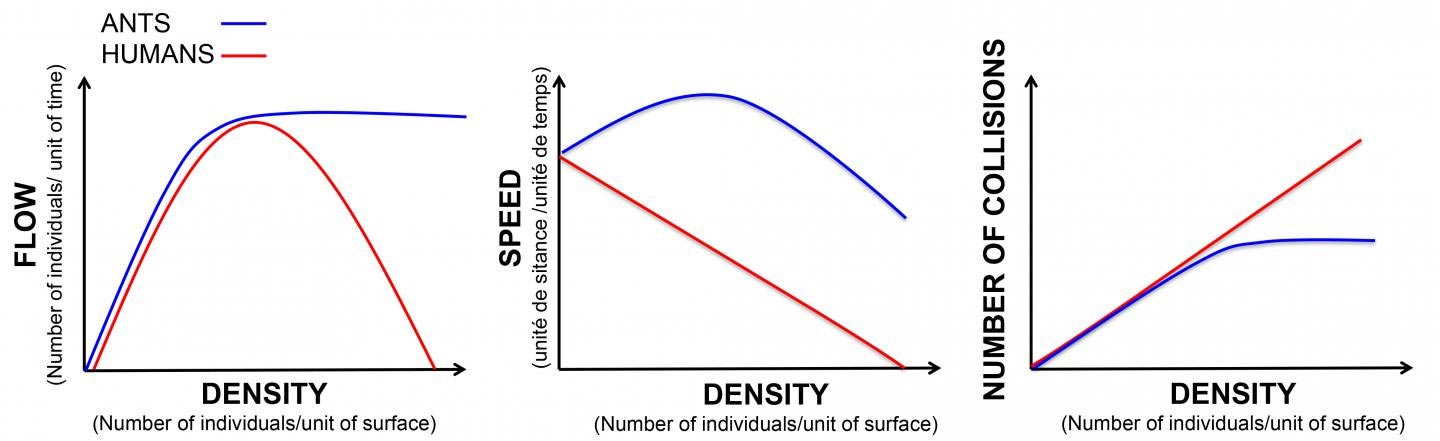
    Comparing Ants vs Humans
    Comparing traffic as a function of density, in ants and humans. Credit: Audrey Dussutour

    While ant traffic is comparable to pedestrian and vehicle flows in many ways, it is also fundamentally different. Ants, protected by their exoskeleton, are not afraid of collisions and can accelerate where we humans prefer to slow down. In addition, movements in ant colonies share a common goal: foraging, which is carried out effectively regardless of density. Ants seem to avoid the traffic jam trap by continuously adapting their traffic rules to suit local crowding, whereas car traffic follows invariable rules such as stopping at a red light regardless of traffic.

    Notes:

    1. The number of individuals covering a given distance per unit of time.
    2. Variation in flow according to density is illustrated by a bell curve.

    Reference: “Experimental investigation of ant traffic under crowded conditions” by Laure-Anne Poissonnier, Sebastien Motsch, Jacques Gautrais, Jerome Buhl and Audrey Dussutour, 22 October 2019, eLife.
    DOI: 10.7554/eLife.48945.001

    Never miss a breakthrough: Join the SciTechDaily newsletter.
    Follow us on Google and Google News.

    Ants CNRS Entomology Popular University of Arizona
    Share. Facebook Twitter Pinterest LinkedIn Email Reddit

    Related Articles

    New Miniature Trap-Jaw Ant Ant Species Discovered – Named in Recognition of Gender Diversity

    Ant Responses to Social Isolation Surprisingly Resemble Those of Humans

    Stunning 99-Million-Year-Old Fossil Reveals “Hell Ants” in Detail: Hunted With Bizarre, Deadly Mandibles

    Asian Hornets Are Invading Europe – Here’s What It’s Going to Cost

    In a Twist of Fate, Ant Expert Discovers Distinct New Species in His Own Backyard

    Invasion of Zombie Ants in Florida – Fungal Infection Takes Over the Ants’ Brains

    Cannibal Wood Ants Were Stuck in a Polish Nuclear Weapons Bunker – Here’s What Happened

    Recording Breaking Speed: World’s Fastest Ant Clocked at 855mm/s, an Incredible 47 Strides/s

    Hyperparasite Fungus Limits the Effects of ‘Zombie-Ant’ Fungus

    1 Comment

    1. Neko on April 16, 2021 8:10 am

      Ant powered cars?? Cars controlled by ants?? I oly come up with genius ideas. That’s on facts. Period poo.

      Reply
    Leave A Reply Cancel Reply

    • Facebook
    • Twitter
    • Pinterest
    • YouTube

    Don't Miss a Discovery

    Subscribe for the Latest in Science & Tech!

    Trending News

    Black Hole Collisions May Follow a Surprisingly Simple Rule

    The Eye Has a Hidden Cleanup System and Scientists Just Discovered It

    The Truth About Vikings Is More Complicated Than Museums Admit

    New Catalyst Turns Stubborn Plant Waste Into Valuable Chemicals

    Quantum Gravity May Be Far Less Quantum Than Physicists Expected

    New Tool Supercharges Immunotherapy Against Prostate Cancer

    The Hidden Cancer Risk of Ketogenic Diets

    One Asteroid Collision May Have Rocked Earth, Mars, and the Moon

    Follow SciTechDaily
    • Facebook
    • Twitter
    • YouTube
    • Pinterest
    • Newsletter
    • RSS
    SciTech News
    • Biology News
    • Chemistry News
    • Earth News
    • Health News
    • Physics News
    • Science News
    • Space News
    • Technology News
    Recent Posts
    • This 518-Million-Year-Old Creature Reveals How Spiders Got Their Bite
    • Forgotten for 20 Years, This 240-Million-Year-Old Fossil Reveals a New Reptile Species
    • 190-Year-Old Museum Specimen Solves a Pangolin Mystery
    • This Tiny Gecko Could Reveal How Cancer Spreads
    • Scientists Built a Programmable Chip That Can Slow Light on Command
    Copyright © 1998 - 2026 SciTechDaily. All Rights Reserved.
    • Science News
    • About
    • Contact
    • Editorial Board
    • Privacy Policy
    • Terms of Use

    Type above and press Enter to search. Press Esc to cancel.