
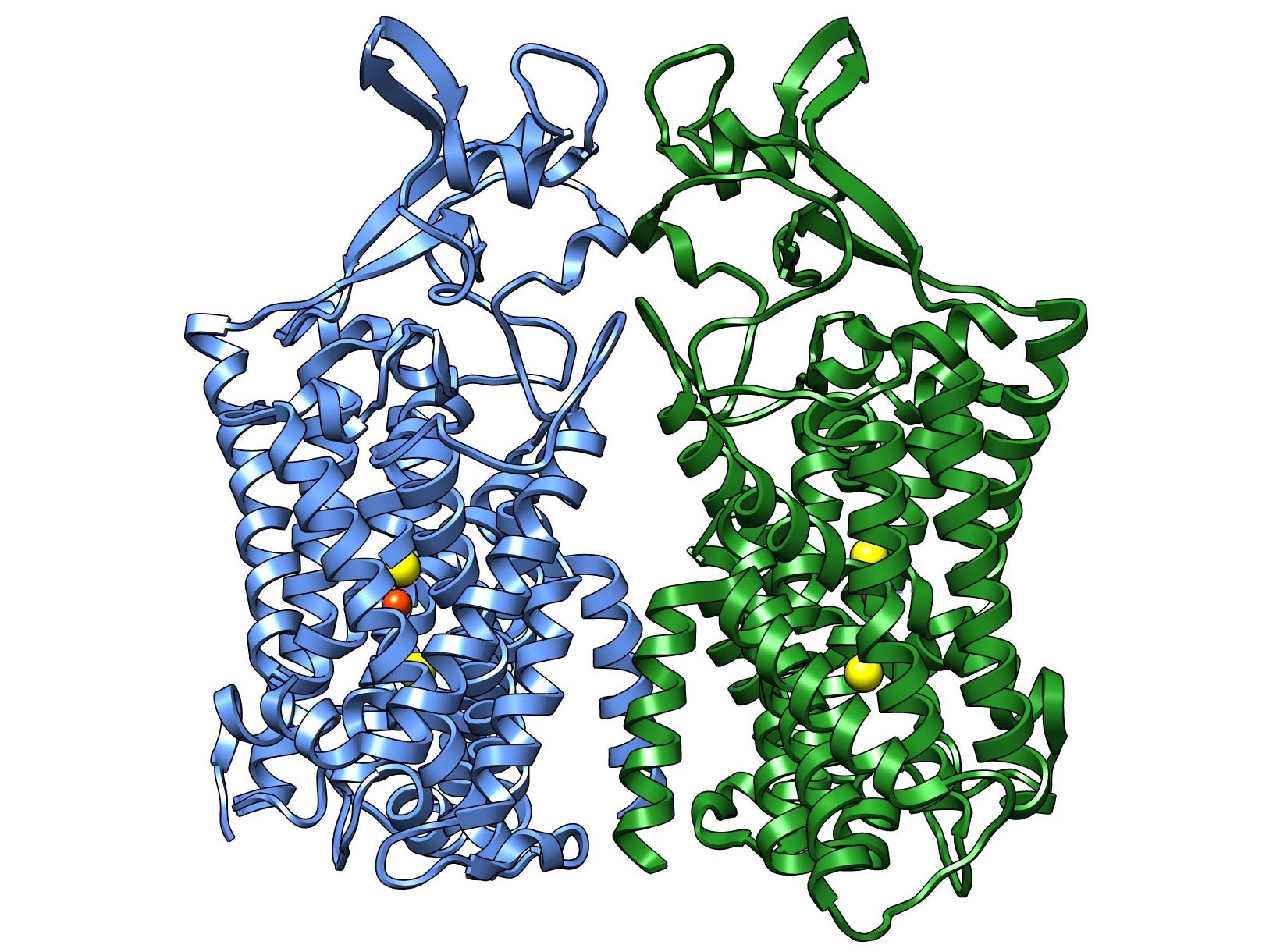
In work that could someday improve treatments for epilepsy, UT Southwestern scientists have published the first three-dimensional structure of a member of a large family of human proteins that carry charged particles – ions – across the cell membrane.
The potassium chloride cotransporter 1 (KCC1) structure solved in this study carries positively charged potassium ions (K+) and negatively charged chloride (Cl–) ions across cell membranes to help regulate the volume of the cell. The protein is one of a large family of cotransporters found in many of the body’s tissues, particularly in the kidneys and the brain.
Despite extensive study of cotransporters, the lack of high-resolution structures has hindered a deeper understanding of their actions. The scientists solved the structure using cryo-electron microscopy (cryo-EM) – an advanced technology in which samples are frozen at extremely low temperatures at speeds that prevent the formation of ice crystals.
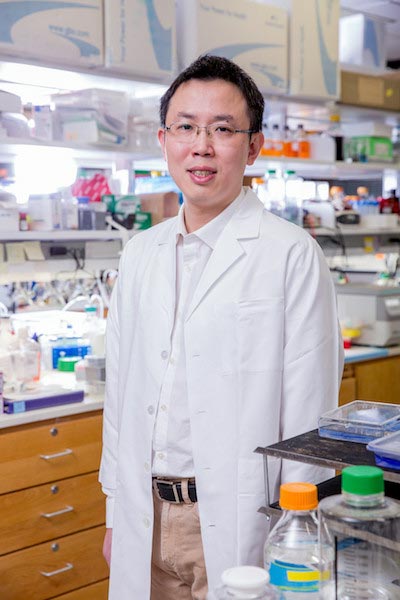
Mutations in this family of cotransporters can lead to diseases such as hereditary epilepsy, including one form that starts in infancy, said Dr. Xiao-chen Bai, corresponding author of the Science study. Drugs that target cotransporters are currently used as diuretics to treat high blood pressure.
“Cryo-EM was the only way to determine the structure of an integral membrane protein such as this one. We hope this structure will facilitate the design of drugs that target this protein,” said Dr. Bai, Assistant Professor of Biophysics and Cell Biology and a Virginia Murchison Linthicum Scholar in Medical Research as well as a Cancer Prevention and Research Institute of Texas (CPRIT) Scholar.
Proteins on the cellular membrane have been particularly resistant to X-ray crystallography, formerly considered the gold standard in structural biology technology before cryo-EM.
In cryo-EM, samples are viewed using robot-assisted microscopes that can be twice as tall as a person. These microscopes containing high-tech electron detectors work with powerful computers to record multiple images and apply advanced algorithms to interpret the data. UT Southwestern’s Cryo-EM Facility operates 24 hours a day, seven days a week.
This work at UT Southwestern using cryo-EM also required advanced specimen preparation techniques that Dr. Bai is known for internationally.
###
Reference: “Cryo-EM structures of the human cation-chloride cotransporter KCC1” by Si Liu, Shenghai Chang, Binming Han, Lingyi Xu, Mingfeng Zhang, Cheng Zhao, Wei Yang, Feng Wang, Jingyuan Li, Eric Delpire, Sheng Ye, Xiao-chen Bai and Jiangtao Guo, 25 October 2019, Science.
DOI: 10.1126/science.aay3129
Other study participants included researchers at Vanderbilt University in Nashville and from China’s Zhejiang University School of Medicine, Tianjin University, and Wuxi Biortus Biosciences Co. Ltd. One of the corresponding authors is Dr. Jingtao Guo of Zhejiang University School of Medicine, who began the project while a postdoctoral researcher in the UTSW laboratory of Dr. Youxing Jiang, Professor of Physiology and Biophysics. Dr. Jiang holds the Rosewood Corporation Chair in Biomedical Science and is a W.W. Caruth, Jr. Scholar in Biomedical Research at UT Southwestern and an Investigator of the Howard Hughes Medical Institute.
The study received funding from China’s Ministry of Science and Technology, the National Natural Science Foundation of China, Zhejiang Provincial Natural Science Foundation, the Fundamental Research Funds for the Central Universities, and Zhejiang University, and from CPRIT, The Welch Foundation, the National Institutes of Health, and the Leducq Foundation.
The authors report no competing financial interests.
About UT Southwestern Medical Center
UT Southwestern, one of the premier academic medical centers in the nation, integrates pioneering biomedical research with exceptional clinical care and education. The institution’s faculty has received six Nobel Prizes, and includes 22 members of the National Academy of Sciences, 17 members of the National Academy of Medicine, and 15 Howard Hughes Medical Institute Investigators. The full-time faculty of more than 2,500 is responsible for groundbreaking medical advances and is committed to translating science-driven research quickly to new clinical treatments. UT Southwestern physicians provide care in about 80 specialties to more than 105,000 hospitalized patients, nearly 370,000 emergency room cases, and oversee approximately 3 million outpatient visits a year.
Never miss a breakthrough: Join the SciTechDaily newsletter.
Follow us on Google and Google News.