
Close Menu
    Facebook X (Twitter) Instagram
    SciTechDaily
    • Biology
    • Chemistry
    • Earth
    • Health
    • Physics
    • Science
    • Space
    • Technology
    Facebook X (Twitter) Pinterest YouTube RSS
    SciTechDaily
    Home»Health»Naturally Occurring Molecule Enhances Defense Mechanisms Against Neurodegenerative Diseases
    Health

    Naturally Occurring Molecule Enhances Defense Mechanisms Against Neurodegenerative Diseases

    By Max Planck InstituteMarch 14, 2014No Comments3 Mins Read
    Facebook Twitter Pinterest Telegram LinkedIn WhatsApp Email Reddit
    Share
    Facebook Twitter LinkedIn Pinterest Telegram Email Reddit
    Small Worm May Help the Fight Against Alzheimers
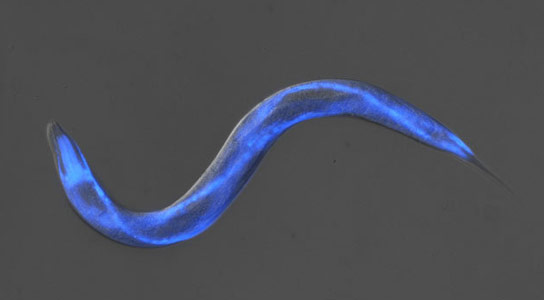
    Image of a C. elegans roundworm. The blue fluorescence highlights the tissue producing most N-acetylglucosamine. Credit: MPI for the Biology of Aging

    Scientists have discovered that a substance called N-acetylglucosamine has the ability to enhance defense mechanisms against neurodegenerative diseases, clear toxic protein aggregates and extend life span.

    Scientists at the Max Planck Institute for Biology of Aging in Cologne have found that a naturally occurring molecule has the ability to enhance defense mechanisms against neurodegenerative diseases. Feeding this particular metabolite to the small round worm Caenorhabditis elegans, helps clear toxic protein aggregates in the body and extends its life span.

    During aging, proteins in the human body tend to aggregate. At a certain point, protein aggregation becomes toxic, overloads the cell, and thus prevents it from maintaining normal function. Damage can occur, particularly in neurons, and may result in neurodegenerative diseases like Alzheimer’s, Parkinson’s, or Huntington’s disease. By studying model organisms like Caenorhabditis elegans, scientists have begun to uncover the mechanisms underlying neurodegeneration, and thus define possible targets for both therapy and prevention of those diseases. “Although we cannot measure dementia in worms“, explains Martin Denzel of the Max Planck Institute for Biology of Aging, “we can observe proteins that we also know from human diseases like Alzheimer’s to be toxic by measuring effects on neuromuscular function. This gives us insight into how Alzheimer actually progresses on the molecular level“.

    Now, the scientists Martin Denzel, Nadia Storm, and Max Planck Director Adam Antebi have discovered that a substance called N-acetylglucosamine apparently stimulates the body’s own defense mechanism against such toxicity. This metabolite occurs naturally in the organism. If it is additionally fed to the worm, “we can achieve very dramatic benefits“, says Denzel. „It is a broad-spectrum effect that alleviates protein toxicity in Alzheimer’s, Parkinson’s, and Huntington’s disease models in the worm, and it even extends their life span.“

    This molecule apparently plays a crucial role in quality control mechanisms that keep the body healthy. It helps the organism to clear toxic levels of protein aggregation, both preventing aggregates from forming and clearing already existing ones. As a result, the onset of paralysis is delayed in models of neurodegeneration – How exactly the molecule achieves this effect is yet to be uncovered. “And we still don’t know whether it also works in higher animals and humans“, says Antebi. “But as we also have these metabolites in our cells, this gives good reason to suspect that similar mechanisms might work in humans.”

    Reference: “Hexosamine pathway metabolites enhance protein quality control and prolong life” by Martin S. Denzel, Nadia J. Storm, Aljona Gutschmidt, Ruth Baddi, Yvonne Hinze, Ernst Jarosch, Thomas Sommer, Thorsten Hoppe and Adam Antebi, 13 March 2014, Cell.
    DOI: 10.1016/j.cell.2014.01.061

    Never miss a breakthrough: Join the SciTechDaily newsletter.
    Follow us on Google and Google News.

    Aging Alzheimer's Disease Cell Biology Genetics Max Planck Institute
    Share. Facebook Twitter Pinterest LinkedIn Email Reddit

    Related Articles

    Surprise Discovery Suggests Scientists May Need To Rethink Which Genes Control Aging

    Researchers Identify People That Are Missing a Critical Cell Process – Unique Insight Into Human Physiology

    Simple Blood Test Can Accurately Reveal Underlying Neurodegeneration (Dementia, ALS)

    Gene Signature Discovered for Plaque-Eating Microglia in Alzheimer’s Disease

    New Mechanism Identified Behind Leading Cause of Blindness

    Scientists Reverse the Aging Clock: Restore Age-Related Vision Loss Through Epigenetic Reprogramming

    Toxic Protein Tau Exposed – Linked to Alzheimer’s and Neurodegenerative Diseases

    Physical Exercise Improves Cognition in Alzheimer’s Disease

    Experimental Alzheimer’s Drug J147 Shows Anti-Aging Effects

    Leave A Reply Cancel Reply

    • Facebook
    • Twitter
    • Pinterest
    • YouTube

    Don't Miss a Discovery

    Subscribe for the Latest in Science & Tech!

    Trending News

    One of the Universe’s Largest Stars May Be Getting Ready To Explode

    Scientists Discover Enzyme That Could Supercharge Ozempic-Like Weight Loss Drugs

    Popular Sweetener Linked to DNA Damage – “It’s Something You Should Not Be Eating”

    Ancient “Rock” Microbes May Reveal How Complex Life Began

    Researchers Capture Quantum Interference in One of Nature’s Rarest Atoms

    “A Plague Is Upon Us”: The Mass Death That Changed an Ancient City Forever

    Scientists Discover Game-Changing New Way To Treat High Cholesterol

    This Small Change to Your Exercise Routine Could Be the Secret to Living Longer

    Follow SciTechDaily
    • Facebook
    • Twitter
    • YouTube
    • Pinterest
    • Newsletter
    • RSS
    SciTech News
    • Biology News
    • Chemistry News
    • Earth News
    • Health News
    • Physics News
    • Science News
    • Space News
    • Technology News
    Recent Posts
    • Revolutionary Imaging Technique Unlocks Secrets of Matter at Extreme Speeds
    • Where Does Mass Come From? Scientists Find Evidence of a New Exotic Nuclear State
    • Quantum Breakthrough: Unhackable Keys Sent Over 120 km Using Quantum Dots
    • Researchers Discover Unknown Beetle Species Just Steps From Their Lab
    • Jellyfish Caught Feasting on Exploding Sea Worms for the First Time
    Copyright © 1998 - 2026 SciTechDaily. All Rights Reserved.
    • Science News
    • About
    • Contact
    • Editorial Board
    • Privacy Policy
    • Terms of Use

    Type above and press Enter to search. Press Esc to cancel.