
Close Menu
    Facebook X (Twitter) Instagram
    SciTechDaily
    • Biology
    • Chemistry
    • Earth
    • Health
    • Physics
    • Science
    • Space
    • Technology
    Facebook X (Twitter) Pinterest YouTube RSS
    SciTechDaily
    Home»Technology»Single Molecule-Based Electronic Devices Explored
    Technology

    Single Molecule-Based Electronic Devices Explored

    By World ScientificDecember 9, 2019No Comments4 Mins Read
    Facebook Twitter Pinterest Telegram LinkedIn WhatsApp Email Reddit
    Share
    Facebook Twitter LinkedIn Pinterest Telegram Email Reddit
    Formation and Measurement of Molecular Junctions of Oligofluorenes
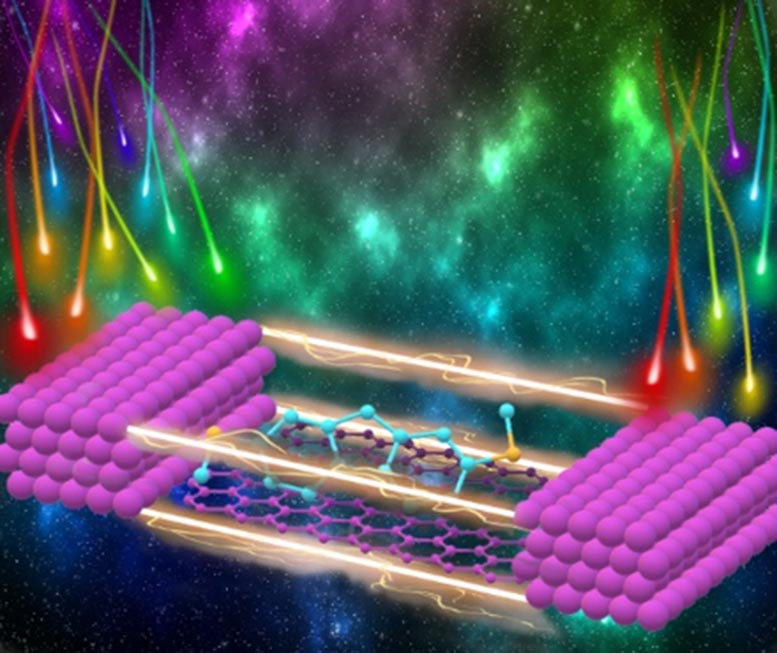
    A schematic diagram of formation and measurement of molecular junctions of oligofluorenes. Oligofluorene molecular wires can be synthesized with high efficiency and high purity. They can be easily incorporated into single molecule circuits under the conditions of solution phase, ambient temperature, and pressure. The molecular conductance of newly synthesized oligofluorene molecules was measured by scanning tunneling microscopy based break-junction method. These molecules can be easily integrated into single molecule circuits. Compared with prototype lines with extended π-electronic states, such as oligophenyleneethynylene and oligophenylenevinylene, oligomeric fluorene molecular lines show higher conductivity, and there is a correlation between conductivity trend and the energy gap between the highest occupied molecular orbital and lowest unoccupied molecular orbital. Credit: Bingrun Chen

    In a paper to be published in the forthcoming issue in NANO, a group of researchers from the Shenyang Jianzhu University in China provide an overview of single molecule electronic devices, including molecular electronic devices and electrode types. Future challenges to the development of electronic devices based on single molecules are described, in the hopes of attracting more experts from different fields to participate in this research.

    How small can computers be in the future? Can you imagine how molecular machines works?

    At present, traditional electronic devices based on semiconductor materials will face severe challenges. These challenges are not only technical and technological limitations, but also, more importantly, theoretical limitations. With the rapid development of nanotechnology and in-depth research, great progress has been made in the theory and practice of molecular electronic devices in recent years

    Molecular electronic devices use molecules (including biomolecules) with certain structures and functions to build an ordered system in the molecular scale or supramolecular scale. They make use of the quantum effect of electrons to work, control the behavior of single electrons, and realize the functions of information detection, processing, transmission, and storage, such as molecular diodes, molecular memories, molecular wires, molecular field effect transistors, and molecular switches.

    As a stable quantum system with abundant photoelectric properties, molecules have many electronic transport properties different from semiconductor devices. Molecular electronic devices have the following advantages: (1) small molecular volume, which can improve the integration and operation speed; (2) selecting appropriate components and structures can widely change the electrical properties of molecules; (3) molecules are easy to synthesize, and the required structure can be formed by a self-assembly method; and (4) the molecular scale is on the nanometer scale and has advantages in cost, efficiency, and power consumption.

    With the traditional silicon-based electronic devices becoming smaller and smaller, the impact of quantum effects is gradually recognized. The research on molecular electronics has made significant breakthroughs. As more and more excellent characteristics such as potential thermoelectric effects, new thermally induced spin transport phenomena, and negative differential resistance are discovered and understood, it is believed that “smaller,” “faster” and “cooler” high-tech products will eventually be realized in the future.

    However, at present, all research work on molecular devices is still theoretical, and there is still much work to be done in terms of device manufacturing reliability, experimental repeatability, and manufacturing cost. Therefore, the purpose of this review is to attract more experts, scholars, and engineers from different fields such as chemistry, physics and microelectronics to participate in this research, so that molecular electronic devices can become a reality as soon as possible.

    Reference: “Single Molecule-Based Electronic Devices: A Review” by Bingrun Chen and Ke Xu, 8 October 2019, NANO.
    DOI: 10.1142/S179329201930007X

    This work was supported by the National Nature Science Foundation of China (Grant Nos. 11704263).

    The corresponding author for this study is Bingrun Chen. Ke Xu from Shenyang Jianzhu University is a co-author.

    Never miss a breakthrough: Join the SciTechDaily newsletter.
    Follow us on Google and Google News.

    Nanotechnology Particle Physics
    Share. Facebook Twitter Pinterest LinkedIn Email Reddit

    Related Articles

    Scientists Strengthen Spin-Orbit Qubits in Milestone Critical for Scale-Up of Quantum Computers

    New Design for “Optical Ruler” Could Revolutionize Clocks, Telescopes, Telecommunications

    Using Chaos as a Tool: Scientists Discover New Method of Making 3D-Heterostructures

    First Quantum Phase “Supercurrent” Battery Ever Developed

    Unraveling the “Magic” Magnetism of a Triangular Graphene Flake

    Researchers Gain Control Over Transparency With Tuning Optical Resonators

    Stanford Researchers Miniaturize a Particle Accelerator to Fit on a Silicon Chip

    Hole-y Superconductor: Entirely New State of Matter Discovered

    New Technology Can Instantly Identify Airborne Chemicals – Down to Parts-Per-Billion

    Leave A Reply Cancel Reply

    • Facebook
    • Twitter
    • Pinterest
    • YouTube

    Don't Miss a Discovery

    Subscribe for the Latest in Science & Tech!

    Trending News

    Monster Storms on Jupiter Unleash Lightning Beyond Anything on Earth

    Scientists Create “Liquid Gears” That Spin Without Touching

    The Simple Habit That Could Help Prevent Cancer

    Millions Take These IBS Drugs, But a New Study Finds Serious Risks

    Scientists Unlock Hidden Secrets of 2,300-Year-Old Mummies Using Cutting-Edge CT Scanner

    Bread Might Be Making You Gain Weight Even Without Eating More Calories

    Scientists Discover Massive Magma Reservoir Beneath Tuscany

    Europe’s Most Active Volcano Just Got Stranger – Here’s Why Scientists Are Rethinking It

    Follow SciTechDaily
    • Facebook
    • Twitter
    • YouTube
    • Pinterest
    • Newsletter
    • RSS
    SciTech News
    • Biology News
    • Chemistry News
    • Earth News
    • Health News
    • Physics News
    • Science News
    • Space News
    • Technology News
    Recent Posts
    • Scientists Were Wrong About This Strange “Rule-Breaking” Particle
    • Webb Space Telescope Uncovers Unexpected Ice Clouds on a Jupiter-Like World
    • 289-Million-Year-Old Reptile Mummy Reveals Origin of Human Breathing System
    • New Brain Discovery Challenges Long-Held Theory of Teenage Brain Development
    • Sharks Are Overheating as Warming Oceans Push Them to the Edge
    Copyright © 1998 - 2026 SciTechDaily. All Rights Reserved.
    • Science News
    • About
    • Contact
    • Editorial Board
    • Privacy Policy
    • Terms of Use

    Type above and press Enter to search. Press Esc to cancel.