
Close Menu
    Facebook X (Twitter) Instagram
    SciTechDaily
    • Biology
    • Chemistry
    • Earth
    • Health
    • Physics
    • Science
    • Space
    • Technology
    Facebook X (Twitter) Pinterest YouTube RSS
    SciTechDaily
    Home»Technology»Unraveling the “Magic” Magnetism of a Triangular Graphene Flake
    Technology

    Unraveling the “Magic” Magnetism of a Triangular Graphene Flake

    By Elhuyar FundazioaMay 17, 2020No Comments3 Mins Read
    Facebook Twitter Pinterest Telegram LinkedIn WhatsApp Email Reddit
    Share
    Facebook Twitter LinkedIn Pinterest Telegram Email Reddit
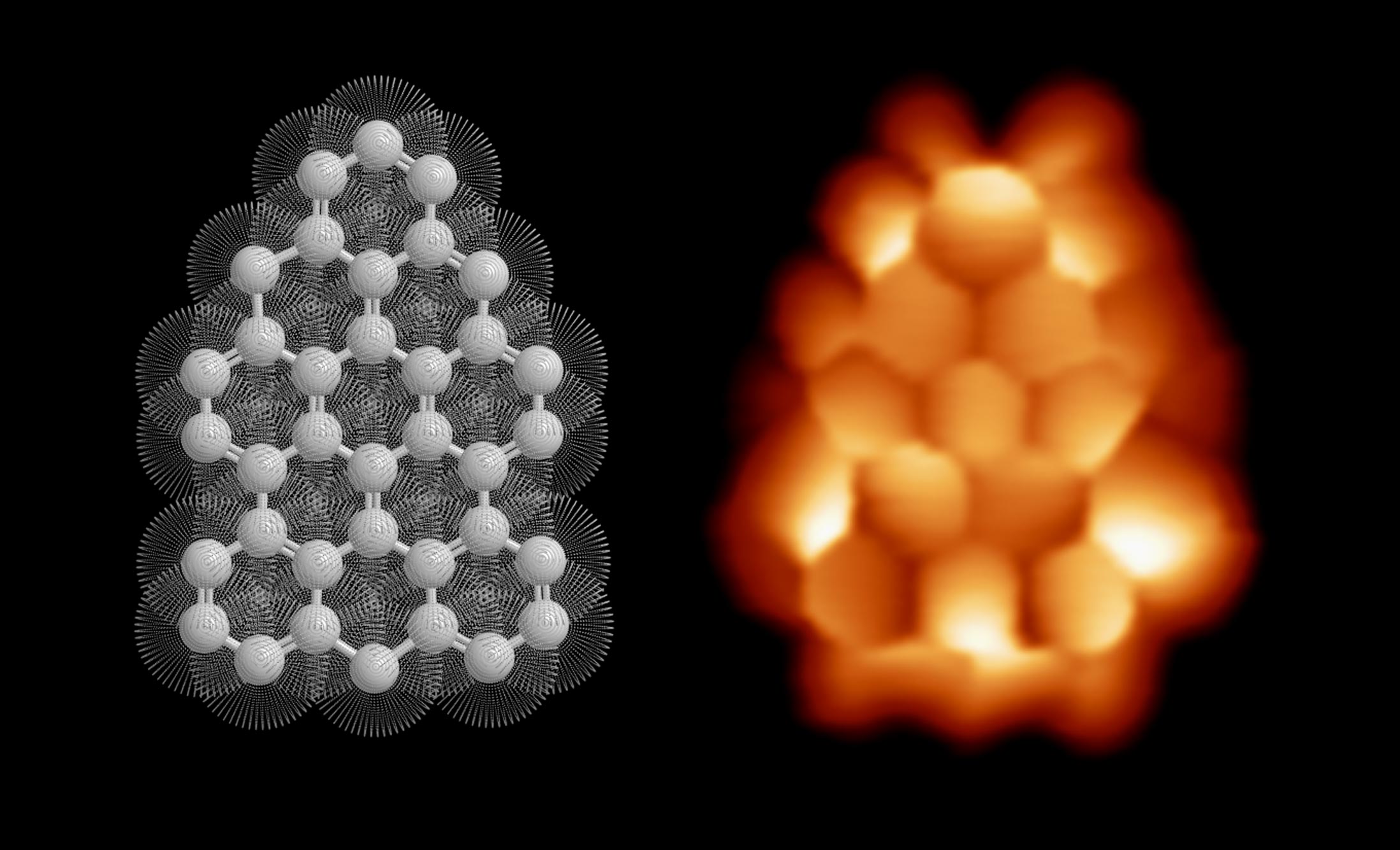
    Triangular Magnetic Graphene
    A triangular piece of graphene is predicted to be magnetic. Credit: CIC nanoGUNE

    Graphene is a diamagnetic material, this is, unable of becoming magnetic. However, a triangular piece of graphene is predicted to be magnetic. This apparent contradiction is a consequence of “magic” shapes in the structure of graphene flakes, which force electrons to “spin” easier in one direction. Triangulene is a triangular graphene flake, which possesses a net magnetic moment: it is a graphene nanometer-size magnet. This magnetic state opens fascinating perspectives on the use of these pure-carbon magnets in technology.

    However, the robust predictions of triangulene magnetism stumbled with the absence of clear experimental proofs, because the production of triangulene by organic synthesis methods in solution was difficult. The bi-radical character of this molecule caused it to be very reactive and difficult to fabricate, and the magnetism appears to be very elusive in those few successful cases.

    In a new study, published in Physical Review Letters, this challenge was revisited using a scanning tunneling microscope (STM). After assembling a triangular-like piece of graphene on a clean gold surface, high-resolution scanning tunneling spectroscopy measurements revealed that this compound has a net magnetic state characterized by a spin S=1 ground state and, therefore, that this molecule is a small, pure carbon paramagnet. These results are the first experimental demonstration of a high-spin graphene flake.

    The findings were further complemented with atomic manipulation steps of hydrogen-passivated triangulene side-products occasionally found in the experiment. By controlled removal of these additional hydrogen atoms in the experiments, the spin state of the flake could be modified from a closed-shell, doubly hydrogenated structure, to an intermediate S=1/2 spin state, and finally to the high-spin S=1 state of the ideal molecular structure.

    The experimental proof of a spin-state in the absence of a magnetic quantization axis (detectable by spin-polarized STM) or magnetic anisotropy (detectable by spin-flip inelastic tunneling spectroscopy) is not simple. In this work, the spin signature was obtained from the underscreened Kondo effect – an exotic version of the standard Kondo effect described in the 1960s – that can arise in high-spin systems. Its observation in a graphene flake on a metal has not been reported before and brings here novel insights to understanding spins interacting with surfaces.

    Reference: “Uncovering the Triplet Ground State of Triangular Graphene Nanoflakes Engineered with Atomic Precision on a Metal Surface” by Jingcheng Li, Sofia Sanz, Jesus Castro-Esteban, Manuel Vilas-Varela, Niklas Friedrich, Thomas Frederiksen, Diego Peña and Jose Ignacio Pascual, 27 April 2020, Physical Review Letters.
    DOI: 10.1103/PhysRevLett.124.177201

    The work was the result of a fruitful collaboration between theoretical and experimental groups at the Donostia International Physics Center (DIPC) and CIC nanoGUNE, both research institutes in San Sebastian, as well as an organic synthesis group at CiQUS, in Santiago de Compostela.

    Never miss a breakthrough: Join the SciTechDaily newsletter.
    Follow us on Google and Google News.

    Graphene Materials Science Nanotechnology Particle Physics
    Share. Facebook Twitter Pinterest LinkedIn Email Reddit

    Related Articles

    Findings to Help Achieve Holy Grail of 2D Materials – Superfast Electronic Devices

    EPFL Creates Memory Cell by Combining Molybdenite and Graphene

    A Cost-Effective Fabrication Method for Micro-Scale Graphene-Based Supercapacitors

    Triangular Layers of Tungsten Disulfide May Have Applications in Optical Technology

    Growing Graphene Without the Defects

    A Step Towards 2D Devices, Hybrid Graphene/Hexagonal Boron Nitride

    Controlled Graphene Crumpling Used as Artificial Muscle Actuators

    New 3D Form of Graphene May Lead to Flexible Electronics

    “Patterned Regrowth” May Lead to Graphene-Based Circuits

    Leave A Reply Cancel Reply

    • Facebook
    • Twitter
    • Pinterest
    • YouTube

    Don't Miss a Discovery

    Subscribe for the Latest in Science & Tech!

    Trending News

    Popular Sugar-Free Sweetener Linked to Liver Disease, Study Warns

    What Is Hantavirus? The Deadly Disease Raising Alarm Worldwide

    Scientists Just Discovered How the Universe Builds Monster Black Holes

    Scientists Unveil New Treatment Strategy That Could Outsmart Cancer

    A Simple Vitamin May Hold the Key to Treating Rare Genetic Diseases

    Scientists Think the Real Fountain of Youth May Be Hiding in Your Gut

    Ravens Don’t Follow Wolves, They Predict Them

    This Common Knee Surgery May Be Doing More Harm Than Good

    Follow SciTechDaily
    • Facebook
    • Twitter
    • YouTube
    • Pinterest
    • Newsletter
    • RSS
    SciTech News
    • Biology News
    • Chemistry News
    • Earth News
    • Health News
    • Physics News
    • Science News
    • Space News
    • Technology News
    Recent Posts
    • Why Are So Many New Fathers Dying? Scientists Say the U.S. Has a Dangerous Blind Spot
    • Scientists Identify Simple Supplement That Greatly Reduces Alzheimer’s Damage
    • You May Have a Dangerous Type of Cholesterol Even if Your Tests Look Normal
    • Study Reveals Dangerous Flaw in AI Symptom Checkers
    • New MRI Breakthrough Captures Stunningly Clear Images of the Eye and Brain
    Copyright © 1998 - 2026 SciTechDaily. All Rights Reserved.
    • Science News
    • About
    • Contact
    • Editorial Board
    • Privacy Policy
    • Terms of Use

    Type above and press Enter to search. Press Esc to cancel.