

Close Menu
    Facebook X (Twitter) Instagram
    SciTechDaily
    • Biology
    • Chemistry
    • Earth
    • Health
    • Physics
    • Science
    • Space
    • Technology
    Facebook X (Twitter) Pinterest YouTube RSS
    SciTechDaily
    Home»Chemistry»Revolutionary Carbon-Based Magnetic Material Finally Synthesized After 70 Years
    Chemistry

    Revolutionary Carbon-Based Magnetic Material Finally Synthesized After 70 Years

    By Osaka UniversityJanuary 28, 2022No Comments3 Mins Read
    Facebook Twitter Pinterest Telegram LinkedIn WhatsApp Email Reddit
    Share
    Facebook Twitter LinkedIn Pinterest Telegram Email Reddit
    Abstract Energy Magnetism Concept
    Researchers have synthesized a crystalline nanographene with magnetic properties predicted since the 1950s, previously confirmed only at extremely low temperatures.

    Researchers from Osaka University and Osaka City University synthesize and crystallize a molecule that is otherwise too unstable to fully study in the laboratory, and is a model of a revolutionary class of magnets.

    Since the first reported production in 2004, researchers have been hard at work using graphene and similar carbon-based materials to revolutionize electronics, sports, and many other disciplines. Now, researchers from Japan have made a discovery that will advance the long-elusive field of nanographene magnets.

    In a study recently published in Journal of the American Chemical Society, researchers from Osaka University and collaborating partners have synthesized a crystalline nanographene with magnetic properties that have been predicted theoretically since the 1950s, but until now have been unconfirmed experimentally except at extremely low temperatures.
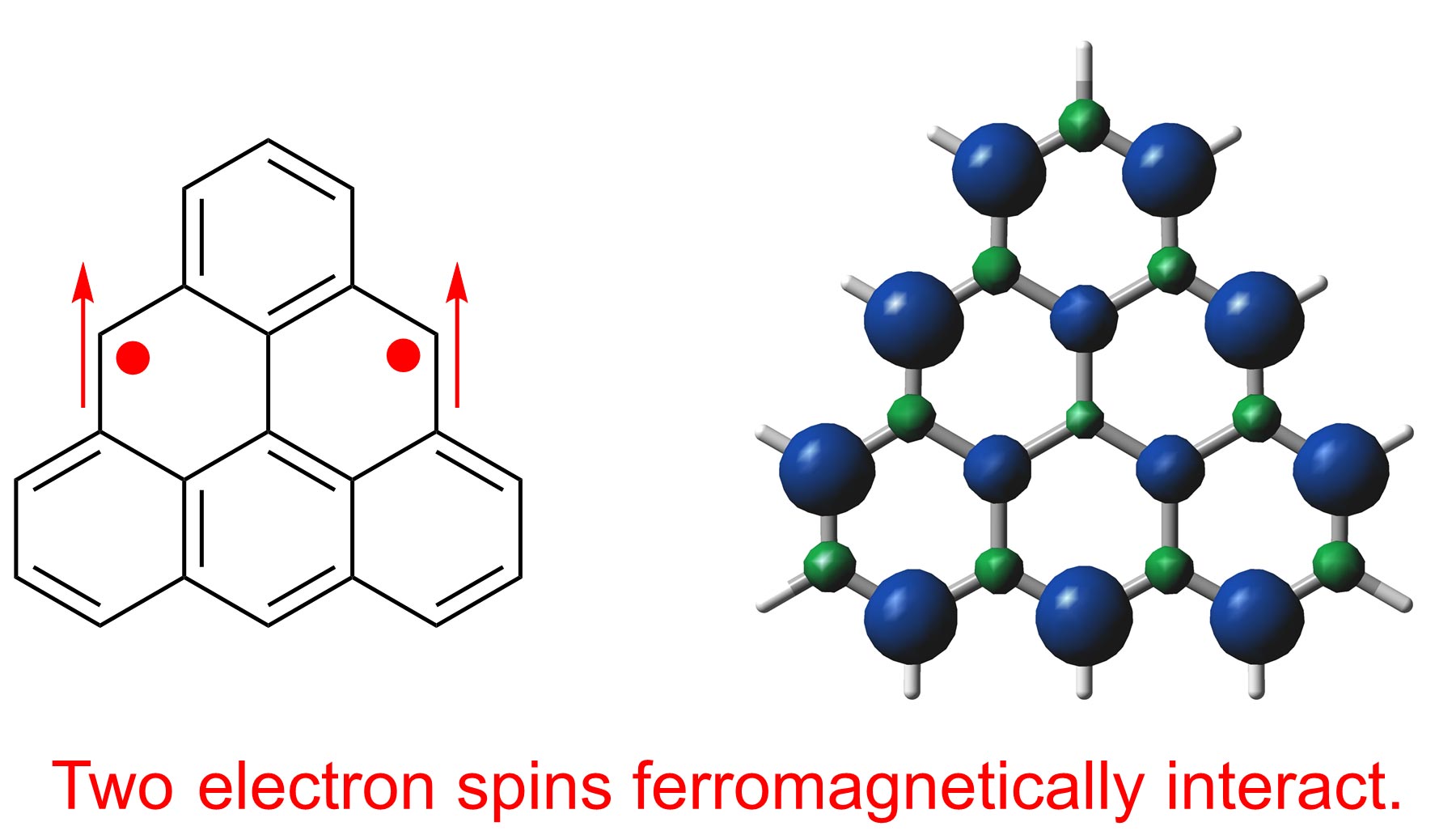
    Structure and Spin Density Distribution of Triangulene
    Structure and spin density distribution of triangulene. Credit: Shinobu Arikawa et al.

    Graphene is a single layer, two-dimensional sheet of carbon rings arranged in a honeycomb lattice. Why does graphene excite researchers? Graphene has impressive properties—it exhibits efficient, long-distance charge transport and has a much higher strength than similarly thick steel. Nanostructures of graphene have edges that exhibit magnetic and electronic properties that researchers would like to exploit. However, graphene nanosheets are difficult to prepare and it’s difficult to study their zigzag edge properties. Overcoming these challenges by using a simpler, yet advanced, model system known as triangulene is something the researchers at Osaka University aimed to address.

    “Triangulene has long eluded synthesis in a crystalline form because of its uncontrolled polymerization,” say both Shinobu Arikawa and Akihiro Shimizu, two key authors of the study. “We prevented this polymerization by steric protection—bulking up the molecule—and did so in a way that didn’t affect its underlying properties.”

    Structure and Spin Density Distribution of Triangulene and Space-Filling Model
    Spin density distribution of triangulene and space-filling model and crystal structure of triangulene derivatives. Credit: Shinobu Arikawa et al.

    The researchers’ triangulene derivative is stable at room temperature but must be kept in an inert atmosphere because it slowly degrades when exposed to oxygen. Nevertheless, crystallization was possible—which enabled confirmation of its theoretically predicted properties, such as localization of unpaired electrons on the zigzag edges of the molecule.

    “By measuring its optical and magnetic properties, we confirmed that our molecule is in the triplet ground state,” explains Ryo Shintani, senior author. “This is an electronic state that can serve as an experimentally tractable model for zigzag-edged nanographene.”

    These results have important applications. Researchers can extend the long-sought synthetic procedure reported here to increase the number of carbon rings in the molecule and perform chemical syntheses of advanced forms of nanographene. In so doing, Osaka University and Osaka City University researchers may be able to synthesize materials that are foundational for future advanced electronics and magnets, and supplement the silicon that’s ubiquitous in modern electronics.

    Reference: “Synthesis and Isolation of a Kinetically Stabilized Crystalline Triangulene” by Shinobu Arikawa, Akihiro Shimizu, Daisuke Shiomi, Kazunobu Sato and Ryo Shintani, 12 November 2021, Journal of the American Chemical Society.
    DOI: 10.1021/jacs.1c10151

    Never miss a breakthrough: Join the SciTechDaily newsletter.
    Follow us on Google and Google News.

    Crystals Materials Science Organic Chemistry Popular University of Osaka
    Share. Facebook Twitter Pinterest LinkedIn Email Reddit

    Related Articles

    After Decades of Global Searching, Scientists Finally Create the Silicon Aromatic Once Thought Impossible

    Breaking the Rules of Chemistry: New Theory Shatters Old Ideas About Crystal Formation

    125 Years After Its Discovery, Actinium’s Chemistry Still Baffles Scientists

    New Ultrahard Diamond Glass Synthesized Using Carbon Buckyballs

    New Technology Can Instantly Identify Airborne Chemicals – Down to Parts-Per-Billion

    Unique Particles – With Stickiness of Gecko Feet – Formed by Harnessing Chaos

    Powerful New Electronics Could Be Created at the Edge of Chaos

    New Discovery Makes Valuable Chemicals Using Excess Carbon Dioxide in the Atmosphere

    Scientists Synthesize an Entirely New Form of Silicon

    Leave A Reply Cancel Reply

    • Facebook
    • Twitter
    • Pinterest
    • YouTube

    Don't Miss a Discovery

    Subscribe for the Latest in Science & Tech!

    Trending News

    Scientists Uncover Potential Brain Risks of Popular Fish Oil Supplements

    Scientists Discover a Surprising Way To Make Bread Healthier and More Nutritious

    After 60 Years, Scientists Uncover Unexpected Brain Effects of Popular Diabetes Drug Metformin

    New Research Uncovers Hidden Side Effects of Popular Weight-Loss Drugs

    Scientists Rethink Extreme Warming After Surprising Ocean Discovery

    Landmark Study Links Never Marrying to Significantly Higher Cancer Risk

    Researchers Discover Unknown Beetle Species Just Steps From Their Lab

    Largest-Ever Study Finds Medicinal Cannabis Ineffective for Anxiety, Depression, PTSD

    Follow SciTechDaily
    • Facebook
    • Twitter
    • YouTube
    • Pinterest
    • Newsletter
    • RSS
    SciTech News
    • Biology News
    • Chemistry News
    • Earth News
    • Health News
    • Physics News
    • Science News
    • Space News
    • Technology News
    Recent Posts
    • Scientists Discover Caffeine Can Repair Key Memory Circuits After Sleep Loss
    • Strange 65-Foot Dinosaur Discovered in Argentina
    • Researchers Uncover Source of Strange Deformation in Earth’s Largest Continental Rift
    • Scientists Solve Mystery of Where the Colorado River Vanished Millions of Years Ago
    • Not Just Alzheimer’s: Scientists Uncover Clues to a Second, Overlooked Disorder
    Copyright © 1998 - 2026 SciTechDaily. All Rights Reserved.
    • Science News
    • About
    • Contact
    • Editorial Board
    • Privacy Policy
    • Terms of Use

    Type above and press Enter to search. Press Esc to cancel.