
A group of international scientists have substantially lengthened the duration of time that a spin-orbit qubit in silicon can retain quantum information for, opening up a new pathway to make silicon quantum computers more scalable and functional.
Spin-orbit qubits have been investigated for over a decade as an option to scale up the number of qubits in a quantum computer, as they are easy to manipulate and couple over long distances. However, they have always shown very limited coherence times, far too short for quantum technologies.
The research published on July 20, 2020, in Nature Materials shows that long coherence times are possible when spin-orbit coupling is strong enough. In fact, the scientists demonstrated coherence times 10,000 times longer than previously recorded for spin-orbit qubits, making them an ideal candidate for scaling up silicon quantum computers.
“We turned the conventional wisdom on its head by demonstrating exceptionally long coherence times — ~10 milliseconds — and therefore, that spin-orbit qubits can be remarkably robust,” says UNSW Professor Sven Rogge, Chief Investigator, Centre for Quantum Computation and Communication Technology (CQC2T), who led the research team.
Strong coupling is key
How stable a qubit is determines the length of time that it can preserve quantum information for.
In spin-orbit qubits information is stored on the spin of the electron as well as its motion — how it ‘orbits’ atoms in the lattice of the chip. It is the strength of the coupling between these two spins that keeps the qubit stable and less prone to being destroyed by electric noise in devices.
“The quantum information in most spin-orbit qubits is extremely fragile. Our spin-orbit qubit is special because quantum information stored in it is very robust,” says lead author Dr. Takashi Kobayashi, who performed the research at UNSW and is now at Tohoku University.
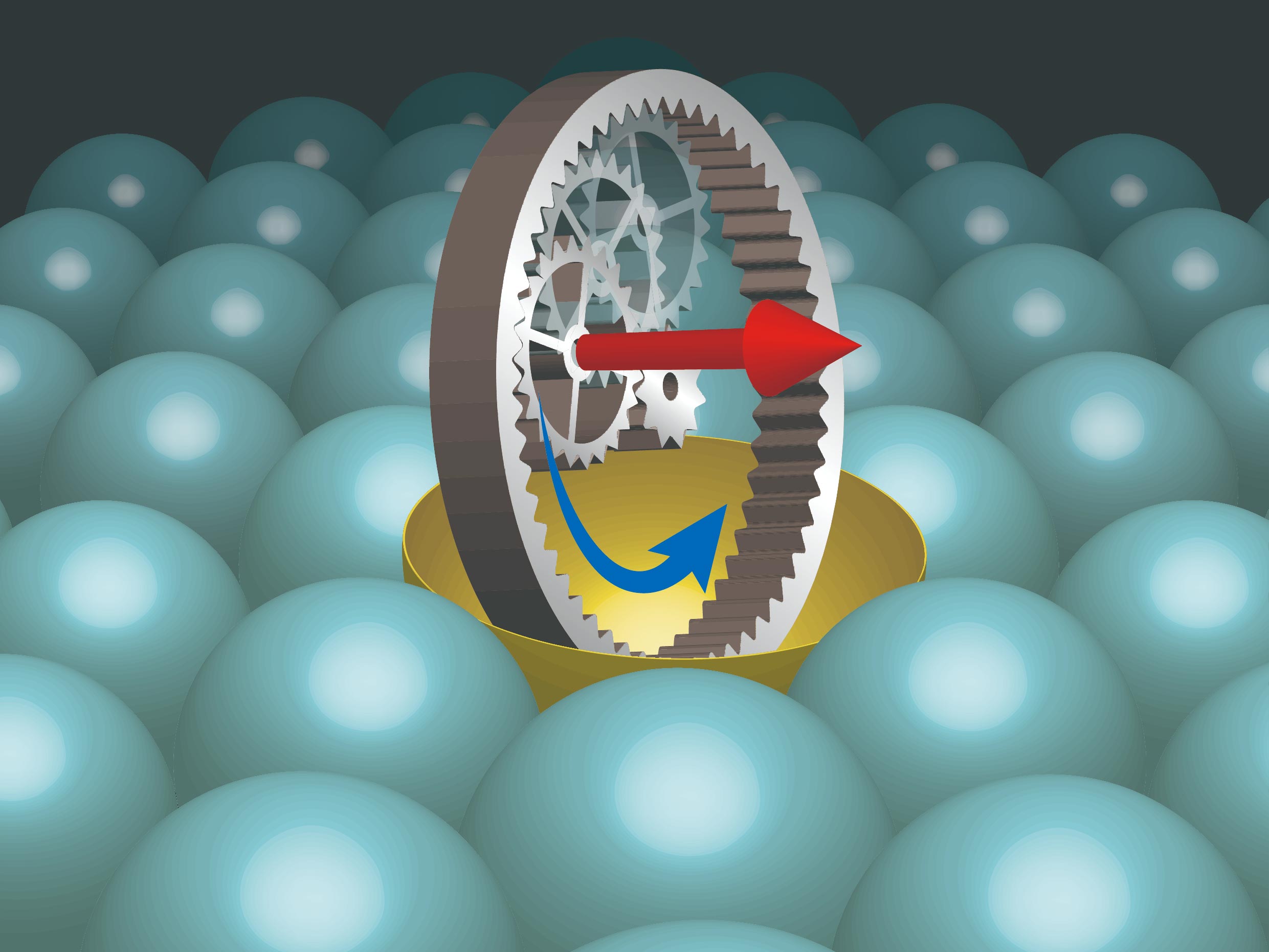
“The information is stored in the orientation of the spin and orbit of the electron, not just the spin. The circular orbit of the charged electron and the spin are locked together like gears due to the very strong attraction in the spin-orbit coupling.
“Increasing the strength of that spin-orbit coupling lets us achieve the significantly longer coherence times we’ve published today.”
Engineering longer coherence times
To increase the coherence time, the researchers first created spin-orbit qubits by introducing impurities, called acceptor dopant atoms, in a silicon crystal. The team then modified the strain in the silicon lattice structure of the chip to generate different levels of spin-orbit coupling.
“The crystal is special because it only contains the isotope of silicon with no nuclear spin. This eliminates magnetic noise, and because it is strained sensitivity to electric noise is also reduced.” Says Kobayashi.
“Our chip was fixed onto a material that at a low temperature stretches out the silicon — like a rubber band. Stretching the lattice to the correct tension allowed us to tune the spin-orbit coupling to the optimal value.”
The end result produced coherence times over 10,000 times longer than previously found in spin-orbit qubits.
This means quantum information is preserved for much longer, allowing many more operations to be performed — an important stepping-stone for scaling up quantum computers.
Scaling up with spin-orbit coupling
For a quantum computer to outperform a classical computer, a large number of qubits need to work together to perform complex calculations.
“The stability of our spin-orbit qubit to electric fields is unique, proving a robust new pathway to make scalable quantum computers.” Says co-author Joe Salfi, who performed the research at CQC2T and is now at the University of British Columbia.
The finding ultimately enables new ways of manipulating individual qubits and coupling qubits over much larger distances, which will make the chip fabrication process more flexible.
The electrical interaction also allows coupling to other quantum systems, opening up the prospects of hybrid quantum systems.
Earlier research published in Science Advances by the UNSW team showed spin-orbit coupling in silicon provides many advantages for scaling up to a large number of qubits.
“Spins in silicon are very attractive for scalable quantum information devices because they’re stable and compatible with current computer processing techniques, making those devices easy to manufacture,” says Prof. Rogge.
“Now that we’ve demonstrated long coherence times, spin-orbit qubits make a strong candidate for a large-scale quantum processor in silicon.”
References:
“Engineering long spin coherence times of spin–orbit qubits in silicon” by Takashi Kobayashi, Joseph Salfi, Cassandra Chua, Joost van der Heijden, Matthew G. House, Dimitrie Culcer, Wayne D. Hutchison, Brett C. Johnson, Jeff C. McCallum, Helge Riemann, Nikolay V. Abrosimov, Peter Becker, Hans-Joachim Pohl, Michelle Y. Simmons and Sven Rogge, 20 July 2020, Nature Materials.
DOI: 10.1038/s41563-020-0743-3
“Readout and control of the spin-orbit states of two coupled acceptor atoms in a silicon transistor” by Joost van der Heijden, Takashi Kobayashi, Matthew G. House, Joe Salfi, Sylvain Barraud, Romain Laviéville, Michelle Y. Simmons and Sven Rogge, 7 December 2020, Science Advances.
DOI: 10.1126/sciadv.aat9199
Never miss a breakthrough: Join the SciTechDaily newsletter.
Follow us on Google and Google News.