
Close Menu
    Facebook X (Twitter) Instagram
    SciTechDaily
    • Biology
    • Chemistry
    • Earth
    • Health
    • Physics
    • Science
    • Space
    • Technology
    Facebook X (Twitter) Pinterest YouTube RSS
    SciTechDaily
    Home»Earth»Mass Extinction That Killed the Dinosaurs Was All About the Asteroid – Not Volcanoes
    Earth

    Mass Extinction That Killed the Dinosaurs Was All About the Asteroid – Not Volcanoes

    By Yale UniversityJanuary 18, 2020No Comments3 Mins Read
    Facebook Twitter Pinterest Telegram LinkedIn WhatsApp Email Reddit
    Share
    Facebook Twitter LinkedIn Pinterest Telegram Email Reddit

    Dinosaur Extinction Asteroid

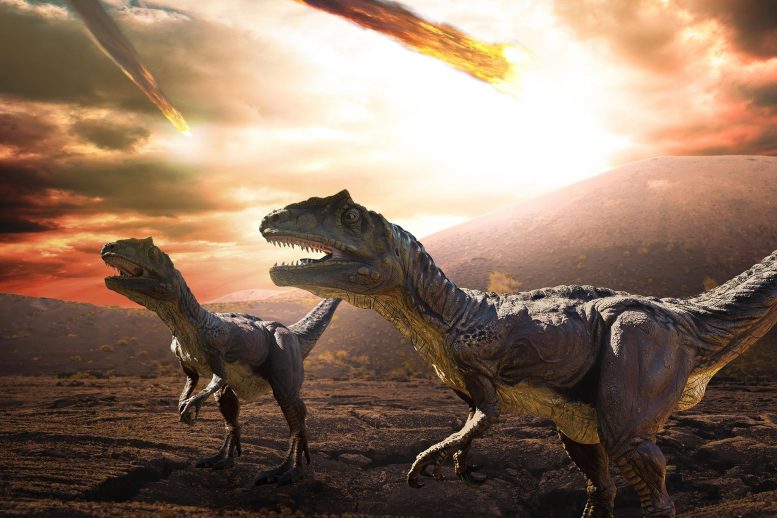
    Volcanic activity did not play a direct role in the mass extinction event that killed the dinosaurs, according to an international, Yale-led team of researchers. It was all about the asteroid.

    In a break from a number of other recent studies, Yale assistant professor of geology & geophysics Pincelli Hull and her colleagues argue in a new research paper in Science that environmental impacts from massive volcanic eruptions in India in the region known as the Deccan Traps happened well before the Cretaceous-Paleogene extinction event 66 million years ago and therefore did not contribute to the mass extinction.

    Most scientists acknowledge that the mass extinction event, also known as K-Pg, occurred after an asteroid slammed into Earth. Some researchers also have focused on the role of volcanoes in K-Pg due to indications that volcanic activity happened around the same time.

    “Volcanoes can drive mass extinctions because they release lots of gases, like SO2 and CO2, that can alter the climate and acidify the world,” said Hull, lead author of the new study. “But recent work has focused on the timing of lava eruption rather than gas release.”

    To pinpoint the timing of volcanic gas emission, Hull and her colleagues compared global temperature change and the carbon isotopes (an isotope is an atom with a higher or lower number of neutrons than normal) from marine fossils with models of the climatic effect of CO2 release. They concluded that most of the gas release happened well before the asteroid impact — and that the asteroid was the sole driver of extinction.

    “Volcanic activity in the late Cretaceous caused a gradual global warming event of about two degrees, but not mass extinction,” said former Yale researcher Michael Henehan, who compiled the temperature records for the study. “A number of species moved toward the North and South poles but moved back well before the asteroid impact.”

    Added Hull, “A lot of people have speculated that volcanoes mattered to K-Pg, and we’re saying, ‘No, they didn’t.'”

    Recent work on the Deccan Traps, in India, has also pointed to massive eruptions in the immediate aftermath of the K-Pg mass extinction. These results have puzzled scientists because there is no warming event to match. The new study suggests an answer to this puzzle, as well.

    “The K-Pg extinction was a mass extinction and this profoundly altered the global carbon cycle,” said Yale postdoctoral associate Donald Penman, the study’s modeler. “Our results show that these changes would allow the ocean to absorb an enormous amount of CO2 on long time scales — perhaps hiding the warming effects of volcanism in the aftermath of the event.”

    German researcher André Bornemann was co-lead author of the study. Yale researcher Ellen Thomas was a co-author of the study, along with additional researchers from institutions in Germany, the United Kingdom, France, Spain, Japan, Denmark, and the United States.

    The International Ocean Discovery Program, the National Science Foundation, and Yale University helped fund the research.

    Never miss a breakthrough: Join the SciTechDaily newsletter.
    Follow us on Google and Google News.

    Dinosaurs Extinction Paleontology Yale University
    Share. Facebook Twitter Pinterest LinkedIn Email Reddit

    Related Articles

    Living Fossils? How Crocodiles Survived What Dinosaurs Couldn’t

    The Reign of the Dinosaurs Ended in Spring: Revelations From Bones of Fish That Died When the Asteroid Hit

    Global Mercury Contamination and Warming When Dinosaurs Perished

    Dinosaur Egg Color Had a Single Evolutionary Origin

    Evidence Shows Dinosaur Extinction Drove Pulses of Fish Diversification

    Mongolian Microfossils Shed Light on the Rise of Animals

    Scientists Replicate the Molecular Processes That Led from Dinosaur Snouts to Bird Beaks

    Study Explains Prevalence of Hadrosaur Skin Among All Known Dinosaur Skin Fossils

    Researchers Conclude Torosaurus and Triceratops Are Different Species of Horned Dinosaurs

    Leave A Reply Cancel Reply

    • Facebook
    • Twitter
    • Pinterest
    • YouTube

    Don't Miss a Discovery

    Subscribe for the Latest in Science & Tech!

    Trending News

    New Research Challenges Common Exercise Advice for Bone Health

    Avoiding These 3 Health Risks in Midlife Linked to 13 More Years Without Dementia

    Where Were All the Tiny Dinosaurs? Scientists May Finally Have an Answer

    Humanity May Soon Have the Technology To Reach Other Star Systems

    Popular GLP-1 Weight-Loss Drugs Linked to 30% Lower Breast Cancer Risk

    A Deadly Fungus Has Found the Perfect Hiding Place: Human Hair Follicles

    Ancient Neanderthal DNA May Give Some People More Muscle

    How a Low-Fat Vegan Diet Helped People Lose Weight Without Counting Calories

    Follow SciTechDaily
    • Facebook
    • Twitter
    • YouTube
    • Pinterest
    • Newsletter
    • RSS
    SciTech News
    • Biology News
    • Chemistry News
    • Earth News
    • Health News
    • Physics News
    • Science News
    • Space News
    • Technology News
    Recent Posts
    • Why Arthritis Can Come Back Stronger After Cancer Immunotherapy
    • Dormant Breast Cancer Cells May Hide Inside Protective Cellular “Shields”
    • New Research May Change How We Think About Weight Loss Drugs Like Ozempic
    • Your Teeth May Reveal a Surprising Clue About Pancreatic Cancer Survival
    • Childhood Pesticide Exposure May Shift the Timing of Puberty
    Copyright © 1998 - 2026 SciTechDaily. All Rights Reserved.
    • Science News
    • About
    • Contact
    • Editorial Board
    • Privacy Policy
    • Terms of Use

    Type above and press Enter to search. Press Esc to cancel.