
Close Menu
    Facebook X (Twitter) Instagram
    SciTechDaily
    • Biology
    • Chemistry
    • Earth
    • Health
    • Physics
    • Science
    • Space
    • Technology
    Facebook X (Twitter) Pinterest YouTube RSS
    SciTechDaily
    Home»Science»Researchers Conclude Torosaurus and Triceratops Are Different Species of Horned Dinosaurs
    Science

    Researchers Conclude Torosaurus and Triceratops Are Different Species of Horned Dinosaurs

    By Yale UniversityMarch 1, 20121 Comment3 Mins Read
    Facebook Twitter Pinterest Telegram LinkedIn WhatsApp Email Reddit
    Share
    Facebook Twitter LinkedIn Pinterest Telegram Email Reddit
    Torosaurus and Triceratops
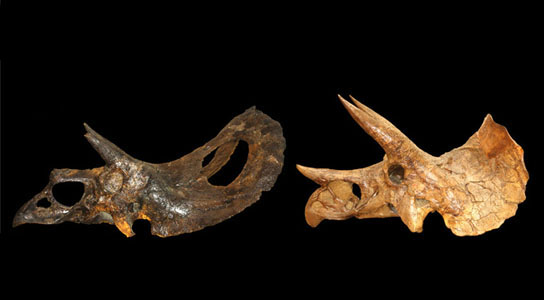
    A year-long study by Yale University paleontologists concludes that two related horned dinosaurs, Torosaurus and Triceratops, are different animals and not adult and juvenile versions of the same. Pictured are Triceratops (right) and Torosaurus (left). Credit: Yale University

    After a detailed structural analysis of 35 Torosaurus and Triceratops skulls, researchers at Yale University have determined that Torosaurus and Triceratops are different species, but both belong to the same family of horned dinosaurs known as Ceratopsidae.

    A year-long study by Yale University paleontologists concludes that two related horned dinosaurs are different animals and not adult and juvenile versions of the same.

    “We’re saying, ‘No, they’re different,’” said Nicholas R. Longrich, a postdoctoral fellow in Yale’s Department of Geology and Geophysics and the lead author of the study. “They’re separate animals.”

    The paper, which appears in the February 29 issue of the journal PLoS ONE, argues in favor of greater diversity among dinosaurs. It specifically refutes the idea that Torosaurus is merely the adult form of Triceratops — the same creature at a different stage of life.

    Available evidence suggests that this cannot be the case, according to Longrich and Yale graduate student Daniel J. Field. Most significant are the existence of physically mature (adult) specimens of Triceratops and relatively immature (juvenile) specimens of Torosaurus. This would be impossible if Torosaurus were an adult Triceratops.

    Consistent anatomical differences further support the claim that Torosaurus and Triceratops are different species, they say. For example, in one animal the frill — a broad sheet of bone curving up from the back of the head — has a pair of large circular openings. In the other, it’s a solid sheet of bone.

    The Yale researchers came to their conclusion after a detailed structural analysis of 35 Torosaurus and Triceratops skulls. Both animals belong to the same family of horned dinosaurs known as Ceratopsidae. They lived 65 million years ago in what is now western North America.

    In the early days of dinosaur research, paleontologists often classified similar skeletal remains differently, based on slight differences, Longrich said. From time to time, researchers have decided that animals formerly considered separate species are in fact the same. In this case, he said, collapsing two species into one is unwarranted. “We’re taking a traditional view,” he said.

    Reference: “Torosaurus Is Not Triceratops: Ontogeny in Chasmosaurine Ceratopsids as a Case Study in Dinosaur Taxonomy” by Nicholas R. Longrich and Daniel J. Field, 29 February 2012, PLoS ONE.
    DOI: 10.1371/journal.pone.0032623

    Support for the research came from the Yale Institute for Biospheric Studies, the National Science and Engineering Research Council of Canada, the Jurassic Foundation, and the Dinosaur Research Institute.

    Never miss a breakthrough: Join the SciTechDaily newsletter.
    Follow us on Google and Google News.

    Dinosaurs Paleontology Species Triceratops Yale University
    Share. Facebook Twitter Pinterest LinkedIn Email Reddit

    Related Articles

    Scientists Just Solved the Mystery of Triceratops’ Giant Nose

    “Big John” Triceratops Specimen Has Skull Injuries That May Have Come From Combat With Another Dinosaur

    Study Explains Prevalence of Hadrosaur Skin Among All Known Dinosaur Skin Fossils

    How Tyrannosaurus Rex Ate Triceratops Horridus

    Cretaceous Period Sankofa Pyrenaica Fossilized Eggs Are Unusually Shaped

    Feathered Yutyrannus Huali Specimen Found in China, Closely Related to Tyrannosaurus Rex

    New Insight on Pterosaur Specimen, Istiodactylus Latidens

    Microraptor Feathers Were Black With Iridescent Sheen

    Jurassic Period Super-Sized Fleas Had Armored Mouthparts to Attack the Thick Hide of Dinosaurs

    1 Comment

    1. Neuropsychologist Clinical Melbourne on March 2, 2012 3:02 am

      you are providing good information i like your blog post and i really impress this is so nice keep it up congrats, continue the blog post its so good thanks for sharing. Great job…!!

      Reply
    Leave A Reply Cancel Reply

    • Facebook
    • Twitter
    • Pinterest
    • YouTube

    Don't Miss a Discovery

    Subscribe for the Latest in Science & Tech!

    Trending News

    One of the Universe’s Largest Stars May Be Getting Ready To Explode

    Scientists Discover Enzyme That Could Supercharge Ozempic-Like Weight Loss Drugs

    Popular Sweetener Linked to DNA Damage – “It’s Something You Should Not Be Eating”

    Ancient “Rock” Microbes May Reveal How Complex Life Began

    Researchers Capture Quantum Interference in One of Nature’s Rarest Atoms

    “A Plague Is Upon Us”: The Mass Death That Changed an Ancient City Forever

    Scientists Discover Game-Changing New Way To Treat High Cholesterol

    This Small Change to Your Exercise Routine Could Be the Secret to Living Longer

    Follow SciTechDaily
    • Facebook
    • Twitter
    • YouTube
    • Pinterest
    • Newsletter
    • RSS
    SciTech News
    • Biology News
    • Chemistry News
    • Earth News
    • Health News
    • Physics News
    • Science News
    • Space News
    • Technology News
    Recent Posts
    • Scientists Prove There Are Just Six Degrees of Separation in a Social Network
    • Bee Bacteria Could Fix a Major Flaw in Plant-Based Milk
    • Scientists Discover a Surprising Way To Make Bread Healthier and More Nutritious
    • Natural Compounds Boost Bone Implant Success While Killing Bacteria and Cancer Cells
    • After 60 Years, Scientists Uncover Unexpected Brain Effects of Popular Diabetes Drug Metformin
    Copyright © 1998 - 2026 SciTechDaily. All Rights Reserved.
    • Science News
    • About
    • Contact
    • Editorial Board
    • Privacy Policy
    • Terms of Use

    Type above and press Enter to search. Press Esc to cancel.