
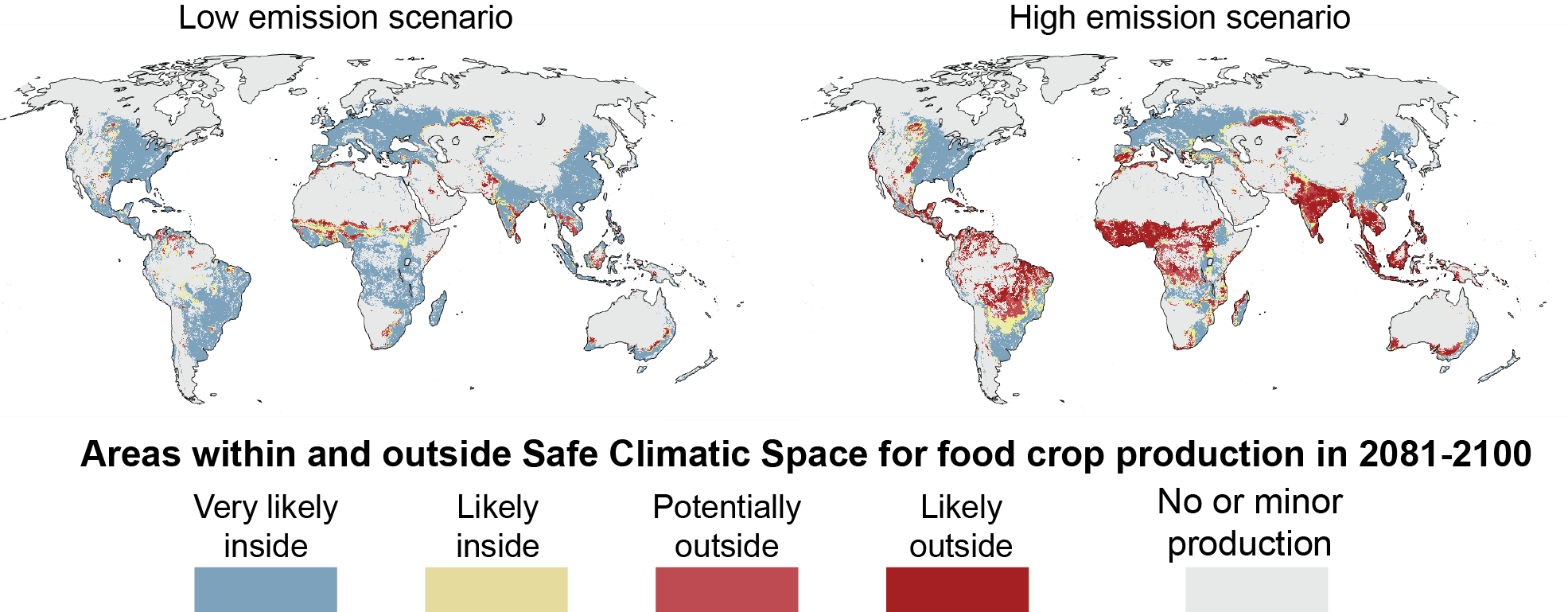
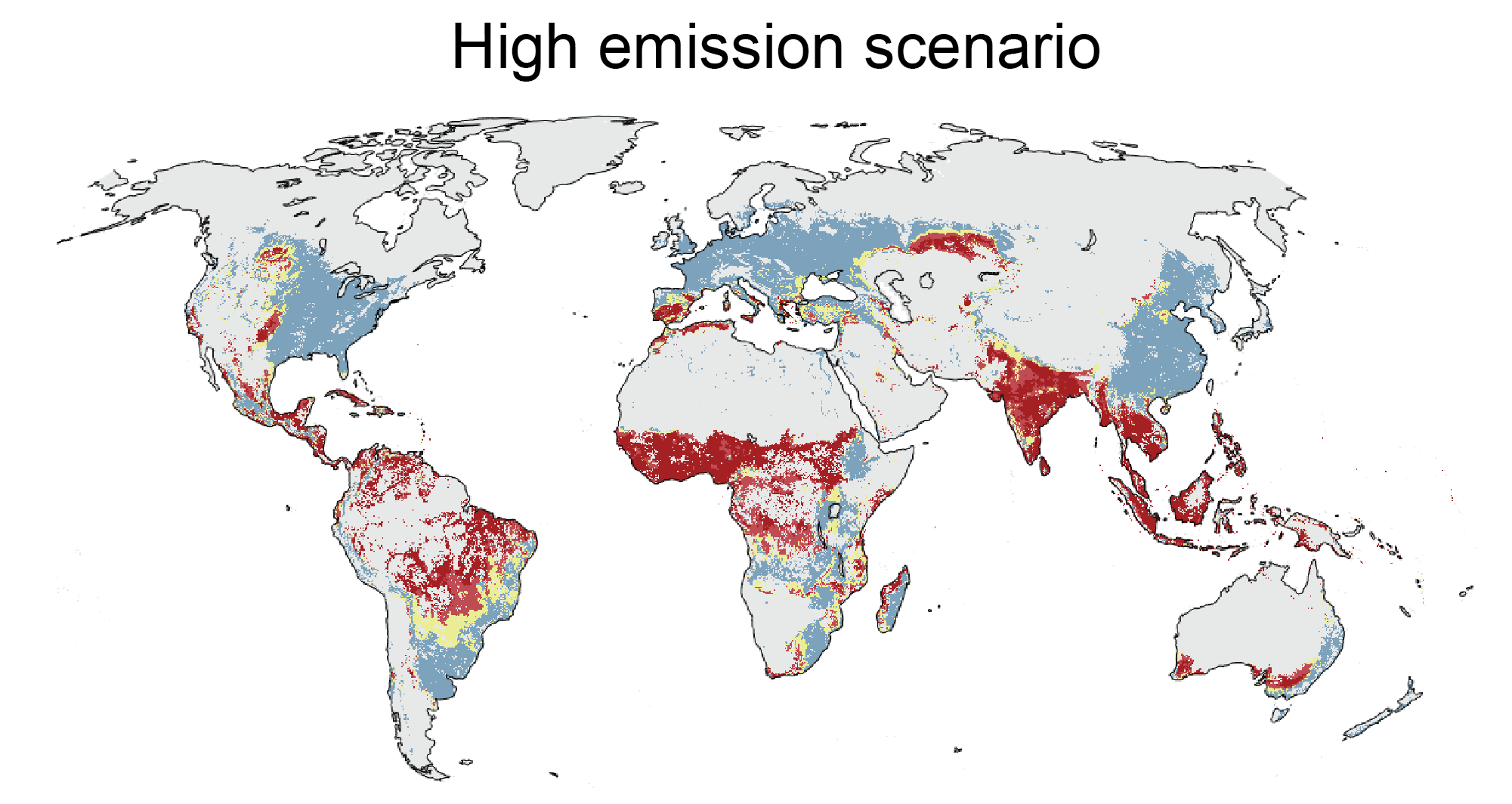
New estimates show that if greenhouse gases continue growing at current rates, large regions at risk of being pushed into climate conditions in which no food is grown today.
Climate change is known to negatively affect agriculture and livestock, but there has been little scientific knowledge on which regions of the planet would be touched or what the biggest risks may be. New research led by Aalto University assesses just how global food production will be affected if greenhouse gas emissions are left uncut. The study is published in the prestigious journal One Earth on today (Friday, May 14, 2021).
“Our research shows that rapid, out-of-control growth of greenhouse gas emissions may, by the end of the century, lead to more than a third of current global food production falling into conditions in which no food is produced today — that is, out of safe climatic space,” explains Matti Kummu, professor of global water and food issues at Aalto University.
According to the study, this scenario is likely to occur if carbon dioxide emissions continue growing at current rates. In the study, the researchers define the concept of safe climatic space as those areas where 95% of crop production currently takes place, thanks to a combination of three climate factors, rainfall, temperature, and aridity.
“The good news is that only a fraction of food production would face as-of-yet unseen conditions if we collectively reduce emissions, so that warming would be limited to 1.5 to 2 degrees Celsius (2.7-3.6 degrees Fahrenheit),” says Kummu.
Changes in rainfall and aridity as well as the warming climate are especially threatening to food production in South and Southeast Asia as well as the Sahel region of Africa. These are also areas that lack the capacity to adapt to changing conditions.
“Food production as we know it developed under a fairly stable climate, during a period of slow warming that followed the last ice age. The continuous growth of greenhouse gas emissions may create new conditions, and food crop and livestock production just won’t have enough time to adapt,” says Doctoral Candidate Matias Heino, the other main author of the publication.

Two future scenarios for climate change were used in the study: one in which carbon dioxide emissions are cut radically, limiting global warming to 1.5-2 degrees Celsius, and another in which emissions continue growing unhalted.
The researchers assessed how climate change would affect 27 of the most important food crops and seven different livestock, accounting for societies’ varying capacities to adapt to changes. The results show that threats affect countries and continents in different ways; in 52 of the 177 countries studied, the entire food production would remain in a safe climatic space in the future. These include Finland and most other European countries.
Already vulnerable countries such as Benin, Cambodia, Ghana, Guinea-Bissau, Guyana, and Suriname will be hit hard if no changes are made; up to 95 percent of current food production would fall outside of safe climatic space. Alarmingly, these nations also have significantly less capacity to adapt to changes brought on by climate change when compared to rich Western countries. In all, 20% of the world’s crop production and 18% of livestock production under threat are located in countries with low resilience to adapt to changes.
If carbon dioxide emissions are brought under control, the researchers estimate that the world’s largest climatic zone of today — the boreal forest, which stretches across northern North America, Russia, and Europe — would shrink from its current 18.0 to 14.8 million square kilometers (6.9 to 5.7 million square miles) by 2100. Should we not be able to cut emissions, only roughly 8 million square kilometers (3.1 million square miles) of the vast forest would remain. The change would be even more dramatic in North America: in 2000, the zone covered approximately 6.7 million square kilometers (2.6 million square miles) — by 2090 it may shrink to one-third.
Arctic tundra would be even worse off: it is estimated to disappear completely if climate change is not reined in. At the same time, the tropical dry forest and tropical desert zones are estimated to grow.
“If we let emissions grow, the increase in desert areas is especially troubling because in these conditions barely anything can grow without irrigation. By the end of this century, we could see more than 4 million square kilometers (1.5 million square miles)of new desert around the globe,” Kummu says.
While the study is the first to take a holistic look at the climatic conditions where food is grown today and how climate change will affect these areas in coming decades, its take-home message is by no means unique: the world needs urgent action.
“We need to mitigate climate change and, at the same time, boost the resilience of our food systems and societies — we cannot leave the vulnerable behind. Food production must be sustainable,” says Heino.
Reference: “Climate change risks pushing one-third of global food production outside the safe climatic space” by Matti Kummu, Matias Heino, Maija Taka, Olli Varis and Daniel Viviroli, 14 May 2021, One Earth.
DOI: 10.1016/j.oneear.2021.04.017
Never miss a breakthrough: Join the SciTechDaily newsletter.
Follow us on Google and Google News.
2 Comments
“… limiting global warming to 1.5-2 degrees Celsius, …”
They claim a “holistic” approach, but the warming limit mentioned is the global average, which includes the ~25% of the globe — the Arctic — that is warming at 3X the rate of the global average. That means that the areas they claim are at risk will not warm as much as the average. Besides, most of the warming is occurring in the Winter and at night, which means the impact on the growing season will be further moderated. This is borderline hysteria. Where is the objectivity?
What is most critical is the precipitation, more so than the temperatures. Unfortunately, as poor as the global circulation models are at predicting global temperatures (all but the Russian model run hot), they are even worse for precipitation, particularly at the regional level!
If the forecasts are close to being true, the world should start leaning on China and India to cut emissions! Instead, they get a free pass.
Lots of “mights” and “coulds” in these tales of woe, but the reality is that as CO2 concentrations have rise, so too has the amount of global vegetation (NOAA) and food production (various sources).
Many factors can account for the rise in temperatures since the Little Ice Age and one could as easily correlate the increase in CO2 to the increase in world population. Regardless, many of the claims about climate change and weather are tenuous at best. For example, area (statewide) high temperature extremes show no pattern of increase from the hottest recorded period in the 1920s-30s. (NOAA – State Climate Extremes Committee (SCEC)). Hurricane frequency has not increased and there are some scientists who propose that they will actually decrease if average temperatures increase. (Nature Climate Change journal).
Of course the response is that we must take action now! Just in case…. Sort of like playing with the weather, eh? (Harvard – The Stratospheric Controlled Perturbation Experiment (SCoPEx))
Too many children playing with too many dangerous toys.