
Close Menu
    Facebook X (Twitter) Instagram
    SciTechDaily
    • Biology
    • Chemistry
    • Earth
    • Health
    • Physics
    • Science
    • Space
    • Technology
    Facebook X (Twitter) Pinterest YouTube RSS
    SciTechDaily
    Home»Space»Mars InSight Lander’s Heat Probe Has Been Stuck for a Year – But NASA Has a New Plan
    Space

    Mars InSight Lander’s Heat Probe Has Been Stuck for a Year – But NASA Has a New Plan

    By Jet Propulsion LaboratoryFebruary 21, 2020No Comments4 Mins Read
    Facebook Twitter Pinterest Telegram LinkedIn WhatsApp Email Reddit
    Share
    Facebook Twitter LinkedIn Pinterest Telegram Email Reddit
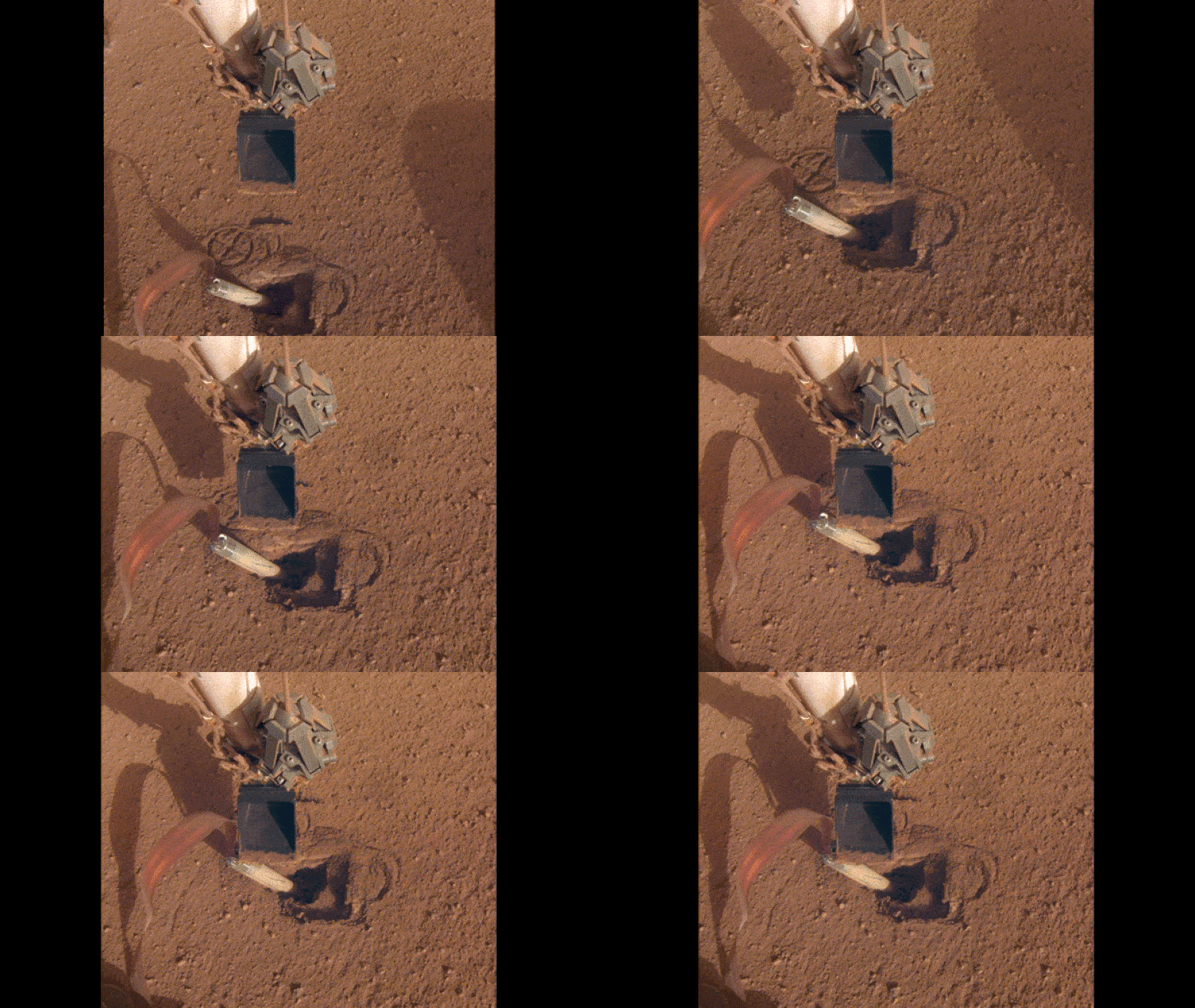
    Mars InSight Robotic Arm Mole
    NASA InSight recently moved its robotic arm closer to its digging device, called the “mole,” in preparation to push on its top, or back cap. Credit: NASA/JPL-Caltech

    Engineers have a plan for pushing down on the heat probe, which has been stuck at the Martian surface for a year.

    After nearly a year of trying to dig into the Martian surface, the heat probe belonging to NASA’s InSight lander is about to get a push. The mission team plans to command the scoop on InSight’s robotic arm to press down on the “mole,” the mini pile driver designed to hammer itself as much as 16 feet (5 meters) down. They hope that pushing down on the mole’s top, also called the back cap, will keep it from backing out of its hole on Mars, as it did twice in recent months after nearly burying itself.

    Part of an instrument called the Heat Flow and Physical Properties Package, or HP3, the mole is a 16-inch-long (40-centimeter-long) spike equipped with an internal hammering mechanism. While burrowing into the soil, it is designed to drag with it a ribbon-like tether that extends from the spacecraft. Temperature sensors are embedded along the tether to measure heat coming deep from within the planet’s interior to reveal important scientific details about the formation of Mars and all rocky planets, including Earth.

    The team has avoided pushing on the back cap until now to avoid any potential damage to the tether.
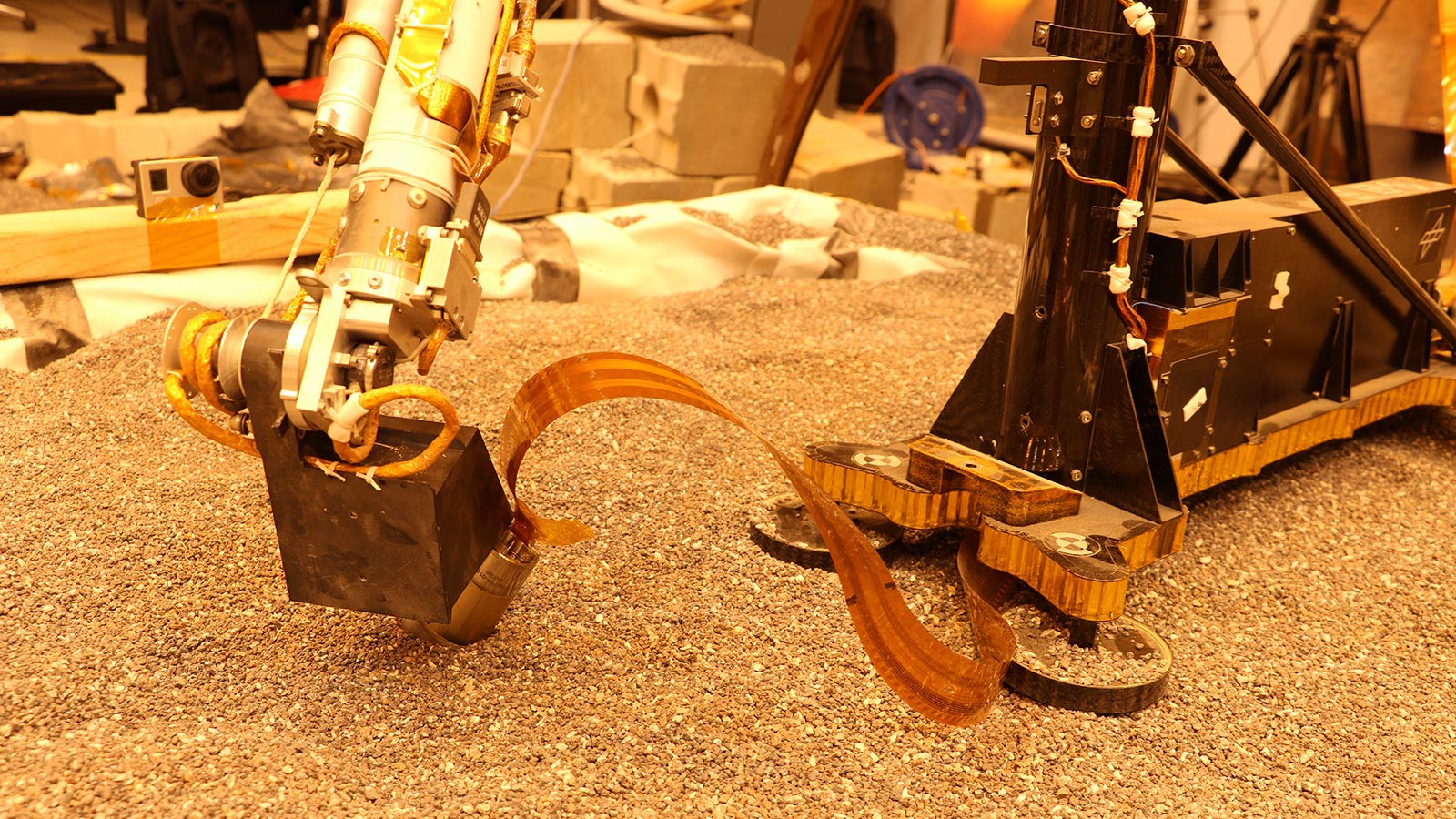
    InSight Lander Mole Digging Device
    This test using an engineering model of the InSight lander here on Earth shows how the spacecraft on Mars will use its robotic arm to press on a digging device, called the “mole.” Credit: NASA/JPL-Caltech

    The mole found itself stuck on February 28, 2019, the first day of hammering. The InSight team has since determined that the soil here is different than what has been encountered on other parts of Mars.InSight landed in an area with an unusually thick duricrust, or a layer of cemented soil. Rather than being loose and sandlike, as expected, the dirt granules stick together.

    The mole needs friction from the soil in order to travel downward; without it, recoil from its self-hammering action causes it to simply bounce in place. Ironically, loose soil, not duricrust, provides that friction as it falls around the mole.

    This past summer, the InSight team started using the robotic arm’s scoop to press on the side of the mole, a technique called “pinning” that added just enough friction to help it dig without coming in contact with the fragile science tether connected to the mole’s back cap.

    While pinning helped, the mole popped back out of the Martian soil on two occasions, possibly from soil building up from beneath. With few alternatives left, the team has decided to try helping the mole dig by carefully pressing on its back cap while attempting to avoid the tether.

    It might take several tries to perfect the back-cap push, just as pinning did. Throughout late February and early March, InSight’s arm will be maneuvered into position so that the team can test what happens as the mole briefly hammers.

    Meanwhile, the team is also considering using the scoop to move more soil into the hole that has formed around the mole. This could add more pressure and friction, allowing it to finally dig down. Whether they pursue this route depends on how deep the mole is able to travel after the back-cap push.

    JPL manages InSight for NASA’s Science Mission Directorate. InSight is part of NASA’s Discovery Program, managed by the agency’s Marshall Space Flight Center in Huntsville, Alabama. Lockheed Martin Space in Denver built the InSight spacecraft, including its cruise stage and lander, and supports spacecraft operations for the mission.

    Never miss a breakthrough: Join the SciTechDaily newsletter.
    Follow us on Google and Google News.

    JPL Mars NASA NASA InSight Lander Popular
    Share. Facebook Twitter Pinterest LinkedIn Email Reddit

    Related Articles

    Mars Is Spinning Faster: NASA’s InSight Uncovers Surprising Acceleration

    “Dead Bus” – NASA Retires InSight Mars Lander Mission After 4 Years on Red Planet

    The End Is Nigh: NASA Prepares To Say “Farewell” to History-Making Mars InSight Lander

    NASA’s InSight Mars Lander Detects Stunning Meteoroid Impact on Red Planet

    Still Alive! NASA’s InSight Lander Waits Out Martian Dust Storm

    Listen to Space Rocks Crash Into Mars – Recorded by NASA’s InSight Lander

    New Life: NASA’s InSight Mars Lander Gets a Few Extra Weeks of Science Operations

    Days Are Numbered: Power Levels Diminishing for NASA’s Marsquake Hunting InSight Lander

    NASA’s InSight Records Monster Quake on Mars – The Largest Ever Detected on Another Planet

    Leave A Reply Cancel Reply

    • Facebook
    • Twitter
    • Pinterest
    • YouTube

    Don't Miss a Discovery

    Subscribe for the Latest in Science & Tech!

    Trending News

    Don’t Miss: A Brilliant Venus and Glowing Harvest Moon Light Up the Sky

    New Twist on the Einstein Problem Reveals Unexpected Physics

    JWST Captures Stunning Evidence of How Supermassive Black Holes Feed

    Early Exercise May Permanently Change How Much Energy the Body Uses To Move

    New Molecule Wipes Out Aggressive Lymphoma Tumors in Mice in Just 11 Days

    The Human Family Tree May Need a Major Rewrite

    Scientists Find a Surprising Cancer-Fighting Effect in Dark Sweet Cherries

    New AI Detects Hidden Warning Signs of Solar Eruptions Hours Before They Emerge

    Follow SciTechDaily
    • Facebook
    • Twitter
    • YouTube
    • Pinterest
    • Newsletter
    • RSS
    SciTech News
    • Biology News
    • Chemistry News
    • Earth News
    • Health News
    • Physics News
    • Science News
    • Space News
    • Technology News
    Recent Posts
    • Africa’s Giant Herbivores Were Disappearing Millions of Years Before Humans Could Hunt Them
    • This Utah Mountain Is Hiding Enough Ice To Fill 600 Olympic Pools
    • Vagus Nerve Stimulation Could Unlock the Brain’s Hidden Learning Potential
    • Your Mother’s Age May Leave a Biological Mark That Lasts for Generations
    • Women Who Ate More Antioxidants Had Strikingly Lower Rates of Cervical Cancer
    Copyright © 1998 - 2026 SciTechDaily. All Rights Reserved.
    • Science News
    • About
    • Contact
    • Editorial Board
    • Privacy Policy
    • Terms of Use

    Type above and press Enter to search. Press Esc to cancel.