
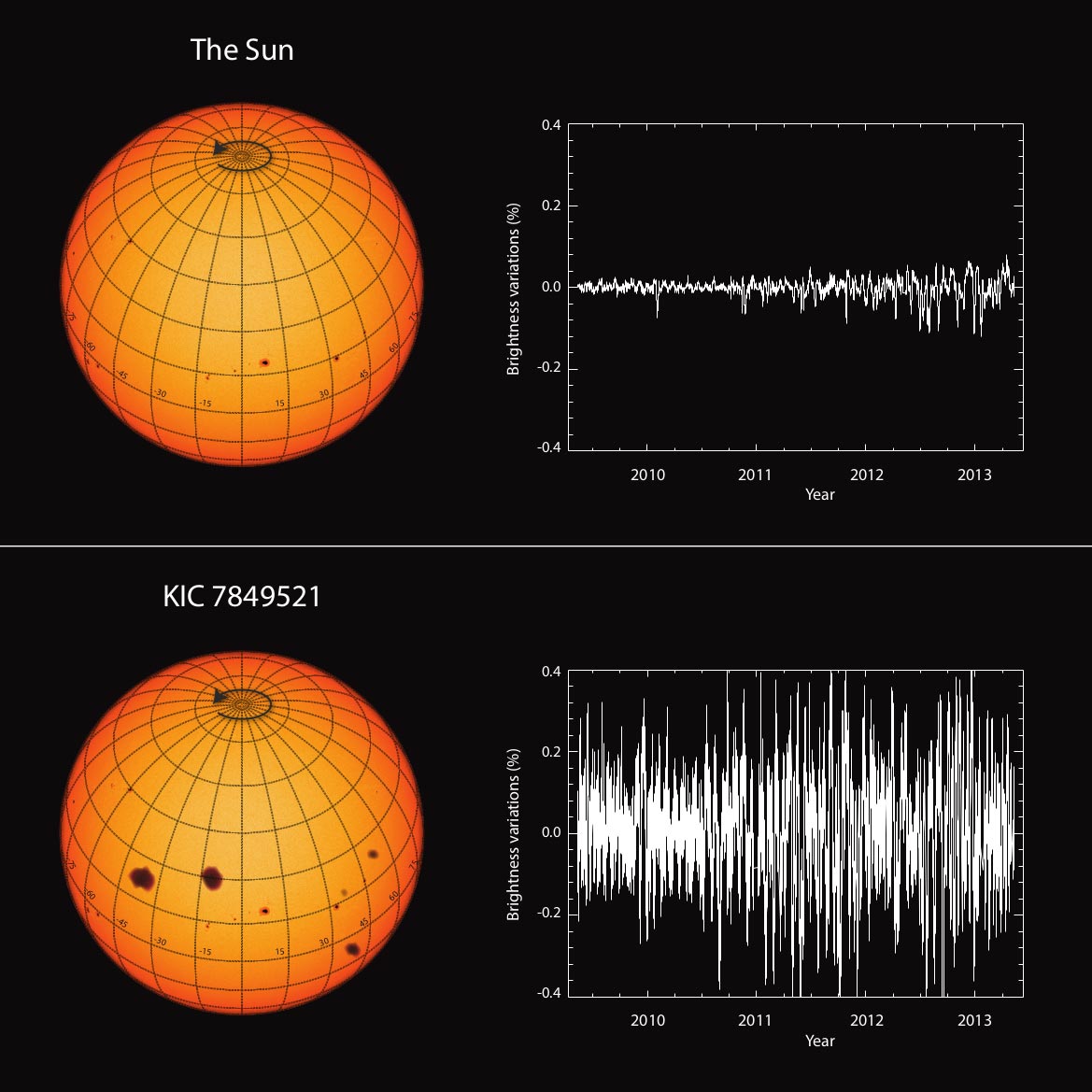
An analysis of 369 solar-like stars shows that solar brightness variations are extremely weak.
The extent to which solar activity (and thus the number of sunspots and the solar brightness) varies can be reconstructed using various methods — at least for a certain period of time. Since 1610, for example, there have been reliable records of sunspots covering the Sun; the distribution of radioactive varieties of carbon and beryllium in tree rings and ice cores allows us to draw conclusions about the level of solar activity over the past 9000 years. For this period of time, scientists find regularly recurring fluctuations of comparable strength as during recent decades. “However, compared to the entire lifespan of the Sun, 9000 years is like the blink of an eye,” says MPS scientist Dr. Timo Reinhold, first author of the new study. After all, our star is almost 4.6 billion years old. “It is conceivable that the Sun has been going through a quiet phase for thousands of years and that we therefore have a distorted picture of our star,” he adds.
Since there is no way of finding out how active the Sun was in primeval times, scientists can only resort to the stars: Together with colleagues from the University of New South Wales in Australia and the School of Space Research in South Korea, the MPS researchers investigated, whether the Sun behaves “normally” in comparison to other stars. This may help to classify its current activity.
“We were very surprised that most of the Sun-like stars are so much more active than the Sun.” Dr. Alexander Shapiro
To this end, the researchers selected candidate stars that resemble the Sun in decisive properties. In addition to the surface temperature, the age, and the proportion of elements heavier than hydrogen and helium, the researchers looked above all at the rotation period. “The speed at which a star rotates around its own axis is a crucial variable,” explains Prof. Dr. Sami Solanki, director at MPS and co-author of the new publication. A star’s rotation contributes to the creation of its magnetic field in a dynamo process in its interior. “The magnetic field is the driving force responsible for all fluctuations in activity,” says Solanki. The state of the magnetic field determines how often the Sun emits energetic radiation and hurls particles at high speeds into space in violent eruptions, how numerous dark sunspots and bright regions on its surface are — and thus also how brightly the Sun shines.
A comprehensive catalog containing the rotation periods of thousands of stars has been available only for the last few years. It is based on measurement data from NASA’s Kepler Space Telescope, which recorded the brightness fluctuations of approximately 150000 main sequence stars (i.e. those that are in the middle of their lifetimes) from 2009 to 2013. The researchers scoured this huge sample and selected those stars that rotate once around their own axis within 20 to 30 days. The Sun needs about 24.5 days for this. The researchers were able to further narrow down this sample by using data from the European Gaia Space Telescope. In the end, 369 stars remained, which also resemble the Sun in other fundamental properties.
The exact analysis of the brightness variations of these stars from 2009 to 2013 reveals a clear picture. While between active and inactive phases solar irradiance fluctuated on average by just 0.07 percent, the other stars showed much larger variation. Their fluctuations were typically about five times as strong. “We were very surprised that most of the Sun-like stars are so much more active than the Sun,” says Dr. Alexander Shapiro of MPS, who heads the research group “Connecting Solar and Stellar Variabilities.”
However, it is not possible to determine the rotation period of all the stars observed by the Kepler telescope. To do this, scientists have to find certain periodically re-appearing dips in the star’s lightcurve. These dips can be traced back to starspots that darken the stellar surface, rotate out of the telescope’s field of view and then reappear after a fixed period of time. “For many stars, such periodic darkenings cannot be detected; they are lost in the noise of the measured data and in overlying brightness fluctuations,” explains Reinhold. Viewed through the Kepler telescope, even the Sun would not reveal its rotation period.
The researchers therefore also studied more than 2500 Sun-like stars with unknown rotation periods. Their brightness fluctuated much less than that of the other group.
These results allow two interpretations. There could be a still unexplained fundamental difference between stars with known and unknown rotation period. “It is just as conceivable that stars with known and Sun-like rotation periods show us the fundamental fluctuations in activity the Sun is capable of,” says Shapiro. This would mean that our star has been unusually feeble over the past 9000 years and that on very large time scales phases with much greater fluctuations are also possible.
There is, however, no cause for concern. For the foreseeable future, there is no indication of such solar “hyperactivity.” On the contrary: For the last decade, the Sun has been showing itself to be rather weakly active, even by its own low standards. Predictions of activity for the next eleven years indicate that this will not change soon.
Never miss a breakthrough: Join the SciTechDaily newsletter.
Follow us on Google and Google News.
3 Comments
The calm before the storm.
obital ejection fire, ice, gravity, death ect
Look to about 2029 for coronal ejection.