
Close Menu
    Facebook X (Twitter) Instagram
    SciTechDaily
    • Biology
    • Chemistry
    • Earth
    • Health
    • Physics
    • Science
    • Space
    • Technology
    Facebook X (Twitter) Pinterest YouTube RSS
    SciTechDaily
    Home»Science»Experimenting With Iron Under Pressure to Better Understand the Physics, Chemistry, and Magnetic Properties of Earth
    Science

    Experimenting With Iron Under Pressure to Better Understand the Physics, Chemistry, and Magnetic Properties of Earth

    By Lawrence Livermore National LaboratoryJune 6, 2020No Comments3 Mins Read
    Facebook Twitter Pinterest Telegram LinkedIn WhatsApp Email Reddit
    Share
    Facebook Twitter LinkedIn Pinterest Telegram Email Reddit
    Earth's Core
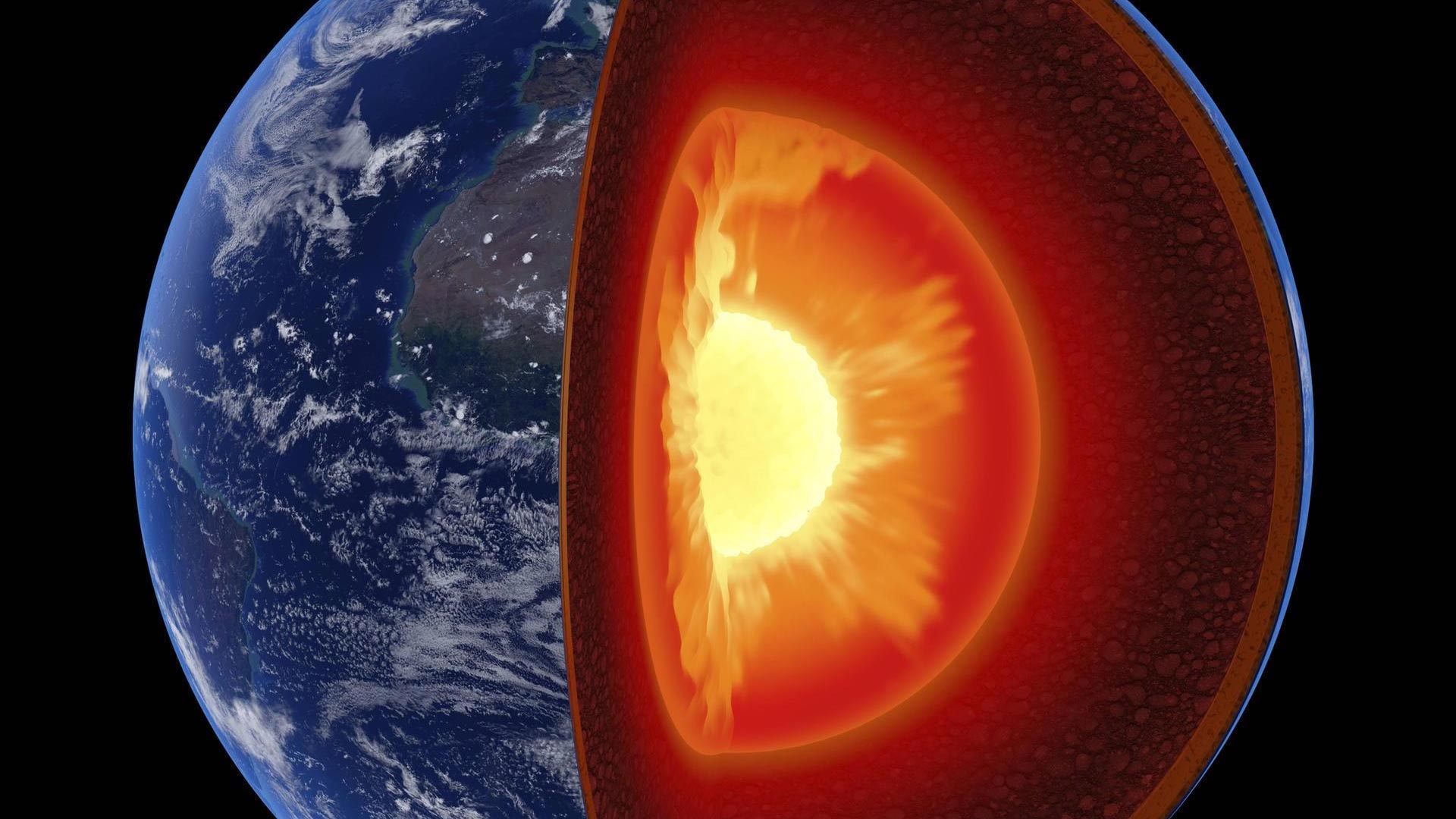
    An international collaboration of researchers has probed the high-pressure behavior of iron, which is found in the core of rocky planets like Earth.

    Iron is the most stable and heaviest chemical element produced by nucleosynthesis in stars, making it the most abundant heavy element in the universe and in the interiors of Earth and other rocky planets.

    To get a better understanding of the high-pressure behavior of iron, a Lawrence Livermore National Laboratory (LLNL) physicist and international collaborators discovered the subnanosecond phase transitions in laser-shocked iron. The research appears in the June 5, 2020, edition of the journal Science Advances.

    The research could help scientists better understand the physics, chemistry, and magnetic properties of Earth and other planets by measuring time-resolved high-resolution X-ray diffractions for the entire duration of shock compression. This allows observation of the timing of the onset of elastic compression at 250 picoseconds and the inferred observation of three-wave structures between 300-600 picoseconds. The X-ray diffraction reveals that the famous phase transformation from ambient iron (Fe) to high-pressure Fe occurs within 50 picoseconds.

    At ambient conditions, metallic iron is stable as a body-centered cubic form, but as pressures rise above 13 gigapascals (130,000 times the atmospheric pressure on Earth), iron transforms to a nonmagnetic hexagonal close-packed structure. This transformation is diffusionless, and scientists can see the coexistence of both the ambient and high-pressure phases.

    There are still debates about the locations of the phase boundaries of iron as well as the kinetics of this phase transition.

    The team used a combination of an optical laser pump and X-ray Free Electron Laser (XFEL) probe to observe the atomic structural evolution of shock-compressed iron at an unprecedented time resolution, about 50 picoseconds under high pressure. The technique showed all of iron’s known structure types.

    Team members even discovered the appearance of new phases after 650 picoseconds with densities similar or even lower than that of the ambient phase.

    “This is the first direct and complete observation of shock wave propagation associated with the crystal structural changes recorded by high-quality time series data,” said LLNL physicist Hyunchae Cynn, a co-author of the paper.

    The team observed three-wave temporal evolution by the elastic, plastic, and the deformational phase transition to the high-pressure phase, followed by post-compression phases due to rarefaction waves in 50-picosecond intervals between 0 and 2.5 nanoseconds after irradiation with the optical laser.

    Further experiments may lead to a better understanding of how rocky planets were formed or whether they have a magma ocean in the interior.

    Other contributors include: Yonsei University, Republic of Korea; SLAC National Accelerator Laboratory; Pohang Accelerator Laboratory, Republic of Korea; Korea Polar Research Institute; Center for High Pressure Science and Technology Advanced Research, Shanghai; Arizona State University; University of South Carolina; and Osaka University.

    Never miss a breakthrough: Join the SciTechDaily newsletter.
    Follow us on Google and Google News.

    DOE Iron Lawrence Livermore National Laboratory
    Share. Facebook Twitter Pinterest LinkedIn Email Reddit

    Related Articles

    Key Discovery for Future Design of Laser–Fusion Energy Reactors

    As Big as It Gets: Massive Hunga Volcano Eruption Comparable to Krakatoa

    Science Made Simple: What is Ultrafast Science?

    Scientists “Magically” Mine Metals From Water

    New Method Allows Scientists To Synthesize Crystals in Ways Not Found in Nature

    Harvesting Fusion Energy on Earth With a Boost From a Common Household Cleaner

    Just How Big Was the Devastating 2020 Beirut Explosion?

    COVID Pandemic Drives Down U.S. Energy Use in 2020

    SLAC Scientists Create First Atomic X-ray Laser

    Leave A Reply Cancel Reply

    • Facebook
    • Twitter
    • Pinterest
    • YouTube

    Don't Miss a Discovery

    Subscribe for the Latest in Science & Tech!

    Trending News

    1.4-Million-Year-Old Footprints Reveal a Giant Human Relative

    Astronomers May Have Found the First Moon Beyond Our Solar System

    Underwater Cameras Expose the Secret Lives of Whale Sharks

    Why Dreaming Leaves the Brain Running Low on Energy

    CERN Experiments Detect Signs of the Universe’s Primordial Matter

    Study Finds a Surprising Link Between Gut Microbes and Aging

    Frequent Cannabis Users Wake Up With More “Stress Hormone”

    Scientists Reveal Hidden DNA Traces in the Shroud of Turin

    Follow SciTechDaily
    • Facebook
    • Twitter
    • YouTube
    • Pinterest
    • Newsletter
    • RSS
    SciTech News
    • Biology News
    • Chemistry News
    • Earth News
    • Health News
    • Physics News
    • Science News
    • Space News
    • Technology News
    Recent Posts
    • World’s First Photonic Time Crystal Can Reshape Light in Trillionths of a Second
    • Meteorite That Smashed Through a New Jersey Roof Hid an Ancient Chemical Secret
    • Astronomers Find Ancient Black Holes Shining With the Power of a Trillion Suns
    • These “Good” Immune Cells Could Hold the Key to Spinal Cord Regeneration
    • New Research Questions Decades of Low-Fat Dairy Advice
    Copyright © 1998 - 2026 SciTechDaily. All Rights Reserved.
    • Science News
    • About
    • Contact
    • Editorial Board
    • Privacy Policy
    • Terms of Use

    Type above and press Enter to search. Press Esc to cancel.