
Greg Stewart/SLAC National Accelerator Laboratory
Formed by an electronic struggle between the atomic layers of the material, this ‘stunning’ herringbone pattern could result in unique features that researchers are just beginning to investigate.
Scientists at the Department of Energy’s SLAC National Accelerator Laboratory and Stanford University have developed a novel quantum material, the atomic framework of which has been drastically distorted into a herringbone pattern.
According to Woo Jin Kim, the lead researcher of the study and a postdoctoral researcher at the Stanford Institute for Materials and Energy Sciences (SIMES) at SLAC, the distortions resulting from this material are “huge” compared to those in other materials.
“This is a very fundamental result, so it’s hard to make predictions about what may or may not come out of it, but the possibilities are exciting,” said SLAC/Stanford Professor and SIMES Director Harold Hwang.
“Based on theoretical modeling from members of our team, it looks like the new material has intriguing magnetic, orbital, and charge order properties that we plan to investigate further,” he said. Those are some of the very properties that scientists think give quantum materials their surprising characteristics.
The research team described their work in a paper published in the journal Nature.
High-Rises Versus Octahedrons
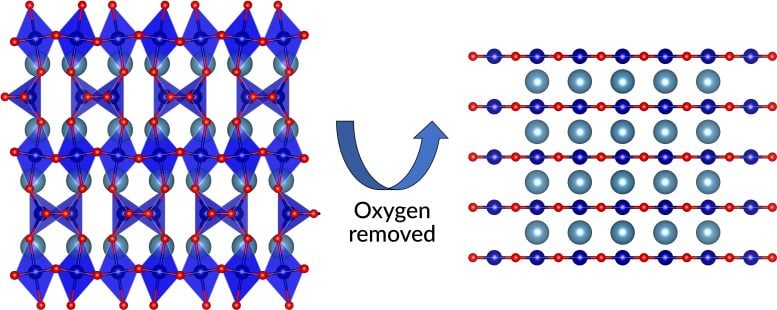
The herringbone-patterned material is the first demonstration of something called the Jahn-Teller (JT) effect in a layered material with a flat, planar lattice, like a high-rise building with evenly spaced floors.
The JT effect addresses the dilemma an electron faces when it approaches an ion – an atom that’s missing one or more electrons.
Just like a ball rolling along the ground will stop and settle in a low spot, the electron will seek out and occupy the vacancy in the atom’s electron orbitals that have the lowest energy state. But sometimes there are two vacancies with equally low energies. What then?
If the ion is in a molecule or embedded in a crystal, the JT effect distorts the surrounding atomic lattice in a way that leaves only one vacancy at the lowest energy state, solving the electron’s problem, Hwang said.
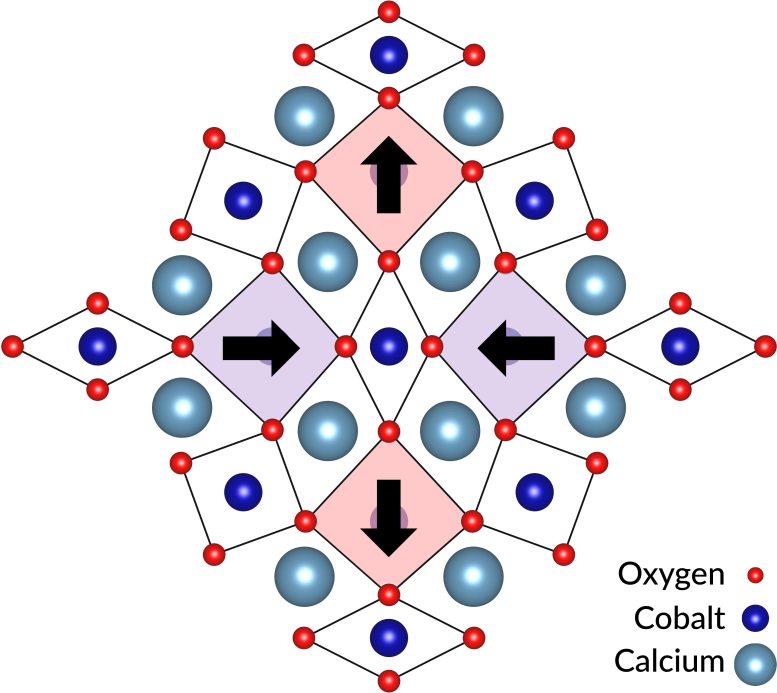
And when the whole crystal lattice consists of JT ions, in some cases the overall crystal structure warps, so the electron’s dilemma is cooperatively solved for all the ions.
That’s what happened in this study.
“The Jahn-Teller effect creates strong interactions between the electrons and between the electrons and the lattice,” Hwang said. “This is thought to play key roles in the physics of a number of quantum materials.”
The JT effect had already been demonstrated for single molecules and for 3D crystalline materials that consist of ions arranged in octahedral or tetrahedral structures. In fact, JT oxides based on manganese or copper exhibit colossal magnetoresistance and high-temperature superconductivity – leading scientists to wonder what would happen in materials based on other elements or having a different structure.
In this study, the SIMES researchers turned a material made of cobalt, calcium, and oxygen (CaCoO2.5), which has a different stacking of octahedral and tetrahedral layers and is known as brownmillerite, into a layered material (CaCoO2) where the JT effect could take hold. They did it with a chemical trick developed at SIMES a few years ago to make the first nickel oxide superconductor.
Pulling Out Jenga Blocks
Kim synthesized a thin film of brownmillerite and chemically removed single layers of oxygen atoms from its lattice, much like players carefully remove blocks from a Jenga tower. The lattice collapsed and settled into a flat, planar configuration with alternating layers containing negatively charged cobalt ions – the JT ions – and positively charged calcium ions.
Each cobalt ion tried to pull calcium ions from the layers above and below it, Kim said.
“This tug-of-war between adjacent layers led to a beautiful pattern of distortions that reflects the best and most harmonious compromise between the forces at play,” he said. “And the resulting lattice distortions are huge compared to those in other materials – equal to 25% of the distance between ions in the lattice.”
Hwang said the research team will be exploring this remarkable new electronic configuration with X-ray tools available at SLAC and elsewhere. “We also wonder what will happen if we can dope this material – replacing some atoms with others to change the number of electrons that are free to move around,” he said. “There are many exciting possibilities.”
Reference: “Geometric frustration of Jahn–Teller order in the infinite-layer lattice” by Woo Jin Kim, Michelle A. Smeaton, Chunjing Jia, Berit H. Goodge, Byeong-Gwan Cho, Kyuho Lee, Motoki Osada, Daniel Jost, Anton V. Ievlev, Brian Moritz, Lena F. Kourkoutis, Thomas P. Devereaux and Harold Y. Hwang, 22 February 2023, Nature.
DOI: 10.1038/s41586-022-05681-2
Researchers from Cornell University, the Pohang Accelerator Laboratory in South Korea and the Center for Nanoscale Materials Sciences, a DOE Office of Science user facility at Oak Ridge National Laboratory, contributed to this work. It received major funding from the DOE Office of Science and the Gordon and Betty Moore Foundation’s Emergent Phenomena in Quantum Systems Initiative.
Never miss a breakthrough: Join the SciTechDaily newsletter.
Follow us on Google and Google News.
1 Comment
Is there a point to this article? How does this help boost my scores at Tetris, for example? Just kidding. “There are many exciting possibilities….” How about naming just ONE? So you changed the material. What difference did it make? What could you use it for? We that are in other fields might want to know the relevance of this change. This reads more like a science journal than a news article intended for mass public consumption. Other than the bit about doping the material (I’m in Electronic Engineering), it could be just about anything. And given they haven’t tried doping it yet (think new type of transistor behavior), it may have nothing useful to bear there yet either.