
Close Menu
    Facebook X (Twitter) Instagram
    SciTechDaily
    • Biology
    • Chemistry
    • Earth
    • Health
    • Physics
    • Science
    • Space
    • Technology
    Facebook X (Twitter) Pinterest YouTube RSS
    SciTechDaily
    Home»Space»Investigating the Fate of Massive Stars: Bright Explosions or Quiet Collapses Into Black Holes?
    Space

    Investigating the Fate of Massive Stars: Bright Explosions or Quiet Collapses Into Black Holes?

    By OzGravJune 13, 2020No Comments3 Mins Read
    Facebook Twitter Pinterest Telegram LinkedIn WhatsApp Email Reddit
    Share
    Facebook Twitter LinkedIn Pinterest Telegram Email Reddit
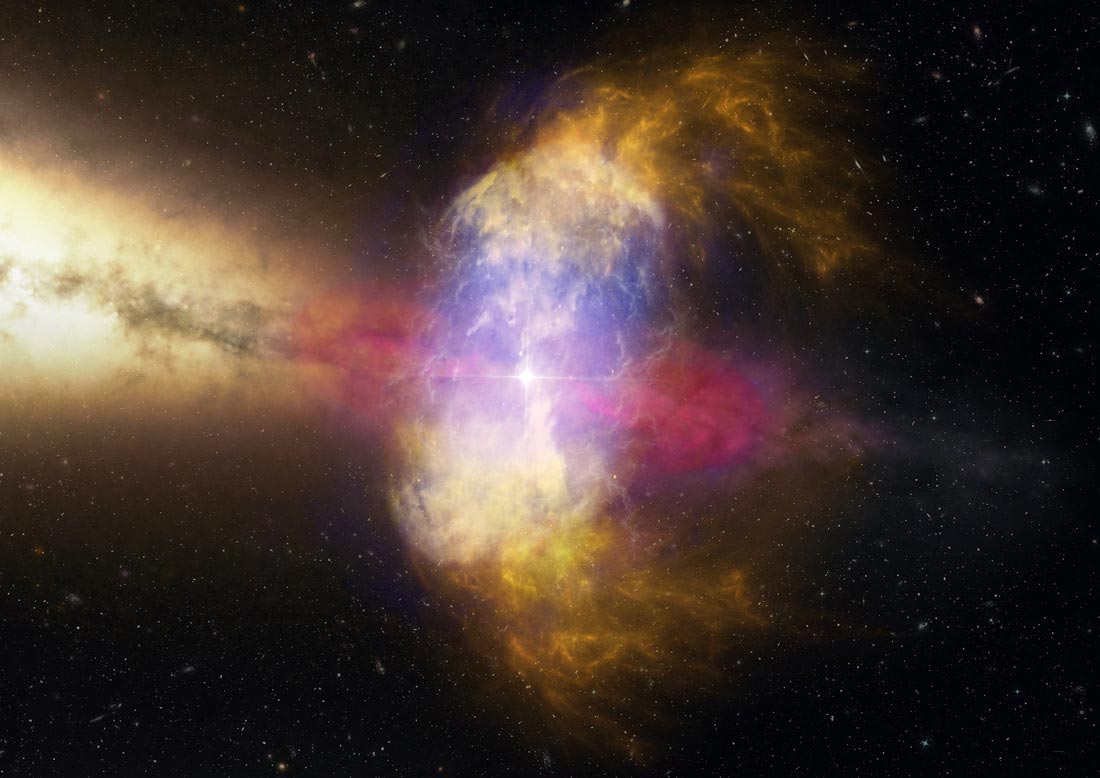
    Artist's Impression of a Supernova
    Artist’s impression of a supernova. Credit: James Josephides, Swinburne University of Technology

    A team of scientists, including Chief Investigator Ilya Mandel from the ARC Centre of Excellence for Gravitational Wave Discovery (OzGrav) at Monash University, recently submitted a paper investigating what happens to rotating massive stars when they reach the end of their lives.

    Stars produce energy by fusing lighter elements into heavier ones in their core: hydrogen into helium, then helium into carbon, oxygen, and so on, up to iron. The energy produced by this nuclear fusion also provides pressure support inside the star, which balances the force of gravity and allows the star to remain in equilibrium.

    This process stops at iron. Beyond iron, energy is required for fusion rather than being released by fusion. A heavy iron star core contracts under gravity, creating a neutron star or, if it is heavy enough, a black hole. Meanwhile, the outer layers of the star explode in a brilliant flash, observable as a supernova. However, some massive stars seem to completely disappear without any explosion. Theories suggest that these massive stars completely collapse into black holes, but is that possible?
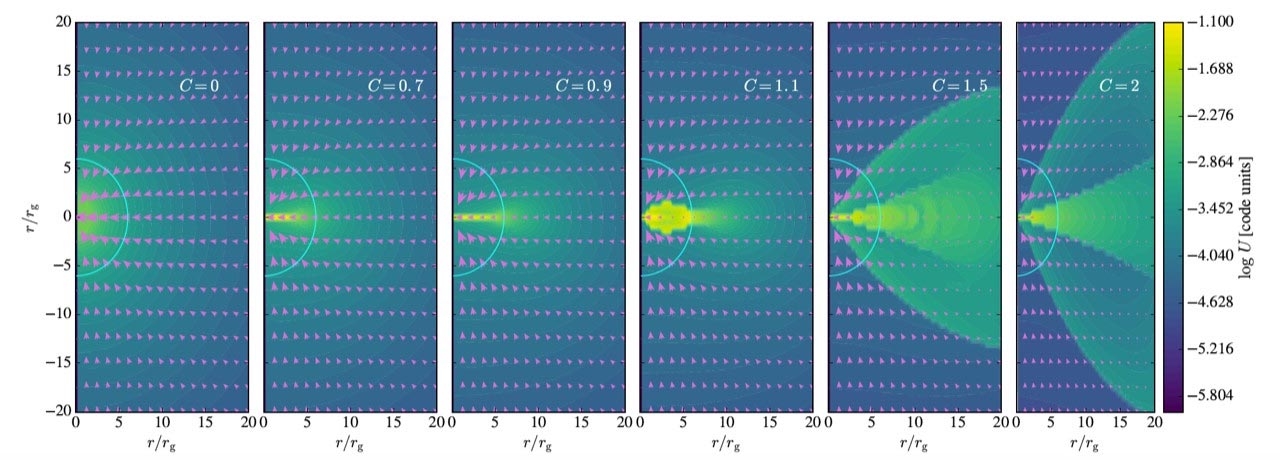
    Rotationally Supported Donut of Gas
    The figure shows the formation of a rotationally-supported donut of gas around the black hole, as the initial gas rotates increasingly faster. Credit: Ilya Mandel, OzGrav

    A team led by Ariadna Murguia-Berthier, a Ph.D. candidate at the University of California Santa Cruz, and involving OzGrav Chief Investigator Ilya Mandel, set out to answer this question. They were particularly interested in understanding whether a rotating star could quietly collapse into a black hole.

    In their paper submitted to Astrophysical Journal Letters, they describe a set of simulations investigating the collapse of a rotating gas cloud into a black hole. It was found that if the gas is rotating too quickly at the beginning, it cannot efficiently collapse; instead, the gas stalls in a donut-like shape around the equator of the black hole.

    The team hypothesized that the heat generated from falling gas slamming into this spinning gas donut will unbind the outer layers of the star and create a supernova-like explosion. A small percentage of all stars were also found to rotate slowly enough—below the threshold for this gas stalling to occur—and could indeed collapse into black holes quietly.

    “It’s very exciting to bring together general relativity, sophisticated computational techniques, stellar models, and the latest observations to explore the formation of black holes from massive stars!” says Mandel.

    Reference: “On the maximum stellar rotation to form a black hole without an accompanying luminous transient” by Ariadna Murguia-Berthier, Aldo Batta, Agnieszka Janiuk, Enrico Ramirez-Ruiz, Ilya Mandel, Scott C. Noble and Rosa Wallace Everson, 20 May 2020, High Energy Astrophysical Phenomena.
    DOI: 10.3847/2041-8213/abb818
    arXiv: 2005.10212

    Never miss a breakthrough: Join the SciTechDaily newsletter.
    Follow us on Google and Google News.

    Astronomy Astrophysics Black Hole OzGrav Popular Supernova
    Share. Facebook Twitter Pinterest LinkedIn Email Reddit

    Related Articles

    Ghost Particles May Decide Whether a Dying Star Explodes or Becomes a Black Hole

    Massive Stellar Triples Leading to Sequential Binary Black-Hole Mergers

    Ripples in the Fabric of Space and Time Offer New Clues to the Shape of Black Holes

    Dancing Stars and Black Holes in a Cosmic Cloud of Gas: Investigating the “Common Envelope Phase”

    Cosmic Search Continues for Supermassive Black Hole Collisions

    Supercomputer Simulations of Core-Collapse Supernovae Reveal Complicated Physics of Exploding Massive Stars

    New Clues Discovered About the Cosmic Missing Link: Intermediate-Mass Black Holes

    Astronomers Watch as Collapsing Star Turns Into a Black Hole

    Cloud of Hydrogen and Helium Plunging Toward the Galactic Center

    Leave A Reply Cancel Reply

    • Facebook
    • Twitter
    • Pinterest
    • YouTube

    Don't Miss a Discovery

    Subscribe for the Latest in Science & Tech!

    Trending News

    Study Finds Natural Dairy Trans Fats Behave Very Differently From Industrial Fats

    Your Voice May Reveal How Fast Your Brain Is Aging

    These Fingernail-Sized Animals Are Moving Astonishing Amounts of California Beach Sand

    NASA’s Perseverance Rover Finds Mars Had a Far More Complicated Water History Than Expected

    Why Do Muscles Weaken With Age? Scientists May Have Found an Important Missing Piece

    Cancer’s “Obesity Paradox” May Have a Surprising Explanation

    Engineers Have Created the World’s First Floating Titanium

    More Than 1 in 3 Adults Had High Blood Pressure – Most Didn’t Know It

    Follow SciTechDaily
    • Facebook
    • Twitter
    • YouTube
    • Pinterest
    • Newsletter
    • RSS
    SciTech News
    • Biology News
    • Chemistry News
    • Earth News
    • Health News
    • Physics News
    • Science News
    • Space News
    • Technology News
    Recent Posts
    • 2 Billion-Year-Old Rocks Reveal How Life Helped Stabilize Earth’s Atmosphere
    • Switzerland’s Glaciers Lost More Than 5% of Their Ice in Just One Year
    • Scientists Decode a 12,000-Year-Old Mystery Hidden in Ancient Spear Points
    • Researchers Reverse Autism-Related Behaviors in Mice by Targeting Brain Blood Vessels
    • Scientists Tested This Tropical Fruit for Diabetes – and Found an Unexpected Blood Pressure Effect
    Copyright © 1998 - 2026 SciTechDaily. All Rights Reserved.
    • Science News
    • About
    • Contact
    • Editorial Board
    • Privacy Policy
    • Terms of Use

    Type above and press Enter to search. Press Esc to cancel.