
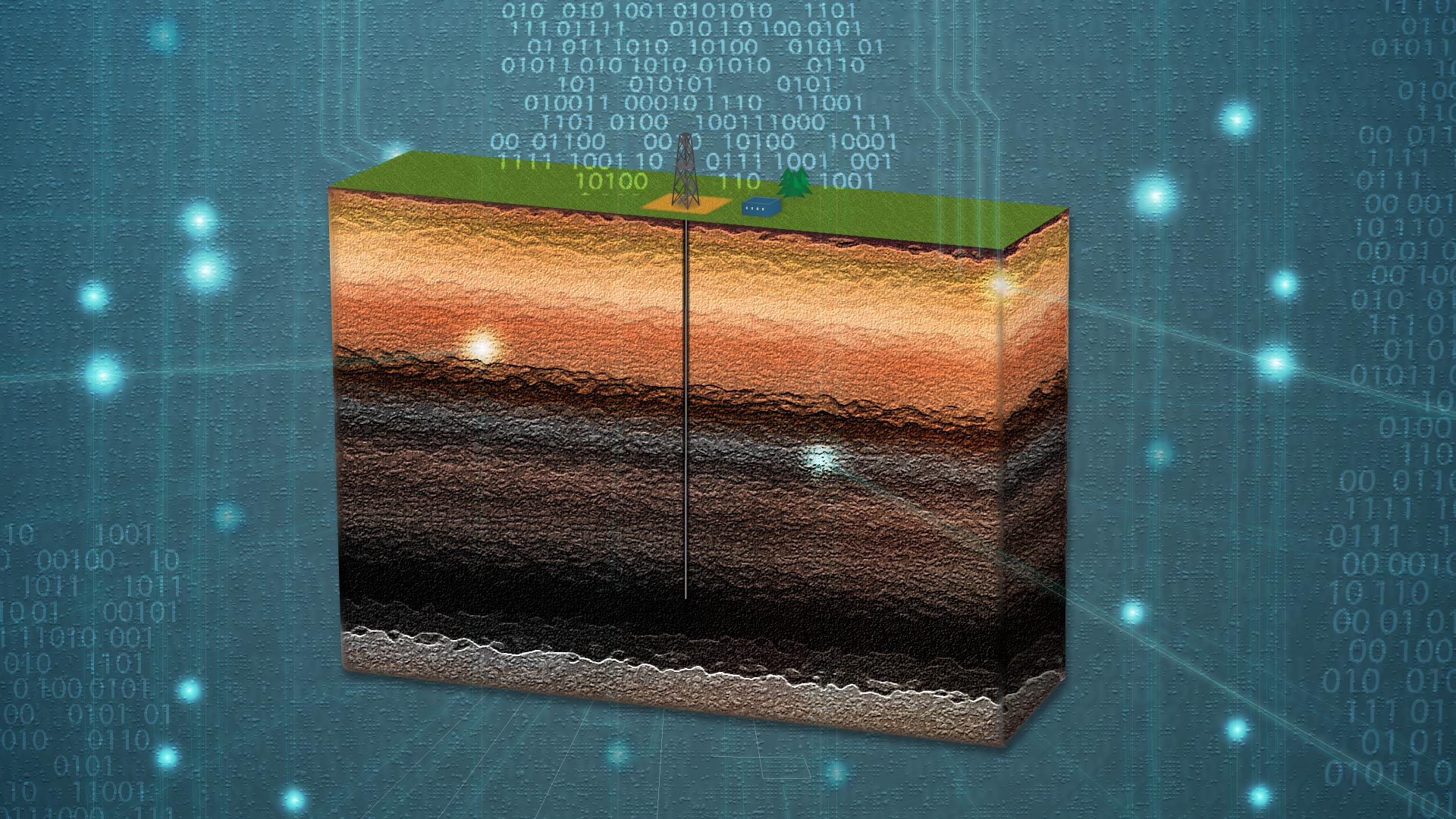
Skoltech scientists and their industry colleagues have found a way to use machine learning to accurately predict rock thermal conductivity, a crucial parameter for enhanced oil recovery. The research, supported by Lukoil-Engineering LLC, was published in the Geophysical Journal International.
Rock thermal conductivity, or its ability to conduct heat, is key to both modeling a petroleum basin and designing enhanced oil recovery (EOR) methods, the so-called tertiary recovery that allows an oil field operator to extract significantly more crude oil than using basic methods. A common EOR method is thermal injection, where oil in the formation is heated by various means such as steam, and this method requires extensive knowledge of heat transfer processes within a reservoir.
For this, one would need to measure rock thermal conductivity directly in situ, but this has turned out to be a daunting task that has not yet produced satisfactory results usable in practice. So scientists and practitioners turned to indirect methods, which infer rock thermal conductivity from well-logging data that provides a high-resolution picture of vertical variations in rock physical properties.
“Today, three core problems rule out any chance of measuring thermal conductivity directly within non-coring intervals. It is, firstly, the time required for measurements: petroleum engineers cannot let you put the well on hold for a long time, as it is economically unreasonable. Secondly, induced convection of drilling fluid drastically affects the results of measurements. And finally, there is the unstable shape of boreholes, which has to do with some technical aspects of measurements,” Skoltech Ph.D. student and the paper’s first author Yury Meshalkin says.
Known well-log based methods can use regression equations or theoretical modeling, and both have their drawbacks having to do with data availability and nonlinearity in rock properties. Meshalkin and his colleagues pitted seven machine learning algorithms against each other in the race to reconstruct thermal conductivity from well-logging data as accurately as possible. They also chose a Lichtenecker-Asaad’s theoretical model as a benchmark for this comparison.
Using real well-log data from a heavy oil field located in the Timan-Pechora Basin in northern Russia, researchers found that, among the seven machine-learning algorithms and basic multiple linear regression, Random Forest provided the most accurate well-log based predictions of rock thermal conductivity, even beating the theoretical model.
“If we look at today’s practical needs and existing solutions, I would say that our best machine learning-based result is very accurate. It is difficult to give some qualitative assessment as the situation can vary and is constrained to certain oil fields. But I believe that oil producers can use such indirect predictions of rock thermal conductivity in their EOR design,” Meshalkin notes.
Scientists believe that machine-learning algorithms are a promising framework for fast and effective predictions of rock thermal conductivity. These methods are more straightforward and robust and require no extra parameters outside common well-log data. Thus, they can “radically enhance the results of geothermal investigations, basin and petroleum system modelling and optimization of thermal EOR methods,” the paper concludes.
Reference: ” Robust well-log based determination of rock thermal conductivity through machine learning” by Yury Meshalkin, Anuar Shakirov, Evgeniy Popov, Dmitry Koroteev and Irina Gurbatova, 5 May 2020, Geophysical Journal International.
DOI: 10.1093/gji/ggaa209
Never miss a breakthrough: Join the SciTechDaily newsletter.
Follow us on Google and Google News.
2 Comments
cameras systems from space and on the ground now can see this and in theory also predict future earthquakes too like with sea level temps and rising of such issues beyond the human factor of global warming as it can isolate where the problems are to fix in cleaning up and terraforming earth before going to the moon and mars are foreigners from earth to colonize and terraform by 2050.
Thermal conductivity (often expressed as k, λ, or κ) refers to the intrinsic ability of a material to transfer or conduct heat. It is one of the three methods of heat transfer, the other two being: convection and radiation. Heat transfer processes can be quantified in terms of the corresponding rate equations. The speed equation in this mode of heat transfer is based on Fourier’s law of heat conduction.
https://thermtest.se/