
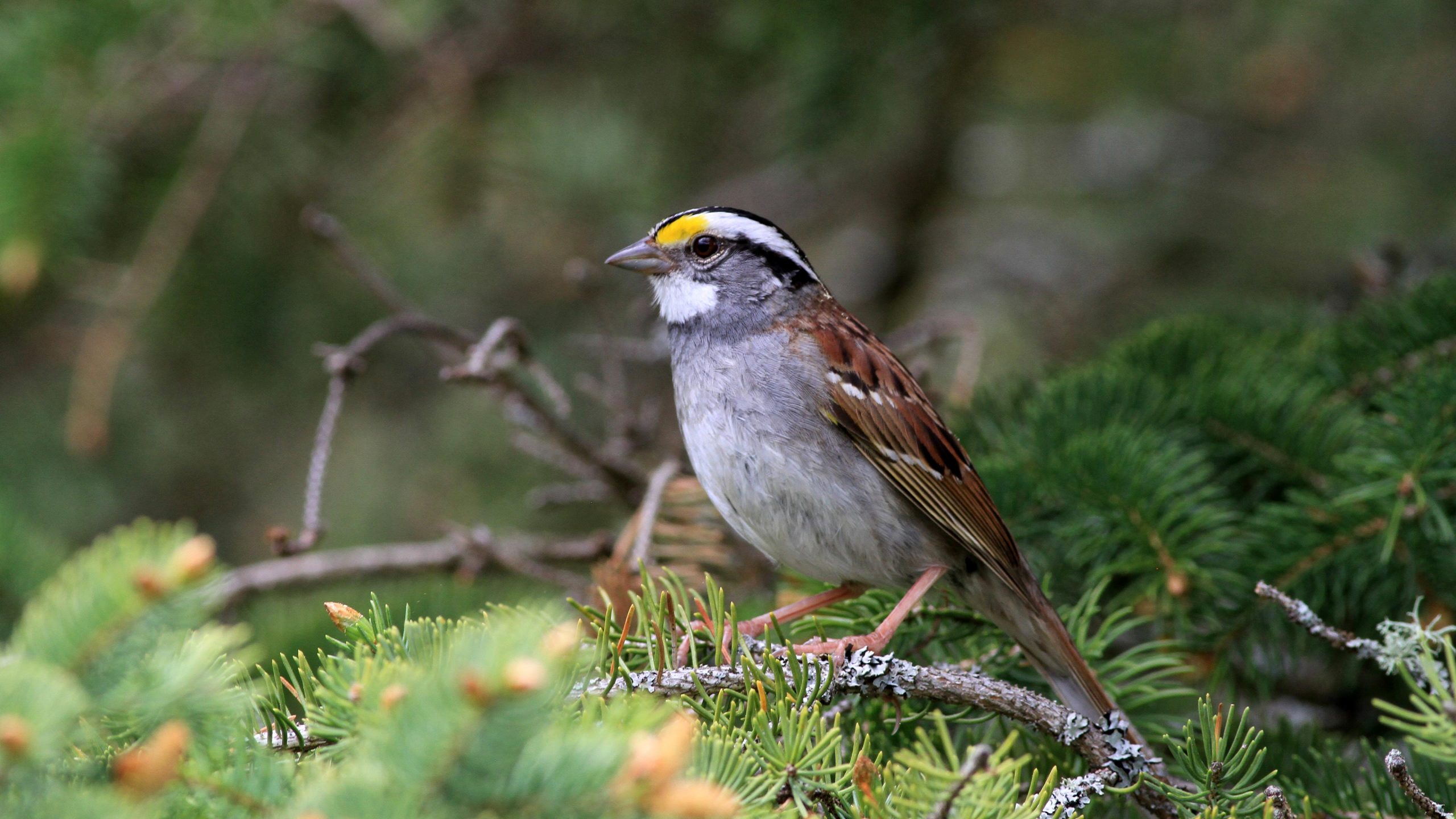
Most bird species are slow to change their tune, preferring to stick with tried-and-true songs to defend territories and attract females. Now, with the help of citizen scientists, researchers have tracked how one rare sparrow song went “viral” across Canada, traveling over 3,000 kilometers (~ 1864 miles) between 2000 and 2019 and wiping out a historic song ending in the process. The study, publishing July 2 in the journal Current Biology, reports that white-throated sparrows from British Columbia to central Ontario have ditched their traditional three-note-ending song in favor of a unique two-note-ending variant–although researchers still don’t know what made the new song so compelling.
“As far as we know, it’s unprecedented,” says senior author Ken Otter, a biology professor at the University of Northern British Columbia. “We don’t know of any other study that has ever seen this sort of spread through cultural evolution of a song type.” Although it’s well known that some bird species change their songs over time, these cultural evolutions tend to stay in local populations, becoming regional dialects rather than the norm for the species. This is how the two-note ending got its start.
In the 1960s, white-throated sparrows across the country whistled a song that ended in a repeated three-note triplet, but by the time Otter moved to western Canada in the late 1990s and began listening to the local bird songs, the new two-note ending had already invaded local sparrow populations. “When I first moved to Prince George in British Columbia, they were singing something atypical from what was the classic white-throated sparrow song across all of eastern Canada,” he says. Over the course of 40 years, songs ending in two notes, or doublet-ending songs, had become universal west of the Rocky Mountains.
Otter and his team used the large network of citizen scientist birders across North America who had uploaded recordings of white-throated sparrow songs to online databases to track the new doublet-ending song. They found that the song was not only more popular west of the Rocky Mountains, but was also spreading rapidly across Canada beyond these western populations. “Originally, we measured the dialect boundaries in 2004 and it stopped about halfway through Alberta,” he says. “By 2014, every bird we recorded in Alberta was singing this western dialect, and we started to see it appearing in populations as far away as Ontario, which is 3,000 kilometers from us.”
The scientists predicted that the sparrows’ overwintering grounds were playing a role in the rapid spread of the two-note ending. “We know that birds sing on the wintering grounds, so juvenile males may be able to pick up new song types if they overwinter with birds from other dialect areas. This would allow males to learn new song types in the winter and take them to new locations when they return to breeding grounds, helping explain how the song type could spread,” Otter says.
So the researchers harnessed sparrows with geolocators–what Otter calls “tiny backpacks”–to see if western sparrows who knew the new song might share overwintering grounds with eastern populations that would later adopt it. They found that they did. And not only did it appear that this rare song was spreading across the continent from these overwintering grounds, but it was also completely replacing the historic triple-note ending that had persisted for so many decades–something almost unheard of in male songbirds.
Otter and his team found that the new song didn’t give male birds a territorial advantage over male counterparts, but still want to study whether female birds have a preference between the two songs. “In many previous studies, the females tend to prefer whatever the local song type is,” says Otter. “But in white-throated sparrows, we might find a situation in which the females actually like songs that aren’t typical in their environment. If that’s the case, there’s a big advantage to any male who can sing a new song type.”
Now, another new song has appeared in a western sparrow population whose early spread may mirror that of the doublet-note ending. Otter and his team are excited to continue their work and see how this song shifts in real time with more help from citizen scientists. “By having all these people contribute their private recordings that they just make when they go bird watching, it’s giving us a much more complete picture of what’s going on throughout the continent,” he says. “It’s allowing us to do research that was never possible before.”
Reference: “Continent-wide Shifts in Song Dialects of White-Throated Sparrows” by Ken A. Otter, Alexandra Mckenna, Stefanie E. LaZerte and Scott M. Ramsay, 2 July 2020, Current Biology.
DOI: 10.1016/j.cub.2020.05.084
This work was supported by the Natural Sciences and Engineering Research Council of Canada, the University of Northern British Columbia, and Wilfrid Laurier University.
Never miss a breakthrough: Join the SciTechDaily newsletter.
Follow us on Google and Google News.
1 Comment
Can l once again hear the original white throated sparrow’s beautiful song from the 50’s and 60’s. I miss it.