
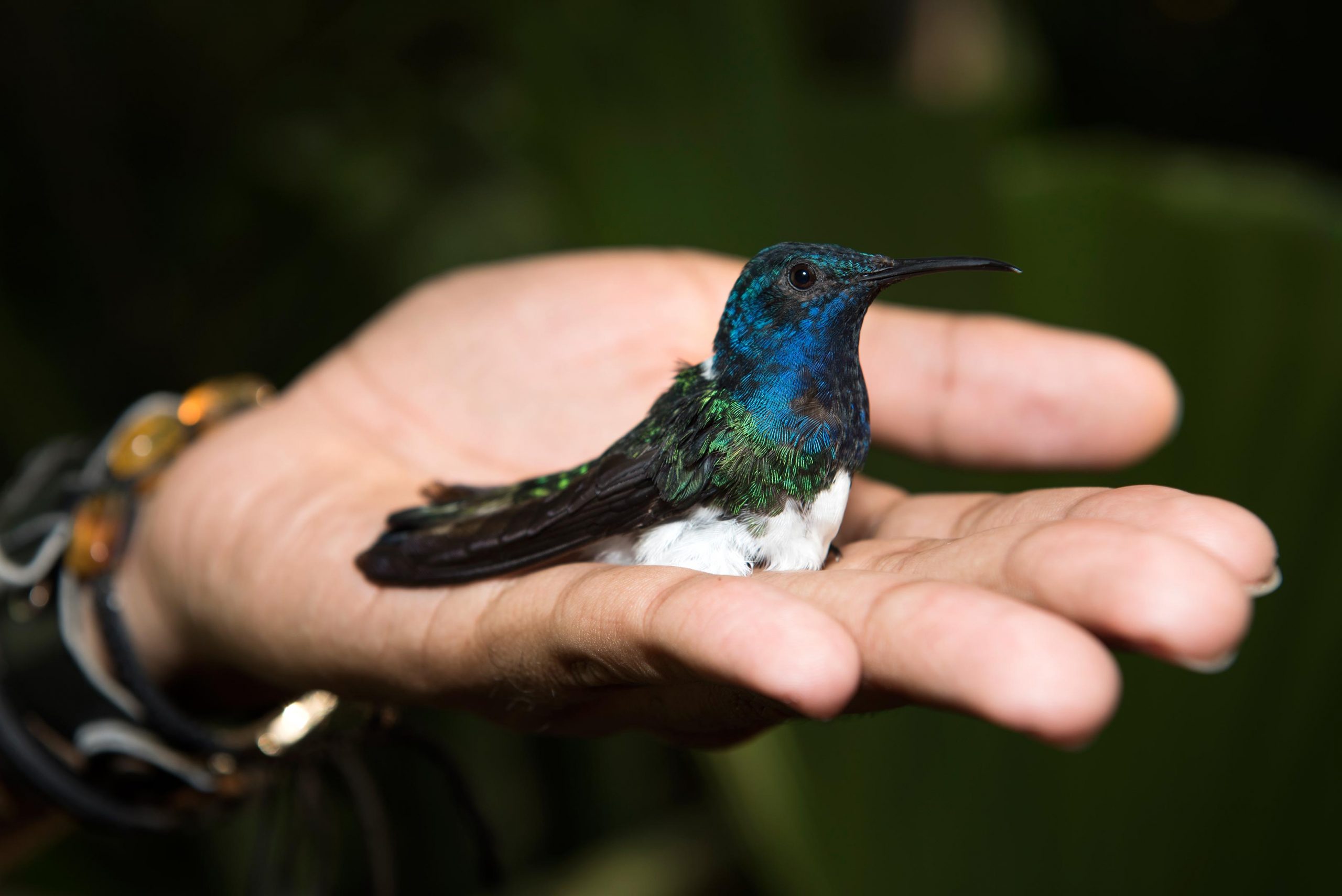
Some female Jacobin hummingbirds keep their flashy juvenile colors to evade male aggression, a rare example of social selection shaping bird plumage.
Much like in human society, female hummingbirds have taken it into their own hands to avoid harassment. By watching white-necked Jacobin hummingbirds in Panama, researchers discovered that over a quarter of females have the same brightly colored ornamentation as males, which helps them avoid aggressive male behaviors during feeding, such as pecking and body slamming. This paper was published in the journal Current Biology on August 26, 2021.
“One of the ‘aha moments’ of this study was when I realized that all of the juvenile females had showy colors,” says first author Jay Falk, who is now a postdoc at the University of Washington but led the research as a part of the Cornell Lab of Ornithology and Smithsonian Tropical Research Institute. “For birds that’s really unusual because you usually find that when the males and females are different the juveniles usually look like the adult females, not the adult males, and that’s true almost across the board for birds. It was unusual to find one where the juveniles looked like the males. So it was clear something was at play.”
This video shows a white-necked Jacobin of an unknown gender visits a data-logging feeder in Gamboa, Panama installed by the researchers. Credit: Jay Falk
Male white-necked Jacobin hummingbirds are known to have bright and flashy colors, with iridescent blue heads, bright white tails, and white bellies. Female Jacobins, on the other hand, tend to be drabber in comparison, with a muted green, gray, or black colors that allow them to blend into their environment. Falk and his team, however, found that around 20% of adult females have showy colors like males.
As juveniles, all females have the showy colors, but this 20% of females doesn’t change to the muted color as they age. It is not clear whether this phenomenon is genetic, by the choice of the hummingbird, or due to environmental factors. However, the researchers found that it is probably the result of the female hummingbirds trying to evade harassment, including detrimental aggression during mating or feeding.
“Hummingbirds are such beloved animals by many people, but there are still mysteries that we haven’t noticed or studied,” says Falk. “It’s cool that you don’t have to go to an obscure unknown bird to find interesting and revealing results. You can just look at a bird that everyone loves to watch in the first place.”
Social Selection, Not Sex Appeal
To learn why some female hummingbirds kept their showy colors, the researchers set up a scenario with stuffed hummingbirds on feeders and watched as real hummingbirds interacted with them. They found that hummingbirds harassed mainly the muted colored female hummingbirds, which is in favor of the hypothesis that the showy colors are caused by social selection. Furthermore, most females had showy colors during their juvenile period and not during their reproductive period. This means that the only time they had showy colors is precisely during the period when they’re not looking for mates. In combination with other results from the study, this indicates that it is not sexual selection causing the phenomenon.
In the future studies, Falk and his team hope to use the results of the variation between female white-necked Jacobins to understand how the variation between males and females in other species may evolve.
For more on this research, see Female Hummingbirds Disguise Themselves As Males To Evade Harassment.
Reference: “Male-like ornamentation in female hummingbirds results from social harassment rather than sexual selection” by Jay J. Falk, Michael S. Webster and Dustin R. Rubenstein, 26 August 2021, Current Biology.
DOI: 10.1016/j.cub.2021.07.043
The authors received financial support from the Smithsonian Tropical Research Institute, the National Science Foundation, the Cornell Lab of Ornithology, the Cornell Department of Neurobiology and Behavior, the Society for the Study of Evolution, the American Society of Naturalists, and the Sigma Xi Society
Never miss a breakthrough: Join the SciTechDaily newsletter.
Follow us on Google and Google News.
1 Comment
“Much like in human society, female hummingbirds have taken it into their own hands to avoid harassment.”
This conclusion has assumed that the individual birds have consciously decided to solve what they perceive to be a problem. This is an example of anthropomorphism! In all likelihood, what is being observed is arrested development of a small fraction of the female population. There is no survival value in the behavior. Were all females to do likewise, the species would soon become extinct!
Researchers are supposed to be unbiased observers, or what was formerly called disinterested observers. Instead, we have researchers that appear to be projecting their personal world view onto the behavior of a species much less complex than humans. I think that it is more likely that these particular females are simply not ready to reproduce yet, and are signaling that by retaining their juvenile plumage.
This is an example of technicians going into the field and interpreting animal behavior as though they were talking Disney characters. This is not how scientists are expected to work!