
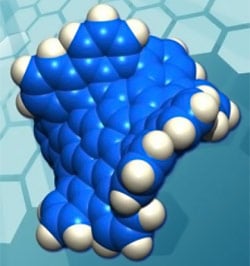
A team of researchers has identified a new form of carbon, a “grossly warped nanographene.”
Chestnut Hill, Massachusetts – Chemists at Boston College and Nagoya University in Japan have synthesized the first example of a new form of carbon, the team reports in the most recent online edition of the journal Nature Chemistry.
The new material consists of multiple identical pieces of grossly warped graphene, each containing exactly 80 carbon atoms joined together in a network of 26 rings, with 30 hydrogen atoms decorating the rim. Because they measure slightly more than a nanometer across, these individual molecules are referred to generically as “nanocarbons,” or more specifically in this case as “grossly warped nanographenes.”
Until recently, scientists had identified only two forms of pure carbon: diamond and graphite. Then in 1985, chemists were stunned by the discovery that carbon atoms could also join together to form hollow balls, known as fullerenes. Since then, scientists have also learned how to make long, ultra-thin, hollow tubes of carbon atoms, known as carbon nanotubes, and large flat single sheets of carbon atoms, known as graphene. The discovery of fullerenes was awarded the Nobel Prize in Chemistry in 1996, and the preparation of graphene was awarded the Nobel Prize in Physics in 2010.
Graphene sheets prefer planar, 2-dimensional geometries as a consequence of the hexagonal, chicken wire-like, arrangements of trigonal carbon atoms comprising their two-dimensional networks. The new form of carbon just reported in Nature Chemistry, however, is wildly distorted from planarity as a consequence of the presence of five 7-membered rings and one 5-membered ring embedded in the hexagonal lattice of carbon atoms.
Odd-membered-ring defects such as these not only distort the sheets of atoms away from planarity, they also alter the physical, optical, and electronic properties of the material, according to one of the principle authors, Lawrence T. Scott, the Jim and Louise Vanderslice and Family Professor of Chemistry at Boston College.
“Our new grossly warped nanographene is dramatically more soluble than a planar nanographene of comparable size,” said Scott, “and the two differ significantly in color, as well. Electrochemical measurements revealed that the planar and the warped nanographenes are equally easily oxidized, but the warped nanographene is more difficult to reduce.”
Graphene has been highly touted as a revolutionary material for nanoscale electronics. By introducing multiple odd-membered ring defects into the graphene lattice, Scott and his collaborators have experimentally demonstrated that the electronic properties of graphene can be modified in a predictable manner through precisely controlled chemical synthesis.
The leader of the team in Japan, Professor Kenichiro Itami, is the Director of the Institute of Transformative Bio-Molecules at the University of Nagoya. The other authors of this paper include Dr. Yasutomo Segawa, an assistant professor at the University of Nagoya, Dr. Qianyan Zhang, a post-doctoral researcher at Boston College, and Katsuaki Kawasumi, a Ph.D. student from Nagoya who worked for three months during the course of this project as a visiting student at Boston College with a fellowship from the Japan Society for the Promotion of Science.
Reference: “A grossly warped nanographene and the consequences of multiple odd-membered-ring defects” by Katsuaki Kawasumi, Qianyan Zhang, Yasutomo Segawa, Lawrence T. Scott and Kenichiro Itami, 14 July 2013, Nature Chemistry.
DOI: 10.1038/nchem.1704
Never miss a breakthrough: Join the SciTechDaily newsletter.
Follow us on Google and Google News.
2 Comments
Carbon is supposed to be the miracle element after Hydrogen which is responsible for life systems anywhere in the universe, Moreover it is the first element in the periodic table to show allotropy like graphite and diamond. Strange crystalline lattice formation makes it to form even wonderful forms like graphene and now nanographene. Carbon chemistry which is nothing but organic chemistry and the basis of all the DNA of living beings is a very exhaustive branch. Carbon proves that it is capable of forming strange combinations once the primordial hydrogen made the nucleo-syntheis to form Heliumm lithium, beryllium, Boron and then of course the miracle called carbon. Of course Lithium, Beryllium, and Boron should be discarded on account of their low valency and fragile structure in first nucleo-synthesis of elements. Thank You.
Just because life has not been found on earth other than carbon based life forms, it should not be assumed that all life in the entire universe is carbon based. That may or may not be true. An environment with a lot more silicon than carbon and completely different chemistry in other ways could be able to produce a completely different form of life. There are life forms on earth that barely fit the usual carbon based mold.