
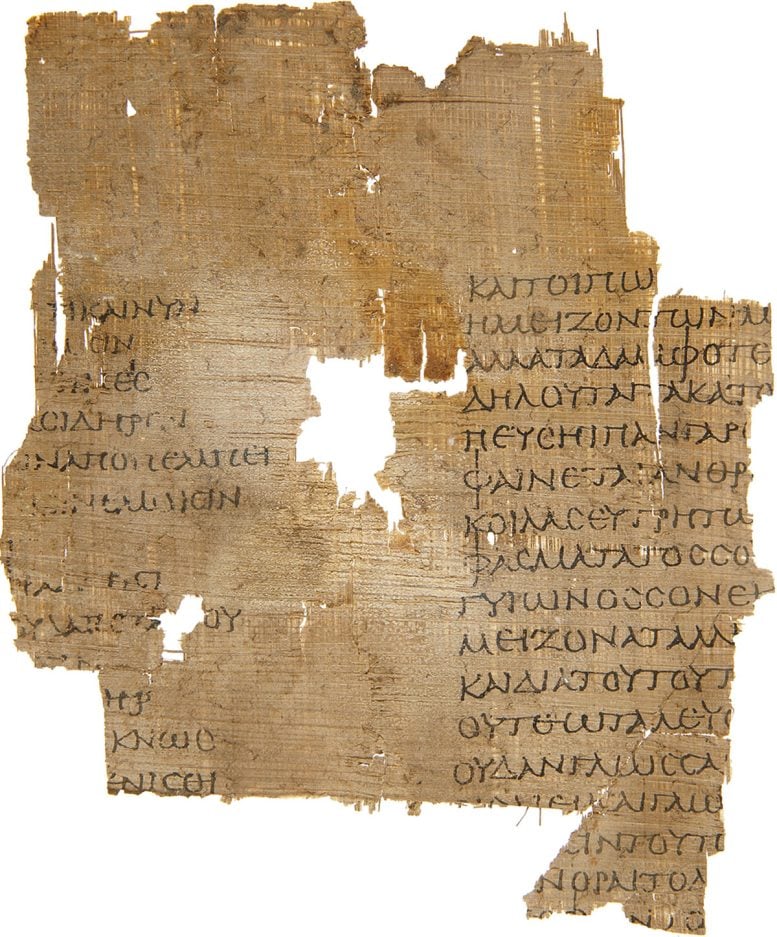
Newly discovered verses of Empedocles provide original insight into his philosophy and influence on later thinkers, reshaping understanding of early Greek thought.
A two-thousand-year-old papyrus fragment uncovered in the archives of the French Institute of Oriental Archaeology in Cairo contains thirty previously unknown verses by Empedocles, a pre-Socratic philosopher from the 5th century BCE.
Empedocles, a pre-Socratic philosopher from 5th century BCE Sicily, was one of the most influential thinkers of early Greek philosophy. Known for his theory of the four root elements, earth, air, fire, and water, and the cosmic forces of Love and Strife that govern their interaction, he sought to explain both the physical world and human perception through a unified natural philosophy.
His ideas helped shape later thinkers from Plato and Aristotle to Roman authors like Lucretius.
For the first time, scholars can examine his ideas directly rather than relying only on later quotations. The first edition, translation, and analysis of these verses appear in the book L’Empédocle du Caire, edited by Nathan Carlig, Alain Martin, and Olivier Primavesi.
Nathan Carlig, a papyrologist at the University of Liège, identified papyrus P.Fouad inv. 218 at the French Institute of Oriental Archaeology in Cairo (IFAO) as a previously unrecognized fragment of Physica, Empedocles’ major poetic work.
Direct Access to Empedocles’ Original Texts
“Until now, our knowledge of Empedocles’ work relied exclusively on indirect sources such as fragmentary quotations, summaries, or allusions scattered throughout the works of authors such as Plato, Aristotle, or Plutarch. Papyrus P.Fouad inv. 218 allows us to read the philosopher in his original text, without the intermediary of often partial or biased sources. It is also the only known copy of the Physica, fragments of other parts of which from the same scroll are preserved in Strasbourg.”
The newly revealed text focuses on theories of particle emissions and sensory perception, especially vision. Researchers have identified surprising links within the material, including what appears to be a direct source for a passage by Plutarch (2nd century CE), as well as connections to a dialogue by Plato and a work by Theophrastus, a student of Aristotle, both from the 4th century BCE.
Additional traces of Empedocles’ ideas appear in the writings of the comic playwright Aristophanes and the Roman philosopher Lucretius. The findings also suggest that Empedocles may have anticipated atomist thinkers, particularly Democritus of Abdera.
Philosophical Connections and Influence Across Antiquity
To illustrate the importance of this discovery, the researchers offer a comparison. Imagine that centuries from now, Victor Hugo survives only through brief excerpts of Les Misérables in schoolbooks, a stage adaptation of Notre-Dame de Paris, and a theater program for Hernani.
If the original pages of Hugo’s work were suddenly found, it would be a major literary event. That is the situation scholars of Empedocles now face. Since the late 19th century, papyrologists have searched ancient papyrus texts in much the same way Renaissance scholars once combed libraries for lost manuscripts.
“It is, in a way, to borrow Peter Parsons’ words, a ‘second Renaissance’ of ancient literature,” says Nathan Carlig. The publication of this research opens up new perspectives on understanding Empedocles’ doctrine and, more broadly, his work, in order to better situate the philosopher within the history of Greek philosophy and to better define his relationship with his predecessors and successors.”
Never miss a breakthrough: Join the SciTechDaily newsletter.
Follow us on Google and Google News.
2 Comments
thanks
At the 1982 Los Angeles Summer Olympics, the most dramatic moment was the quenching of the Olympic Torch.
Actor Richard Basehart recited Pindar’s “Ode to Fire.”
American t.v. coverage was anchored by Peter Jennings.
Jennings was on a caffeine binge; his continual prattling-on totally obscured Basehart’s recitation.
The Los Angeles Olympic Committee has no video or audio record of the event.