
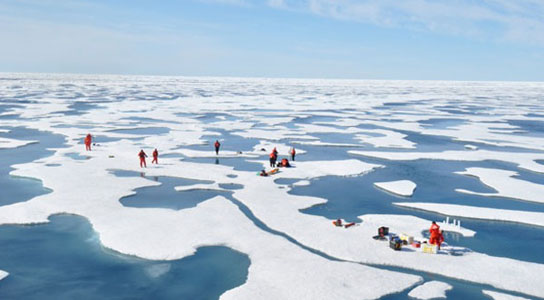
During a NASA-sponsored ICESCAPE expedition, scientists found a massive algal bloom under the Arctic sea ice. Once thought impossible, this marks the first direct observation of an under-ice bloom. Scientists also noted that the Algal cells were doubling more than once a day and that the appearance of under-ice blooms may signal shifts in the ecosystem of the Arctic.
A massive phytoplankton bloom has been found underneath the Arctic pack ice in the Chukchi Sea. The under-ice bloom, previously thought impossible, will require a complete rethinking of Arctic ecosystems – and is a potent indicator of global warming’s effects on the far north.
The 2011 NASA-sponsored ICESCAPE expedition that discovered the bloom was led by Stanford environmental Earth system science Professor Kevin Arrigo. The paper announcing the find appeared today in Science.
Under-ice discovery
Unlike most Arctic research teams, ICESCAPE headed deep into the Chukchi Sea ice pack, north of the Bering Strait. The research cruise, consisting of prominent scientists in the fields of oceanography, biology, chemistry and optics, was intended to improve NASA’s remote monitoring of the Arctic’s changing conditions.
“Suddenly, the fluorometer” – the fluorescence-measuring device used to estimate the algal content of water – “went nuts,” Arrigo said. “We thought there was something wrong with the instrument.”
Most models of biological production in the Arctic Ocean assume a value of zero below pack ice. Sea ice and snow cover have historically reflected incoming solar radiation, leaving no sunlight for plankton in the water below.
“Not only was the value not zero,” said Arrigo, “production was higher there than it was in open water.”
Based on samples from surrounding water and on the species of algae in the bloom, the scientists confirmed that the phytoplankton had not drifted under the ice from elsewhere.
Instead, changing ice conditions now allow light to penetrate large swaths of Arctic sea ice. Thick “multi-year” ice, which requires several seasons to accumulate, is on the decline, while warming temperatures favor thinner “first-year ice.” Additionally, the melt pools that now commonly form on top of Arctic sea ice decrease the ice pack’s ability to reflect light.
The resulting under-ice environment is ideal for Arctic phytoplankton. The thin ice lets in light while protecting the algae from ultraviolet radiation.
“Grow rates under the ice are higher than I thought was possible for Arctic phytoplankton,” Arrigo said. Algal cells that would normally take three days to divide were doubling more than once a day.
A shifting Arctic
While the discovery marks the first direct observation of an under-ice bloom, the conditions that allow for it in the Chukchi Sea exist over a large area of the Arctic.
“We suspect that this is a lot more widespread than we realize,” said Arrigo.
The appearance of under-ice blooms may presage wholesale shifts in the ecosystem of the Arctic. Colder-water phytoplankton production, as with under-ice algae, may cause organic matter to drop to the ocean floor sooner. The effect would benefit bottom-feeding species, to the detriment of species that feed in the water column.
And, as algal blooms are able to occur earlier in the year, animals that depend on timing their behavior to “pulses” in algal productivity may be left out in the cold.
One piece of seemingly good news is an increase in the Arctic’s ability to sequester carbon. As the Arctic Ocean’s productivity increases, so should its carbon capture rate. But, Arrigo says, the effect is unlikely to make much difference.
“Even if the amount of CO2 going into the Arctic Ocean doubled, it’s a blip on a global scale,” he said.
Reference: “Life Blooms Under Arctic Ice,” 8 June 2012, Science.
DOI: 10.1126/science.336.6086.1218
Never miss a breakthrough: Join the SciTechDaily newsletter.
Follow us on Google and Google News.